Skip the marketing math. Plug in your camping nights and typical campsite rate, and our free calculator does the break-even math for Good Sam, Passport America, Thousand Trails, and KOA Rewards.
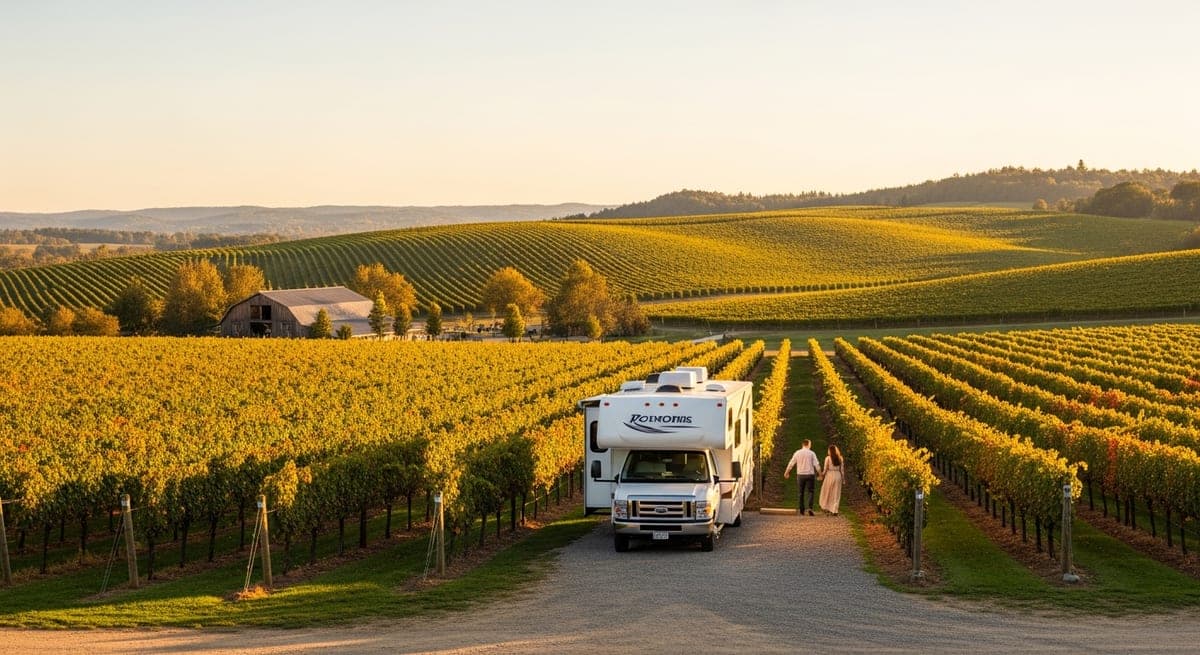
In a single October sweep through Oregon's Willamette Valley, I camped at three different wineries in four nights — paid nothing in site fees, drank very well, and didn't sleep in a spot that looked like a campground once. That's Harvest Hosts at its best, and it has almost nothing to do with saving money.
Harvest Hosts is a paid membership that connects self-contained RVs with host venues — businesses that allow member rigs to overnight park on their property in exchange for your patronage. The network spans wineries, working farms, craft breweries, distilleries, golf courses, museums, and genuinely unusual attractions across North America. As of early 2026, the directory lists more than 5,000 locations, though individual availability varies by season and host — verify the current count and terms at harvesthosts.com before joining.
The appeal isn't the savings. It's the mornings. Waking up in a vineyard, watching sheep get fed through your dinette window, having a brewer hand you a fresh pour from the tap twenty feet from where you slept — these are the nights that make it into trip stories. This is how you get them consistently.
What You're Actually Paying For — and What You're Not
Harvest Hosts is not free camping in the boondocking sense. You're a guest at a business. The host isn't a campground operator — they're a winemaker, a farmer, a brewer running their own operation who has agreed to let member RVs park overnight. The entire arrangement hinges on one exchange: you support their business, they give you a place to sleep.
Get that wrong and you've missed the whole point. Members who roll in, park overnight, and leave without buying anything are the reason hosts quietly stop accepting requests. Members who show up for the tasting, buy a bottle they'll open on the road, and leave the spot cleaner than they found it — those are the ones who get warm confirmations, and occasionally get word of spots that aren't even listed in the app.
What's included: Overnight parking. That's the baseline. No hookups (self-contained is required), no bathrooms beyond your own, no campground amenities. What you get beyond that varies entirely by host — some wineries offer private tastings after hours, some farms let you wander the property freely, some breweries hand you a welcome flight. Ask when you book; the listing won't always tell you.
What self-contained means in practice: Full fresh water tank before you arrive. Working solar, battery, or generator — there is no shore power. A functioning grey and black waste system. Travel trailers without onboard bathrooms typically don't meet the requirement. If you're borderline on tank capacity, top off before you pull in rather than asking the host to solve it.
Membership Tiers (as of Early 2026)
Harvest Hosts currently offers two tiers, priced at approximately $99-119 per year depending on current promotions — confirm pricing at harvesthosts.com before purchasing, as these numbers have shifted with promotional periods:
Standard (around $99/year): Full access to the Harvest Hosts directory. One RV, typically covering two adults and accompanying children — check the current member terms for exact household definitions, as these have been updated in the past. This covers the vast majority of members' needs.
Plus (around $119/year): Standard Harvest Hosts access with the addition of Boondockers Welcome — a separate community where private homeowners allow RVs to park overnight in their driveway or on their property. It's a fundamentally different kind of stay from the commercial hosts: more like a fellow RVer with a long driveway than a business venue. I've found it worth the difference on trips through cities where neither campground membership zones nor host venues are convenient, but confirm this bundling is still current before buying.
Harvest Hosts occasionally runs joint promotions with Good Sam and other programs — worth checking at purchase or renewal time.
How Booking Actually Works
The booking flow is simpler than most campground reservation systems. Log into the Harvest Hosts app or website, filter by host type (winery, farm, brewery, distillery, golf, museum, unique), location, and dates. Send a request with your arrival date, rig dimensions — length, height, slide-outs — party size, and a brief note about your group. The host confirms or declines, typically within 24 hours.
Lead time by location type: Well-reviewed wineries in Virginia's Shenandoah foothills or the Finger Lakes can book 2-4 weeks out during fall harvest season. Smaller farms in rural areas often confirm same-day requests. In shoulder season — mid-April or early November — even popular spots often have availability with less than a week's notice. Match your planning horizon to the destination's draw.
One night per host: The typical policy allows one night per visit at each location, which keeps hosts accessible across the broader membership. Some hosts offer extended stays — ask when you send your request, and don't assume it's available. I've had hosts spontaneously invite us to stay a second night after a good visit, and I've had others who needed the spot cleared by 10am for an early farm delivery. Read the confirmation for checkout expectations.
Rig size matters before you book: Some winery driveways and farm access roads aren't built for 40-foot fifth wheels. The app listing usually notes size limits — pay attention to them. When in doubt, message the host with your exact dimensions before booking rather than discovering the problem on arrival.
The Rules Nobody Publishes
These aren't in the member handbook, but they separate the members who consistently get great confirmations from those who get quietly passed over:
Buy something real. Not a bottle of water and a postcard — at a winery, that means at least a bottle or a case; at a brewery, a tasting flight and a couple crowlers to go; at a farm stand, a meaningful haul of produce. The purchase is the exchange. Members who treat "free camping" as the point are the ones burning it for everyone else.
Arrive when the business is open. The mistake I see most first-timers make is planning to arrive at dusk after the tasting room closed at 5pm. For wineries, I aim for late afternoon so there's still time for a proper tasting before dark. For farm stays, early morning is when things happen — feeding, chores, the smell of a working property waking up. Time your arrival to what you actually want to experience.
Leave it cleaner than you found it. Take your trash. Don't let dogs dig in the garden rows or wander through planted areas. If a farmer asks if you want to see the morning milking, say yes even if it's early — that's why you came.
Don't show up with unannounced guests. If you booked for two and arrive with four extra adults and a second rig, you've misrepresented the visit. Ask ahead. Hosts have a specific expectation when they confirm — honor it.
Leave a review. Three minutes, right after checkout. The review system is what keeps the network honest — it helps good hosts get more bookings and helps members avoid spots that have declined. Do it as a matter of habit.
What Each Host Type Actually Delivers
Wineries deliver the experience that made Harvest Hosts popular. Waking up in the vines at first light — before the tasting room opens, before staff arrives, while mist still sits in the rows — is something no campground can replicate. Virginia's Shenandoah Valley and the Monticello wine region have strong host concentrations, as does the Willamette Valley in Oregon, which runs from Portland south through McMinnville and into the Coast Range foothills. New York's Finger Lakes — Seneca and Keuka in particular — and Texas Hill Country around Fredericksburg round out the densest areas in the network.
Arrive before the tasting room closes. The experience is in the interaction with the people who made what's in the glass — a parking spot at an empty vineyard after closing is a much thinner version of the stay.
Working farms are often the most memorable nights in the whole network. A sheep operation in Vermont's Northeast Kingdom, berry farms along the Maine coast in July, lavender farms in Washington's Sequim Valley that smell like a different country — these stays work best when something is actively happening at the property: lambing season, harvest, a picking window. Check what's seasonal at the farm before you book.
I've had a host at a Vermont goat farm walk us through the whole morning routine and send us off with a wheel of fresh chèvre. Kids who have grown up entirely in cities find these stays genuinely disorienting in the best way — a morning watching a working greenhouse or a dawn feeding is the kind of thing that stays with them. That doesn't happen at a campground.
Craft breweries are the fastest-growing segment of the network. The typical stay offers taproom access and a tasting flight — some hosts run evening sessions specifically for overnight members. Many brewery hosts are in unexpected places: a rural county seat in West Virginia, a small Montana town, an industrial neighborhood of a mid-sized city you'd otherwise pass through without slowing down. The overnight stop turns a place you'd never have chosen into a destination.
Golf courses are utilitarian rather than scenic for most members, but reliably practical near urban areas. If you need a night within driving distance of a major city and don't want resort campground rates, a golf course host often has a clean, level lot with access to a restaurant or pro shop. Think of them as the business-trip option of the Harvest Hosts world — not the experience you came for, but exactly right when that's what you need.
Unique venues and museums are worth browsing just for the strangeness — vintage slot car racing tracks, military vehicle museums, dinosaur parks, working glassblowing studios. Harvest Hosts actively recruits venues that don't fit the standard categories, and this is where the most unexpected nights come from. I once stayed in the parking area of a working antique carousel museum in upstate New York; the owner came out at 9pm and ran the carousel for twenty minutes just because we were there. No campground reservation has ever started that way.
How It Fits With Your Other Memberships
Harvest Hosts doesn't replace Thousand Trails, Passport America, or full campground memberships — it occupies a different slot in the stack. I use it for two or three nights per week when I want an experience rather than just a site, and campground memberships for nights when hookups matter or I'm basing out of one area for multiple days. The combination keeps costs manageable and prevents the sameness that sets in after two weeks of sites that all look identical.
Plan your driving days around when you'd rather have an experience than a parking spot, and browse and book host stays directly in the Harvest Hosts app — it's the only place with the current, verified host roster and availability.
Quick Reference
Annual cost: Approximately $99 (Standard) / $119 (Plus with Boondockers Welcome) as of early 2026 — verify current pricing at harvesthosts.com. Self-contained required: Yes — full fresh water, battery/solar/generator, working waste system. Standard stay limit: Typically one night per host per visit; extended stays sometimes available on request.
Booking lead time: 1-4 weeks for popular hosts in peak season; same-day requests often work in rural areas off-season. The one non-negotiable: Buy something from every host you stay with. Best membership stack: Harvest Hosts + a Thousand Trails zone membership + Passport America covers most scenarios from experience nights to hookup stays to budget stopovers.
Written by an RVmapper editor who has used Harvest Hosts across more than 40 stays at wineries, farms, and breweries in a dozen states — and still finds the vineyard mornings the hardest spots to leave on time.
Ready to Plan Your Trip?
Put this knowledge to work. Let our AI build a personalized RV itinerary for your next adventure, or browse community trips for inspiration.
Keep Reading
Passport America: Is the 50% Campground Discount Worth It in 2026?
10 min read
Membership MaximizingKOA Campgrounds and KOA Rewards: An Honest Look at the Largest Campground Chain in North America
10 min read
Membership MaximizingEscapees RV Club: The Full-Timer's Guide to Mail, Domicile, and Community
11 min read