
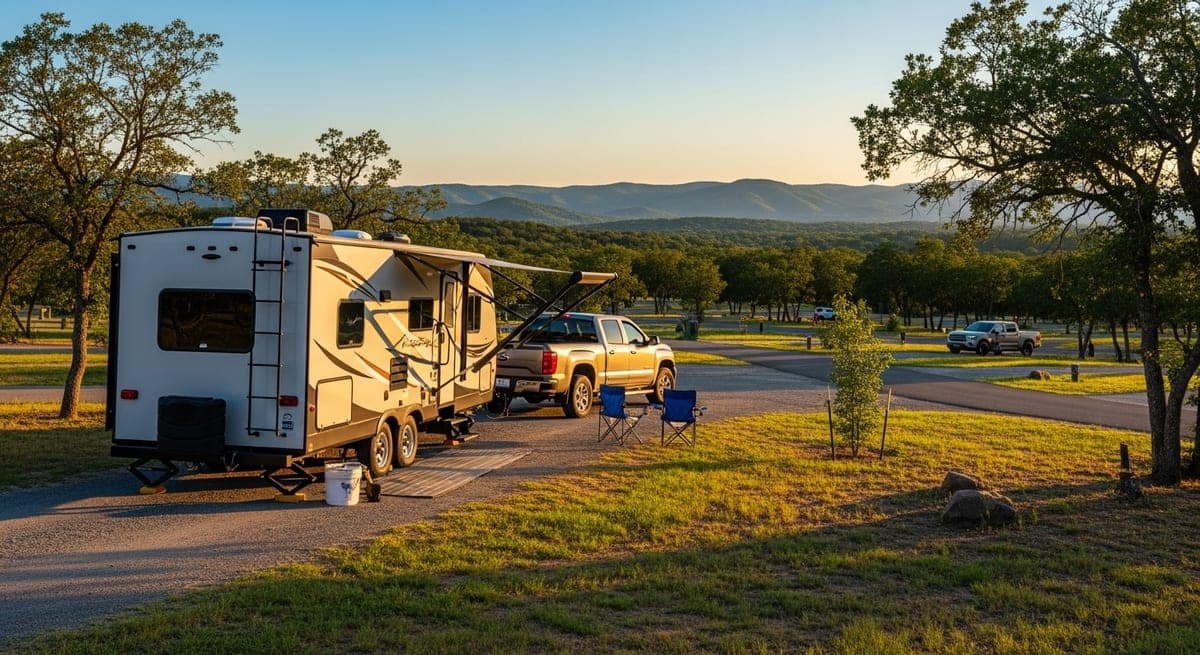
Know Your Numbers Before You Know Your Trailer
At 60 mph, a loaded 26-foot travel trailer adds 80–100 feet to your stopping distance compared to driving solo. That single fact changes everything about following distance, lane selection, and when you commit to a merge — and it's the first thing you need to internalize before you pull out of the driveway.
Four numbers run every towing decision:
GVWR (Gross Vehicle Weight Rating): The maximum your trailer can weigh fully loaded — gear, water, food, all of it. The sticker is inside the trailer door. Load your rig at a certified CAT scale before your first real trip (Love's and Pilot locations have them) to see where you actually land versus where you assumed you'd land.
Tow vehicle capacity: The max trailer weight your vehicle is rated for — but two identical-looking F-150s can have 2,000-lb differences in what they're rated to pull depending on engine, transmission, and axle ratio. Check your specific build in the towing section of your owner's manual, not the marketing sheet.
Tongue weight: The downward force the trailer exerts on the hitch. Too light and the trailer wants to wander; too heavy and it overloads your rear axle. Industry guidance typically puts the sweet spot around 10–15% of loaded trailer weight, though your hitch manufacturer or owner's manual may have a tighter spec for your specific setup — check both before you're confident in that number.
Payload capacity: The total weight your tow vehicle can carry in the cab, bed, and on the hitch combined. Tongue weight counts against your payload, not just your tow rating. Full-size trucks with 14,000-lb tow ratings can have payload ratings under 1,800 lbs — and that ceiling fills up faster than people expect.
The Hitch Setup
The receiver, ball mount, and hitch ball all need to be rated at or above your trailer's GVWR. Using undersized components isn't a judgment call — it's how hitches separate from trailers at highway speed.
Ball size varies by coupler, so check the coupler on your specific trailer tongue rather than assuming. Many travel trailers use either a 2-inch or 2-5/16-inch ball, but the wrong one either won't couple or will couple loose, and neither is acceptable once you're rolling.
Weight distribution hitches (WDH) spread tongue weight forward onto the front axle, improving steering feel and brake balance. Whether you need one depends on your vehicle's rear axle rating and actual tongue weight — not just trailer size. If your rear end is noticeably squatting and your headlights are aimed at the sky, that's your sign. Brands like Andersen and Equal-i-zer both have strong reputations among experienced towers, but the setup process matters as much as the hardware — a poorly calibrated WDH is nearly as bad as none at all.
Pre-Trip Hookup Checklist
Do this before every trip — including the return trip home. Rushing this sequence is how you pull out of a campsite in Moab with the tongue jack still halfway down.
- Hitch ball fully engaged with coupler locked and safety pin secured
- Safety chains crossed and attached — crossed so they cradle the tongue if the hitch separates instead of dragging on the road
- Breakaway cable clipped to the tow vehicle (not to the safety chain)
- Electrical connected — verify turn signals, brake lights, and running lights before you move
- Trailer brake controller active; test it manually before leaving the driveway
- Tongue jack retracted and locked
- Stabilizer jacks retracted
- All compartments, hatches, and exterior doors latched
- Slides fully retracted
- Walk the trailer once before you drive — you'll catch the thing you forgot
The lights check is the one people rush. Plug in, then have someone stand behind the trailer while you cycle through turns and brakes — or back up close to a wall and watch the reflections. A burned-out brake light earns you a ticket and gets the car behind you far more intimate with your rig than anyone wants.
Driving With a Trailer: The Real Adjustment
The first time you merge onto a freeway with 6,000 lbs trailing behind you, everything feels different. That reaction is useful — the goal isn't to stop feeling it, it's to learn to work with it.
Acceleration and braking: Both take significantly longer. Give yourself 5–6 seconds of following distance at highway speed and brake earlier than feels necessary. Hard, late braking on a descent is how sway starts.
Turning: Your trailer's rear wheels track inside your tow vehicle's turning path, so every turn needs to swing wider than your instincts say. Interstate off-ramps are where new towers get their first real education. The trailer doesn't care that the curb exists.
Backing: This is the skill that takes real time to develop, and no amount of reading substitutes for 20 minutes in an empty parking lot on a Tuesday afternoon. Straight first, then gentle curves, then actual parking maneuvers. A spotter who knows the hand signals is worth more than any backup camera. If your passenger is pointing randomly and mouthing directions, stop and get out.
Trailer sway: If the trailer starts oscillating side to side, ease off the accelerator and steer straight. Don't brake hard — it often amplifies the problem. If you have trailer brakes, applying them manually (not your vehicle brakes) helps stabilize. Anti-sway equipment prevents most sway from developing in the first place, and any sway deserves serious attention because it typically escalates faster than it starts.
Highway Driving, Speed, and Fuel
Towing cuts fuel economy — often 25–50% depending on trailer size and conditions. Budget for it, and think in terms of smaller fill-ups at known stations rather than running the tank down.
On I-70 through the Rockies or US-50 across Nevada, sustained grades are a fact of life. Move right early, let the transmission downshift, and don't race it. Overheating transmission fluid on a long grade in July is a trip-ender; a $150–200 transmission cooler installed before you go is cheap insurance if your vehicle isn't factory-equipped with one.
Crosswinds above 20 mph make high-profile trailers work hard. If you've run I-10 through west Texas in spring, you already know what a gust from a passing semi feels like when it rocks your whole rig. Slowing down in wind isn't timid — it's what experienced towers do every time. The instinct to push through it is almost always wrong.
Is that campground membership actually worth it?
Plug in your camping nights and typical nightly rate. Our free calculator does the break-even math for Good Sam, Passport America, Thousand Trails, and KOA Rewards.