
Why Tow Ratings Matter and the Consequences of Exceeding Them
Exceeding your vehicle's tow rating is dangerous for multiple reasons: brakes designed for the vehicle's stopping distance can't safely stop an overloaded trailer combination; the transmission overheats on grades; the frame is stressed beyond its design limits; and sway becomes difficult to control. Insurance may deny claims in accidents involving over-towing, and some states allow law enforcement to cite for overloaded trailer combinations.
This isn't about being conservative — it's about the physics of what a vehicle's drivetrain, brakes, and frame were designed to do.
Key Tow Rating Numbers to Understand
Maximum Tow Rating: The manufacturer-specified maximum weight your vehicle can pull. This is the number most people check, but it's not the only one that matters. Tow ratings often assume a specific axle ratio, engine option, and tow package that your specific vehicle may or may not have. Always check the sticker in your driver's door jamb or your owner's manual for the actual rating for your specific configuration.
GVWR (Gross Vehicle Weight Rating): The maximum loaded weight of the trailer alone — not the amount your vehicle can pull. A trailer's GVWR is relevant for selecting the appropriate tow vehicle and understanding the trailer's total weight capacity.
Tongue Weight: The downward force the trailer tongue (hitch ball connection point) exerts on the hitch. Tongue weight should be 10–15% of the trailer's total loaded weight. Too little tongue weight causes trailer sway; too much overloads the rear axle of the tow vehicle.
GCWR (Gross Combined Weight Rating): The maximum total weight of the loaded tow vehicle plus the loaded trailer. Often the most restrictive number — a truck rated to tow 10,000 lbs but with a GCWR of 15,000 lbs can only tow 10,000 lbs if the truck itself weighs 5,000 lbs loaded.
Hitch Classes: What They Mean
Hitches are rated by weight class:
Class I (up to 2,000 lbs trailer / 200 lbs tongue weight): Small car hitches for bicycle racks and very light cargo carriers. Not appropriate for trailers.
Class II (up to 3,500 lbs / 350 lbs tongue): Sedans and smaller crossovers. Light utility trailers and small pop-up campers.
Class III (up to 6,000 lbs / 600 lbs tongue): The most common hitch class for mid-size trucks, SUVs, and larger crossovers. Covers most travel trailers under 25 feet.
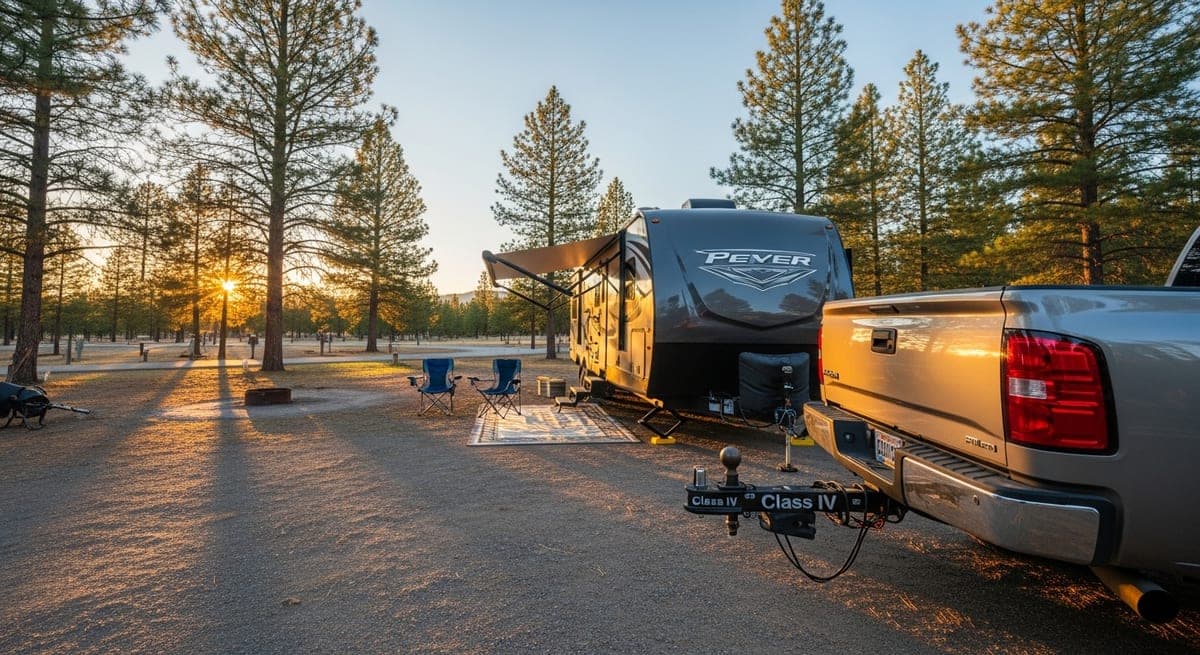
Class IV (up to 10,000 lbs / 1,200 lbs tongue): Full-size trucks and heavy SUVs. Covers most travel trailers and smaller fifth wheels (fifth wheel requires a different coupling in the truck bed).
Class V (up to 20,000 lbs / 2,700 lbs tongue): Heavy-duty trucks. Large travel trailers, fifth wheels, and toy haulers.
The Weight Distribution Hitch Requirement
When tongue weight exceeds approximately 500 lbs, or your vehicle's rear squats noticeably with the trailer attached, a weight distribution hitch is required to redistribute weight forward and restore proper vehicle geometry. Most hitch manufacturers specify the tongue weight threshold at which their hitch requires weight distribution. When buying a trailer that will stress your vehicle's tow rating, factor in the additional cost of a WD hitch ($300–$900).
From the RVmapper team
Fishing along your route?
Hooked Fisherman publishes fishing reports for all 50 states, species guides, and honest gear reviews. Know what's biting before you park the rig.