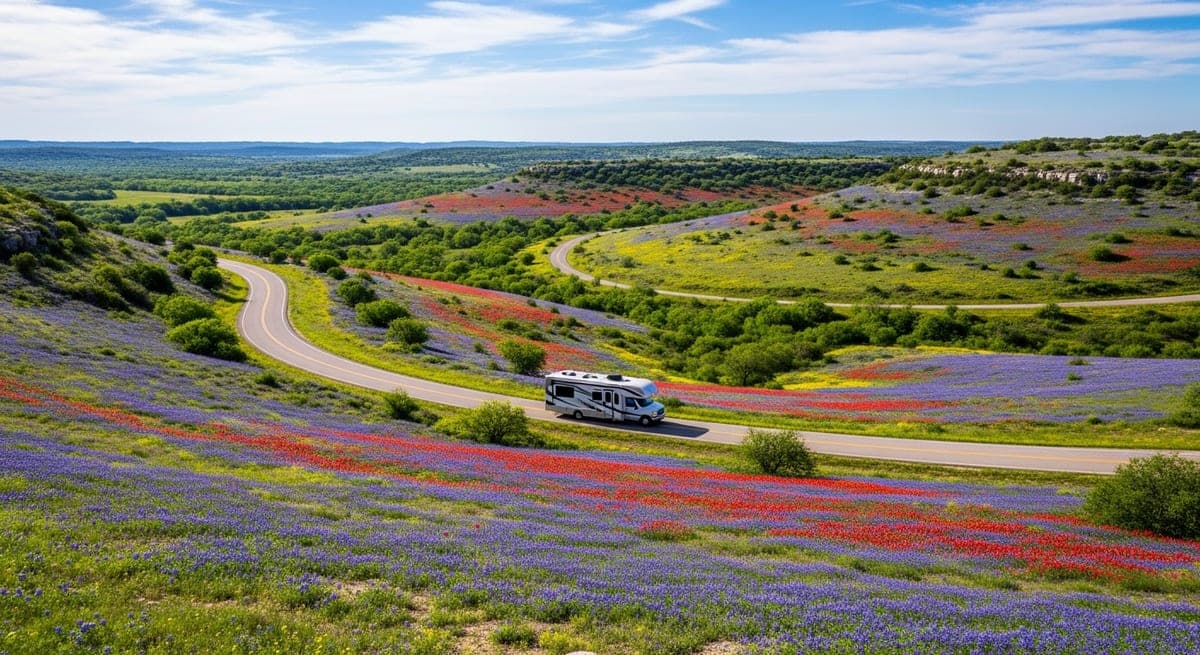
Bluebonnets line Highway 290 between Johnson City and Fredericksburg in densities that returning visitors describe as unlike anything else in the continental United States — but reports from owners who have made this trip across multiple seasons make clear that the wildflower window and the campsite window are two very different things, and conflating them is the most common planning mistake first-timers make. The blooms don't hold for open hookup sites, and the Hill Country's most sought-after RV parks don't hold for the blooms to confirm.
The bloom window: what drives peak timing and how to read it year to year
The Texas Hill Country wildflower season centers on bluebonnets (Lupinus texensis), the state flower, but peak timing is not anchored to a fixed calendar date. Research from Texas A&M AgriLife Extension documents that bloom timing correlates closely with the prior autumn's rainfall totals and winter temperature patterns: wet falls followed by mild winters push peak color toward late March, while dry falls or sustained hard freezes can delay peak bloom into mid-April or compress the entire window to under two weeks.
Data aggregated by the Lady Bird Johnson Wildflower Center — which maintains a crowdsourced bloom tracker updated by statewide observers throughout the season — shows that the Fredericksburg-to-Marble Falls corridor typically reaches maximum density between the last week of March and the second week of April. Returning visitors consistently note that individual years deviate significantly from that average. A late freeze in 2021 pushed bluebonnet peak nearly three weeks behind the historical median; the wet autumn of 2019 produced some of the densest reported blooms that longtime Hill Country visitors describe encountering in recent memory.
What owners who have made this trip multiple times recommend for timing decisions:
- Monitor the Wildflower Center's bloom map at wildflower.org starting in early March — crowdsourced reports update multiple times weekly once the season is underway
- Use I-10 corridor reports as a leading indicator: blooms in the lower-elevation areas near Kerrville and Comfort typically precede the higher-elevation zones around Enchanted Rock by 7-10 days
- Target late March through early April as a flexible arrival window and hold exact dates adjustable until mid-March real-time reports are available
- Budget at least five nights on the ground — owners who commit to four nights or fewer consistently report running out of time before completing the full loop
Indian paintbrush, Texas phlox, and evening primrose extend color through late April, so visitors who miss the bluebonnet peak still encounter meaningful wildflower cover across the corridor. That said, feedback from returning visitors is unambiguous: the bluebonnet window is the draw, and the planning should center on it.
Where to camp: state parks, private options, and the dispersed camping reality
Owners who return to the Hill Country annually during wildflower season are emphatic on one point: the campsite competition starts in January, not March. Texas state parks operate on a rolling 89-day advance booking window, and Enchanted Rock State Natural Area — the most prominent landmark in the wildflower corridor — routinely sells out its sites within hours of the booking window opening for peak weekends.
State park options in the bloom corridor, with rig-length notes drawn from owner reports:
- Enchanted Rock State Natural Area: No RV hookups; primitive backpacking sites only. Owners treat it exclusively as a day-use destination and base camp at nearby Fredericksburg-area parks. The site configuration makes RV overnight camping impractical regardless of rig size.
- Pedernales Falls State Park (near Johnson City): 69 water-only sites plus a small hookup loop. Internal road curves create real challenges for rigs above 30 feet. Strong wildflower density along the river corridor in March and April.
- Blanco State Park: 31 water-and-electric sites along the Blanco River in the town of Blanco. Owners consistently describe it as more accommodating for larger rigs than most Hill Country parks and report finding availability here when Enchanted Rock and Pedernales Falls are fully booked.
- South Llano River State Park (Junction): Further west and stronger for wildlife observation than wildflower density, but full-hookup sites and more generous site dimensions make it a favored western anchor for owners running the full loop.
Private park options near the bloom corridors:
- Fredericksburg-area private parks along Highway 290: Full hookups with pull-through sites accommodating rigs in the 60-65-foot range. Owners describe them as functional and predictable, if less scenic than state parks.
- Wimberley and Dripping Springs area: Multiple private parks along Ranch Road 12 and FM 3237 fill quickly during spring break and the final two weekends of March, per owner feedback.
- Llano and Mason: Smaller towns west of the primary tourist cluster with full-hookup private parks that owners report often hold availability well into February, making them reliable western anchor options when Fredericksburg is already locked out.
No dispersed camping on public land exists within the core Hill Country wildflower corridor. The region is predominantly private ranch land and designated state parks with defined sites. Bureau of Land Management land is effectively absent from this part of Texas. Owners seeking boondocking typically position outside the corridor — further west toward the Llano Uplift — and day-drive into the bloom zones.
The recommended loop route, driving distances, and rig-length realities on FM roads
Returning visitors consistently describe a loop configuration as yielding substantially higher wildflower density per mile than an out-and-back approach from Austin or San Antonio. The most-reported itinerary:
Fredericksburg → Enchanted Rock → Llano → Mason → Wimberley → Fredericksburg
Approximate driving distances:
- Fredericksburg to Enchanted Rock via FM 965: 18 miles, roughly 30 minutes
- Enchanted Rock to Llano via RM 965 north and TX-16: 35 miles, roughly 50 minutes
- Llano to Mason via TX-71 west and US-87: 38 miles, roughly 45 minutes
- Mason to Fredericksburg via US-87 south: 58 miles, roughly 1 hour
- Optional Wimberley spur: adds approximately 90 miles and 2 hours from the Fredericksburg anchor
Total loop excluding the Wimberley spur runs approximately 150-160 miles, typically spread over 2-3 days by owners who stop frequently at roadside pull-offs, trailheads, and accessible wildflower fields.
Each stop carries distinct character beyond wildflower viewing:
- Enchanted Rock: The 425-foot granite dome is a signature day hike; owners report arriving at trailhead parking by 8:00 AM on weekdays to secure a spot before the day-use capacity cap fills. The surrounding Llano Uplift geology produces striking wildflower-against-granite photography opportunities that returning visitors cite as unlike any other stop on the loop.
- Llano: A working ranching town with full-service diners and a non-tourist-facing atmosphere that regulars describe as a grounding contrast to Fredericksburg's wine-tourism orientation. The Llano River offers wade fishing access from within town.
- Mason: Known regionally for topaz mining and quieter wildflower viewing than the Highway 290 corridor. Services are limited in town, but a full-hookup private park sits within a mile of the square.
- Wimberley: The Blanco River corridor along RM 12 carries strong wildflower density through late April; owners who can schedule a weekend overlap cite the regional Saturday market as worth planning around.
FM road realities for rigs above 35 feet
Owner feedback on FM road conditions is consistent and specific: rigs above 35 feet encounter real operational challenges on the Farm-to-Market roads that form the scenic core of the loop. FM 965 between Fredericksburg and Enchanted Rock is the most frequently cited problem segment — a two-lane road with narrow shoulders, blind curves near the granite dome approach, and passenger vehicle traffic that crowds the centerline during peak morning hours.
Specific owner-reported challenges by road segment:
- FM 965: Narrow on the Enchanted Rock approach; owners above 35 feet recommend traveling before 7:30 AM to avoid day-tripper traffic buildup
- RM 1323 (Llano corridor): Chip-seal surface with soft shoulders; towing rigs report stress on passing encounters with wide agricultural vehicles
- Ranch Road 12 (Wimberley spur): Multiple tight turns and low-clearance bridge approaches; owners of slideout coaches above 32 feet consistently avoid the western approach into town
- TX-16 and US-87: Both state highways are fully suitable for any rig size and serve as the recommended backbone routing for large coaches
The consensus among owners of Class A coaches above 38 feet: tow a small vehicle for FM road exploration. Driving the full scenic loop in a large coach is reported as possible but operationally stressful, with limited pullout options when oncoming traffic appears on blind curves.
Crowd management, hookup scarcity, and backup strategies owners recommend
The Hill Country wildflower corridor is one of the most heavily trafficked rural tourism zones in Texas during peak season. Feedback from returning visitors is consistent: weekends from mid-March through the second week of April transform Highway 290 into a slow-moving corridor between Stonewall and Fredericksburg, with Austin and San Antonio day-tripper volumes that bear little resemblance to a midweek experience on the same road. The single highest-leverage itinerary adjustment owners recommend is a weekday-heavy schedule.
Crowd management strategies that appear consistently in returning visitor feedback:
- Arrive Sunday, depart Thursday: Avoids the weekend compression almost entirely; owners describe weekday Highway 290 as a qualitatively different experience
- Start moving by 7:30 AM: Early directional light is optimal for wildflower photography; owners who reach popular pull-offs by 8:00 AM report having roadside fields nearly to themselves
- Avoid Fredericksburg's Hauptstrasse on Saturdays: Wine and antique tourism creates parking and pedestrian gridlock that compounds severely for RVs attempting to navigate the main commercial block
- Willow City Loop: A private ranch road that opens seasonally for wildflower viewing at no charge, but the 10-foot width restriction is enforced at the gate — no RVs, no trailers, passenger vehicles only. Owners consistently report this as a hard rule, not a suggestion
Hookup scarcity is the operational constraint that reshapes every other decision on this trip. Owner reports describe a reliable pattern: full-hookup sites within the primary corridor (Fredericksburg, Kerrville, Marble Falls) are effectively zero-availability for peak spring weekends when booking is attempted within 30 days of the desired arrival date. The backup approach experienced owners recommend:
1. Lock state park reservations the morning the 89-day window opens — log into the Texas Parks and Wildlife reservation system at exactly 7:00 AM CST on the target date; sites for peak weekends are gone within the first hour 2. Book a private full-hookup park simultaneously as a held backup, then cancel within that park's stated policy window if the state park reservation secures 3. Target Llano and Mason first for the western leg — these towns consistently hold private park availability deeper into the booking window than Fredericksburg-area options 4. Consider Marble Falls and Burnet on the eastern edge of the corridor: frequently overlooked, full-hookup private parks, and meaningfully lower competition through mid-March 5. Do not plan on overnight roadside stops along Highway 290: TxDOT does not permit overnight parking on highway shoulders in this corridor, and owners who have attempted it report enforcement contact
Owners who have run this trip across multiple consecutive springs offer one consistent piece of advice for first-timers: build two extra nights into the itinerary. The combination of bloom unpredictability, campsite scarcity, and the sheer density of worthwhile stops means that every planned schedule stretches longer than expected — and the owners who report the highest satisfaction are consistently the ones who were not in a hurry to leave.
From the RVmapper team
Fishing along your route?
Hooked Fisherman publishes fishing reports for all 50 states, species guides, and honest gear reviews. Know what's biting before you park the rig.