Understanding Weight Distribution Hitches
Weight distribution (WD) hitches are required when your trailer tongue weight exceeds a percentage of your tow vehicle's front axle capacity — typically when your tow setup shows "squat" (rear of tow vehicle sinking, front rising). Beyond aesthetics, a squatting tow vehicle has compromised steering and braking as front axle weight is reduced.
A WD hitch uses spring bars that transfer weight forward onto the tow vehicle's front axle, leveling the rig and restoring proper weight distribution. When properly set up, your tow vehicle should sit level or very slightly nose-high compared to when unloaded. Most WD hitches require a specific adjustment procedure — typically tightening the head to achieve a specific number of chain links engaged, or a specified rise from unladen height to laden height with the bars installed.
Sway control is often integrated into weight distribution hitch systems or available as a separate add-on. Friction sway control bars dampen trailer oscillation; active sway control systems (Equal-i-zer, Hensley, Reese Strait-Line) use geometry to prevent sway initiation rather than damping it after it starts. Active systems are significantly more effective and worth the premium for trailers over 6,000 lbs.
Brake Controllers: Electric Trailer Brakes
Trailers over a certain weight (usually 3,000 lbs GVWR) require electric trailer brakes. The brake controller in your tow vehicle sends a signal to the trailer's brake actuators when you apply your vehicle's brakes. Proportional (time-proportional) brake controllers apply trailer brakes in proportion to your vehicle's braking force — smoother and more effective than older time-delay controllers.
Proper brake controller gain adjustment is critical. Too low and the trailer pushes the tow vehicle; too high and trailer brakes lock, causing fishtailing. The gain is typically adjusted by doing a 25 mph brake stop and feeling for whether the trailer or the vehicle's brakes are doing more work. Adjust up or down until both are contributing proportionally. Do this adjustment on a flat, empty road — not on the highway or a grade.
Handling Steep Descents
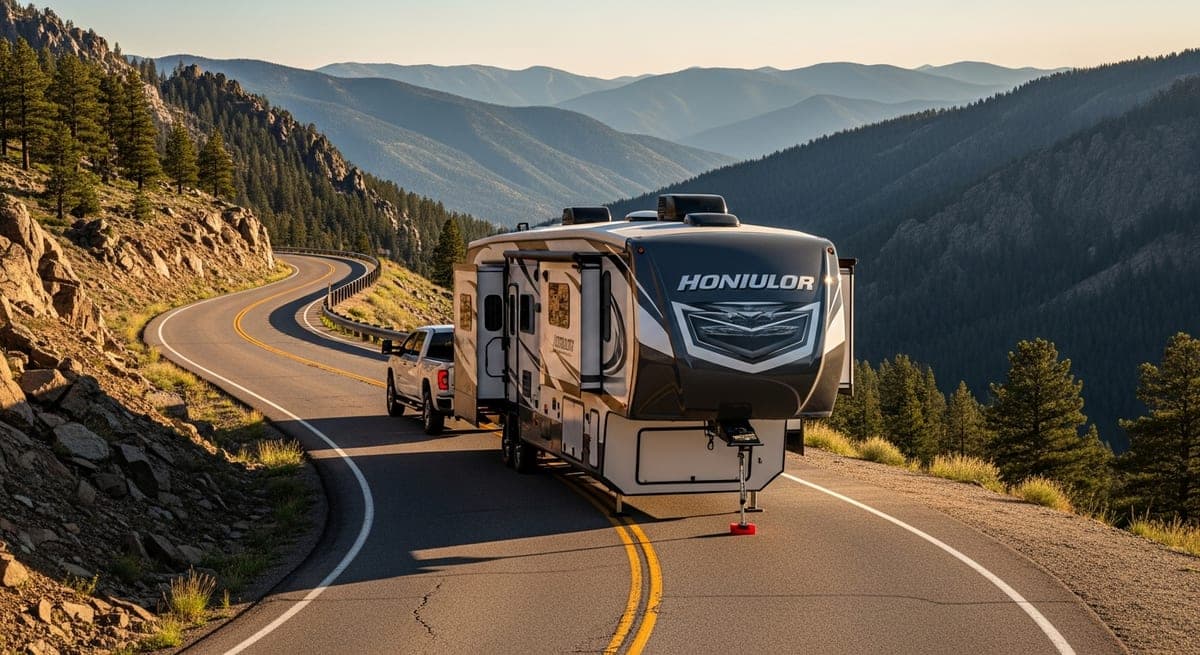
Steep mountain grades are where towing mistakes become dangerous quickly. The fundamental rule for descents: use engine braking, not your service brakes, to maintain speed. Downshift before the descent to a gear that maintains 30–40 mph with light or no brake application. Your engine and transmission absorb the energy instead of your brakes, which will overheat on long grades if used continuously.
If you're in a truck with tow/haul mode, activate it — this holds lower gears longer during deceleration and significantly improves engine braking on grades. Diesel trucks have exhaust brakes that are extremely effective on grades. If you have one, use it. If you're in a gas vehicle without exhaust braking, downshifting to 2nd or 3rd (manual selection) is the equivalent.
If your brakes overheat (brake fade — pedal feels mushy, vehicle doesn't decelerate appropriately), pull over immediately in a safe location and allow brakes to cool for at least 20–30 minutes before continuing. Driving on overheated brakes risks complete brake failure.
Tire Management and Blowouts
Trailer tire blowouts are common and dangerous if you react incorrectly. The counterintuitive response to a blowout while towing: accelerate gently and steer straight. Do not brake hard — this transfers weight rearward and increases sway. Maintain speed briefly, then reduce speed gradually as you steer to the shoulder. Practice the mental response before you need it.
Prevent blowouts by maintaining proper inflation (trailer tire pressure is on the trailer's sticker, not the tire sidewall — they're often different), not overloading beyond the tire's max load rating, and replacing tires by age (5–6 years maximum) regardless of tread depth. UV-degraded trailer tires with good tread can still fail from sidewall cracking.
From the RVmapper team
Fishing along your route?
Hooked Fisherman publishes fishing reports for all 50 states, species guides, and honest gear reviews. Know what's biting before you park the rig.