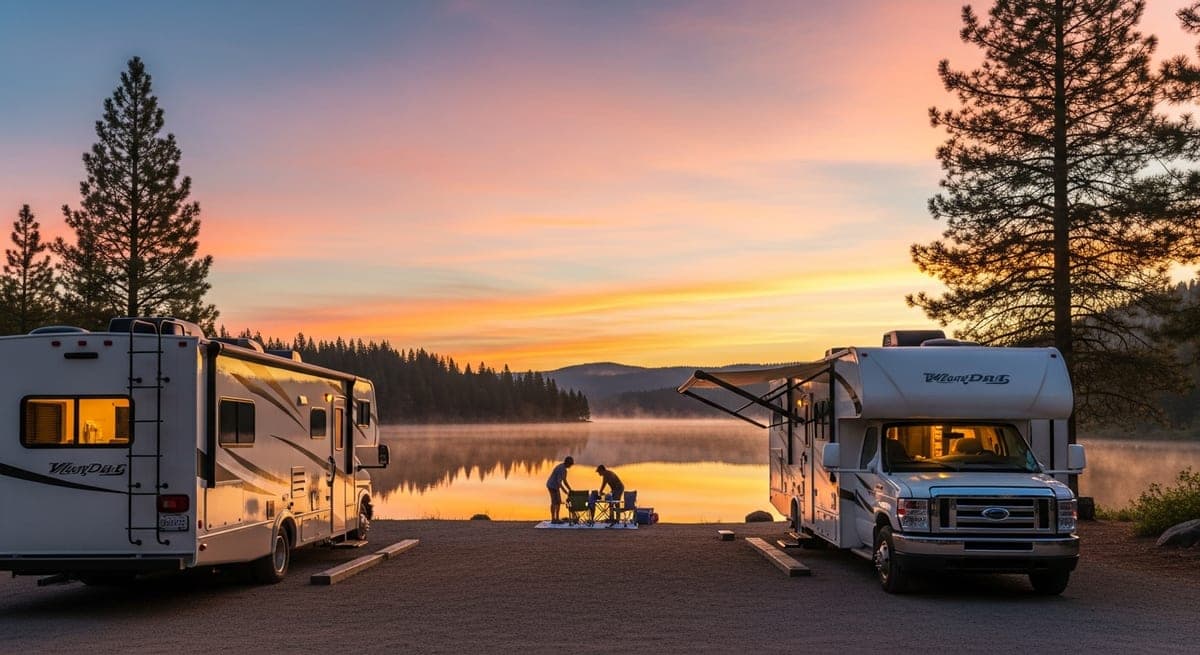
Families in the iRV2 forums and Full-Time Families Facebook communities who describe successful first infant RV trips share a consistent starting point: the campsite has shore power. The ability to run climate control continuously, without burning generator hours or propane through the night, is what the RV infant-travel community identifies as the logistics variable that determines whether a trip is manageable or exhausting. Destination, scenery, and campground amenities are secondary decisions. The hookup comes first.
Where Families with Infants Camp, and How Hookup Access Shapes the Choice
Full-timer and weekender families with infants tend to cluster around campgrounds with reliable full hookups. Fort Wilderness Resort & Campground at Walt Disney World in Orlando is cited frequently in family RV communities as a strong entry-point destination: 50-amp service, year-round climate control, and proximity to pediatric care.
Thousand Trails membership campgrounds, with dozens of locations across the country, come up often in budget-conscious full-timer threads for similar reasons: predictable electric hookups and a quieter, longer-stay culture that aligns well with infant schedules.
KOA Holiday locations near mid-size metros (Myrtle Beach, Branson, and Tucson among the most frequently mentioned) offer a practical middle ground: full hookups within a reasonable drive of pediatric urgent care clinics. Families in the community typically report treating that proximity as a site-selection criterion. Many run a Google Maps search for "pediatric urgent care" as part of evaluating a campground, alongside checking amperage.
For winter travel, the community consensus leans toward Florida's Gulf Coast and the Rio Grande Valley in Texas, the Harlingen and McAllen areas specifically, as destinations that reduce the climate-control burden while keeping hookup access consistent. Summer trips in shaded, temperate campgrounds with shore power are widely preferred over high-altitude or desert sites where infant temperature management compounds.
Safe Sleep Setup: Pack-n-Play Placement and Temperature Management in an RV
AAP safe sleep guidance doesn't change based on where you're sleeping: firm flat surface, no loose bedding, no soft co-sleeping surfaces. The forum discussion focuses on the practical question of where that surface goes inside an RV.
The Pack-n-Play is the most commonly reported solution across RV family communities. Parents note that standard models can often be stowed in exterior storage compartments on larger rigs, with Class A and fifth-wheel owners mentioning this most frequently. Inside, they get deployed in slide-out areas, dinette conversions, or bunkhouse spaces. Travel bassinets (the Lotus Travel Crib comes up most often) are mentioned as a more space-efficient option for families with very young infants.
Temperature management in the sleep space surfaces repeatedly as the non-obvious challenge. RV interiors heat and cool unevenly, and the area where the baby sleeps can differ meaningfully from what the main thermostat reads.
Full-timers consistently recommend placing a standalone digital room thermometer in the sleep area rather than relying on the central thermostat. For winter camping, the community-cited target for the sleep space is generally 68–72°F, maintained via the RV's own furnace on shore power. Families who address auxiliary heat in forum threads emphasize using only devices UL-listed for enclosed-space use.
Feeding on the Road: Why the RV Kitchen Holds an Advantage
Breastfeeding families consistently describe RV travel as more comfortable than car travel for feeding: a private, temperature-controlled space, refrigerator access for pumped milk, and no airport nursing rooms. The rhythm families describe settling into is stops roughly every two to three hours, though the community notes this varies considerably by baby and trip style.
Formula prep in a full RV kitchen is described as straightforward. Most families keep a gallon of filtered or distilled water on hand, and a compact microwave sterilizer is mentioned often. The main community-noted complication is ambient temperature: an RV that's warm from sun exposure or cool from lost heat can affect formula temperature in ways a home counter doesn't, requiring more active attention.
Families who've begun solids during RV trips report the kitchen as a genuine advantage over eating at restaurants while traveling. The Inglesina Fast Table Chair and similar clip-on designs appear frequently in gear lists. They attach directly to the RV's dinette bench and eliminate the need to carry a floor-standing high chair.
Shorter Days, Slower Miles: How Families Rebuild the Drive Schedule
Families across the infant-travel community consistently describe cutting their daily driving significantly compared to pre-baby trips. Community retrospectives point to three to four hours of driving per day as the window that works for most families, organized around feeding and nap schedules rather than distance targets. Many note that infants sleep well in moving vehicles, which leads families to align driving time with nap windows where they can.
The failure mode that comes up repeatedly in retrospective threads is over-scheduling: mapping out the same daily distances as a pre-baby itinerary and discovering that a sick day, a disrupted nap, or an unplanned stop makes the plan unworkable.
The consistent community advice is building buffer days, itinerary days with no drive commitment, so that disruptions absorb without cascading through the rest of the trip.
Medical Prep Before Departure: What Families Wish They'd Handled Earlier
The medical preparation items that come up most often in community retrospectives aren't dramatic. They're the pre-trip logistics families report wishing they'd handled before departure rather than scrambling for on the road:
- Researching pediatric urgent care at each stop in advance. Families consistently report doing this during trip planning, confirming a clinic is within a reasonable drive of each campground before the trip starts, not on arrival.
- Setting up telehealth with their home pediatrician. Many practices offer virtual visits for established patients. Families who arrange this before leaving report that it covered most in-trip concerns without requiring a clinic visit.
- Packing more infant medication than expected. Commonly cited kit contents: infant acetaminophen, ibuprofen for six months and older, a nasal aspirator, oral electrolytes, and a digital thermometer. Families note that small-town convenience stores often don't stock infant-specific formulations, making packing ahead more important than it seems at home.
Across community threads, preparation is what separates manageable trips from stressful ones, more reliably than any specific campground choice, destination, or drive schedule does on its own.
Related: RV camping with toddlers · RV camping with teenagers · RV travel with kids
Ready to Plan Your Trip?
Put this knowledge to work. Let our AI build a personalized RV itinerary for your next adventure, or browse community trips for inspiration.