
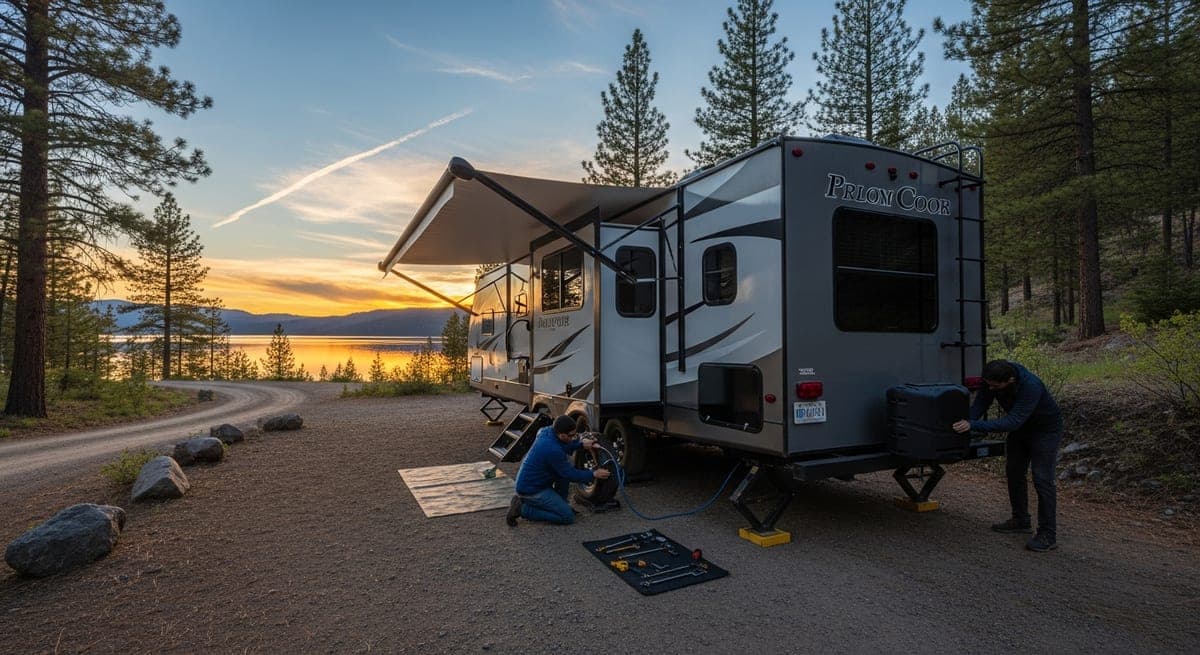
In the fall of 2023, I pulled into a campground in the Ozarks and found water stains on the interior ceiling panels that hadn't been there three months earlier — a sealant seam above the front cap had been quietly failing since spring. The repair bill came to $2,400. The tube of Dicor that could have prevented it costs $12. That was my second expensive lesson; the first was a water heater failure 200 miles from home that turned a four-day trip into a two-day scramble for parts. RV maintenance isn't glamorous, but it's the difference between a trip you'll remember fondly and one that costs you two months of camping budget in a single afternoon.
What follows is the inspection and maintenance system I've built since then — pre-trip, monthly, and seasonal tasks, organized by how often they need attention. Print it, bookmark it, or tape it to your dashboard. — RVMapper editorial team, on the road since 2019.
Pre-Trip Inspection: The 15-Minute Walk-Around
Every single time you hit the road, do a walk-around. It takes 15 minutes and can save you thousands. No excuses.
Tires: Check pressure with a quality gauge (not the built-in ones at gas stations — they're notoriously inaccurate). Your tire pressure should match the manufacturer's recommendation on the sidewall or in your owner's manual, and always check when tires are cold. Look for cracks, bulges, uneven wear, and objects embedded in the tread. A tire pressure monitoring system (TPMS) typically runs in the $150–$300 range depending on the brand and configuration — check current listings before you buy, as pricing shifts often.
Lights and signals: Have someone stand outside while you cycle through headlights, turn signals, brake lights, running lights, and clearance lights. Replace burned-out bulbs before you leave — a pack of replacement bulbs costs $10–$20 and keeps you legal.
Fluid levels: Check engine oil, transmission fluid, coolant, brake fluid, power steering fluid, and windshield washer fluid. If you're consistently low on any of these, that's a symptom — find the leak before it finds you on the highway.
Hitch and tow connections: If you're towing, inspect the hitch, safety chains, breakaway cable, and electrical connections. Give everything a good tug. Rattle the coupler. Make sure your weight distribution bars are properly tensioned if you use them.
Slide-outs and awnings: Retract everything and make sure it's fully secured. Check that slide seals are clean and intact. A loose awning at highway speed is a disaster waiting to happen — I've seen them rip right off the side of a rig on I-40 in New Mexico.
Interior quick-check: Make sure the fridge door is latched, cabinets are closed, and nothing's going to become a projectile when you hit the brakes. Secure your coffee maker, instant pot, and anything on the counters. Check that the LP gas detector is working.
Month-to-Month: Catching Problems Before They Compound
Whether the rig is sitting between weekend trips or parked through a long work stretch, these monthly checks keep small problems from turning into expensive ones.
Generator
If you have an onboard generator, run it under load for at least two hours every month, even if you're not camping. Generators that sit unused develop fuel system problems, and a generator rebuild can run $1,000–$3,000. While it's running, check the oil level and look for leaks. Oil change intervals vary by manufacturer — Onan and Cummins have meaningfully different specs, so consult your owner's manual rather than guessing; a common baseline is every 100–150 hours of use or annually, whichever comes first. A quart of generator oil is $8–$12.
Battery Care
Check your battery water levels monthly if you have flooded lead-acid batteries — use only distilled water and fill to about 1/8 inch below the fill ring. Clean the terminals with a baking soda and water solution if you see any corrosion (that white or greenish crusty buildup). A battery terminal cleaner brush costs about $5 and is a toolbox essential.
If your rig is in storage, use a battery maintainer (not a trickle charger — there's a difference). A good maintainer runs about $30–$50 and will extend your battery life significantly. Lithium batteries are more maintenance-free but still need to be kept at a partial charge during storage.
Roof Inspection
Get up on that roof every month. My $2,400 Ozarks repair came directly from skipping two consecutive monthly roof checks — a mistake I won't make twice. A small tear or lifted sealant around a vent or antenna can let water in, and water damage is the leading killer of RVs. Look for cracks, bubbles, or separation in the sealant around every penetration — vents, antennas, air conditioners, solar panels. Reseal anything suspicious with self-leveling lap sealant like Dicor (about $12 a tube). While you're up there, clear off any debris, branches, or leaves.
Seals and Seams
Check every exterior seal — windows, doors, compartment doors, the junction between the sidewall and roof. Flex the sealant gently with your finger. If it's hard, cracked, or pulling away, it needs to be replaced. A tube of silicone or polyurethane sealant is $6–$10, and spending 30 minutes resealing is infinitely cheaper than repairing water-damaged walls.
Engine and Drivetrain
If you drive a motorhome, your engine is doing a lot more work than a typical car engine. Respect that.
Oil changes: Follow your chassis manufacturer's schedule — as a general starting point, gas engines often need an oil change every 3,000–5,000 miles or annually, diesel engines every 5,000–10,000 miles, but your chassis manual has the final word. A DIY oil change runs $50–$80 in materials; a shop will charge $100–$200 for gas, $200–$400 for diesel.
Transmission service: Change the transmission fluid and filter on your chassis manufacturer's schedule — the interval varies significantly by platform. Ford F-53, Freightliner, and Ram ProMaster all have different specs, so pull your chassis manual rather than relying on generic RV advice. Budget about $200–$400 for a professional service. Skipping it is not optional; transmission replacements on motorhomes can run $3,000–$7,000.
Coolant system: Flush and replace coolant per your chassis manufacturer's recommendation. Many modern extended-life coolants (HOAT and OAT formulations) are rated for five years or 150,000 miles — check your chassis manual before scheduling a flush, because the old "two years or 30,000 miles" baseline doesn't apply to all coolant types. Mixing types can cause gel formation and clogged passages. A coolant flush runs about $100–$150 at a shop.
Belts and hoses: Inspect for cracks, fraying, glazing, or soft spots every few months. Replace belts at the interval your manufacturer specifies or at the first sign of wear. A broken serpentine belt on the side of the road is a bad day — the belt itself is only $30–$60, but the tow will cost you ten times that.
Air filter: Check monthly during travel season, replace when dirty. A clean air filter improves fuel economy and engine performance. Replacement filters run $15–$40. If you're running dusty roads — the kind you find through Utah canyon country or eastern Nevada — check it more often.
Brake inspection: Have brakes inspected annually or every 12,000 miles. RVs are heavy, and worn brakes on a 20,000-pound vehicle are genuinely dangerous. Budget $200–$600 per axle for brake service depending on whether you need pads only or rotors too.
Electrical System
RV electrical systems are more complex than most people realize. You've got 12-volt DC, 120-volt AC, possibly solar, and a converter or inverter tying it all together.
Shore power cord: Inspect the plug and cord for melting, discoloration, or loose prongs every time you connect. A burned shore power connection is a fire hazard. Replace damaged cords immediately — a 30-amp cord runs $40–$80, a 50-amp cord $80–$150.
Converter/inverter: Listen for unusual buzzing or humming. Check that the converter is properly charging your batteries by measuring voltage at the battery terminals while connected to shore power — you should see 13.2–14.4 volts. If your converter fan runs constantly, it may be overheating or failing.
GFCI outlets: Test your GFCI outlets monthly by pressing the test button. These protect you from electrical shock in wet areas like the kitchen and bathroom. If they won't reset, replace them — about $15–$20 per outlet and a straightforward DIY job if you're comfortable with electrical work.
12-volt system: If interior lights are dimming, your water pump seems sluggish, or your furnace fan sounds weak, your batteries may be failing or your connections may be corroded. Check voltage at the battery bank — fully charged should read 12.6–12.8 volts for lead-acid, 13.0–13.4 for lithium.
Plumbing and Water System
Water system problems range from annoying to genuinely disgusting. Stay on top of these.
Sanitize the fresh water system: Do this at least twice a year, or any time the RV has been sitting unused for more than two weeks. Use 1/4 cup of household bleach per 15 gallons of tank capacity. Fill the tank, run water through every faucet until you smell bleach, let it sit for 12 hours, then flush thoroughly.
Water heater: Drain and flush the water heater every few months to remove sediment buildup. Check the anode rod annually if you have a Suburban water heater — replace it when it's 75% or more consumed (about $10–$15 for a replacement rod). A water heater replacement runs $400–$800 installed.
Water pump: Listen for cycling when no faucets are open — this indicates a leak somewhere in the system. Check pump connections and the accumulator tank if equipped. A replacement water pump is $50–$150 depending on the brand.
Holding tanks: Use RV-specific tank treatments (never home chemicals) and dump regularly. Flush your black tank thoroughly after each dump. Check tank level sensors and clean them if they're reading incorrectly — false readings are one of the most common RV complaints.
Toilet seals: If you smell sewer odors inside or see water slowly seeping around the base of the toilet, the flapper seal needs replacement. This is a common wear item and costs $10–$20 for the seal kit. It's a 30-minute DIY job.
Tires: The Most Underrated Safety Item
RV tire failures are one of the leading causes of accidents, and most are preventable with basic maintenance.
Age matters more than tread: RV tires should be replaced every 5–7 years regardless of tread depth or mileage. UV exposure, ozone, and the sheer weight they carry causes the rubber to degrade internally. Find the DOT date code on the sidewall — the last four digits tell you the week and year of manufacture.
Proper inflation is critical: Underinflated tires generate excessive heat, which causes blowouts. Overinflated tires reduce your contact patch and make handling unpredictable. What I do that most RVers skip: weigh the rig fully loaded at a CAT scale ($12–$15) and cross-reference the tire manufacturer's load/inflation chart rather than going by the sidewall number alone. The sidewall shows max load inflation — optimal loaded inflation is often different, and that gap matters for heat buildup on long highway runs.
Tire covers: If your RV sits for any length of time, use tire covers to protect against UV damage. A set of four covers runs $30–$60 and can add years to your tire life.
Appliances
Your RV appliances work harder than their residential counterparts because they deal with vibration, temperature extremes, and LP gas operation.
Refrigerator: Clean the burner assembly and flue annually — a spider web or wasp nest in the burner tube is one of the most common causes of fridge failure and can also be a fire hazard. Check the door gasket by closing it on a dollar bill — if the bill slides out easily, the gasket needs replacement ($30–$60).
Furnace: Before the cold season, run the furnace and listen for unusual noises. Inspe
Ready to Plan Your Trip?
Put this knowledge to work. Let our AI build a personalized RV itinerary for your next adventure, or browse community trips for inspiration.