This article contains affiliate links. If you make a purchase through these links, we may earn a small commission at no extra cost to you. Learn more.
The summer I was trying to do day trips out of Apgar Village at Glacier National Park, I put over 600 miles on our Class A in a single week — mostly repositioning the rig because we had no car. Parking a 38-foot diesel pusher anywhere near Going-to-the-Sun Road isn't happening. That was the season I bought a used Jeep Wrangler TJ, had a base plate welded up, and stopped fighting National Park parking lots for good. If you're still on the fence about whether a toad setup is worth the effort, that story is my answer. — The RVMapper editorial team, running toads behind motorhomes since 2018.
Three Ways to Tow a Vehicle — And Why the Method Matters More Than the Price Tag
Each towing method solves a different problem. The right one depends less on budget and more on what vehicle you already own or plan to buy.
1. Flat towing (four wheels down): The vehicle rolls on all four of its own wheels behind the motorhome. No trailer — just a tow bar connecting the toad's base plate to the motorhome's hitch receiver. This is the lightest and most convenient approach, and the one most Class A owners land on eventually. The vehicle must be manufacturer-approved for four-down towing. Setup involves a base plate, a tow bar, safety cables, and a supplemental braking system (required by law in most states).
2. Tow dolly: The front wheels ride on a two-wheel trailer while the rear wheels stay on the ground. Useful for front-wheel-drive vehicles with automatic transmissions that aren't approved for flat towing. I ran a dolly for two seasons before switching, and the honest version is: it works, but loading and unloading the car every time you move camp adds fifteen minutes to every departure. Dollies typically weigh 800–1,200 pounds and contribute meaningfully to tongue weight. Backing into a forest service site with one behind you is its own skill set.
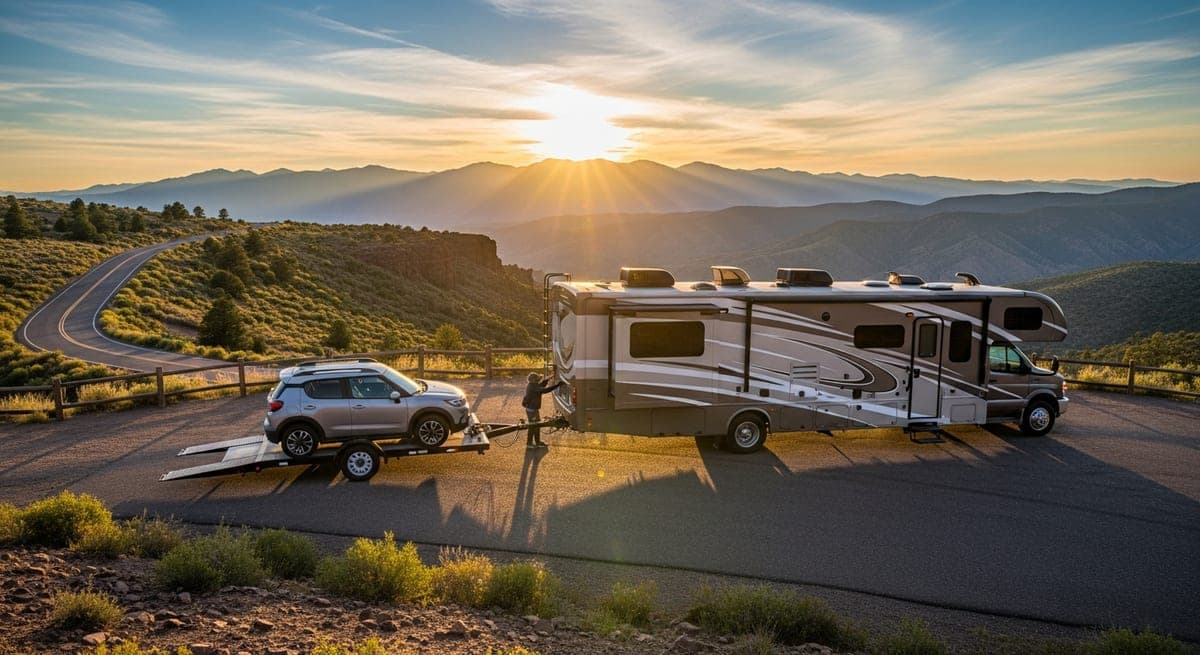
3. Car hauler (full trailer): All four wheels are off the ground on a fully enclosed or open trailer. Works with any vehicle regardless of drivetrain. Car haulers typically run 3,000–5,000 pounds empty, add serious combined length, and some campgrounds won't accommodate the total setup. Worth considering if you need to transport a specific vehicle that can't be towed any other way — but most RVers I've talked to treat this as the last resort, not the first choice.
Flat Towing: Why Most Serious Motorhome Owners End Up Here
The daily routine is what makes flat towing stick. At camp, you back the motorhome up, drop the tow bar arms into the base plate receivers, clip the cables and electrical connector, run the checklist, and you're moving in about ten minutes. No loading a car onto a platform, no worrying about whether the dolly clears the fire ring when you're trying to back into a narrow site at Ouray, Colorado or along the Oregon Coast.
The constraint: not every vehicle qualifies. The drivetrain needs to rotate freely with the engine off — which means the transmission can't rely on the running engine to circulate lubrication fluid while rolling. Vehicles with a neutral position in their transfer case (most 4WD trucks and SUVs), manual transmissions, or specific automatic transmissions that have been tested and documented by the manufacturer are candidates. Automatics that require engine-running lubrication will sustain serious drivetrain damage within the first few miles of towing — unless you add a separate transmission lube pump. Always verify your specific year, model, and transmission against the manufacturer's published flat-tow list. The same truck nameplate can change approval status between model years.
Vehicles worth knowing about: Jeep Wrangler (widely considered the default toad in the RV community — neutral transfer case, compact footprint, capable on the unpaved roads near most campgrounds), Jeep Gladiator, Ford Bronco, Chevy Spark, Fiat 500, and a number of Buick models depending on year. The Chevy Colorado and GMC Canyon work with manual transmissions. Community forums and RV rallies consistently put the Wrangler at the top of toad popularity surveys, and the reasons are practical: it parks anywhere, handles the kind of dirt road access you get near dispersed sites in Colorado or eastern Oregon, and holds resale value better than most small SUVs.
What You're Actually Installing: The Flat Tow Equipment List
- Base plate: A vehicle-specific frame attachment that becomes the connection point for the tow bar arms. Get it professionally installed — improperly fitted base plates have failed at highway speed, and it's not the place to cut corners. Blue Ox and Roadmaster both produce base plate systems that are well-regarded and widely used in the RV community. Cost: $400–$700 installed, varies by vehicle.
- Tow bar: The rigid or telescoping bar that bridges the base plate to the motorhome's hitch receiver. Telescoping designs make hitching easier when alignment isn't perfect — which is most of the time when you're backing up solo. Popular mid-range options include the Roadmaster Sterling and Blue Ox Aventa LX. Cost: $600–$1,500.
- Safety cables: Two cables that independently connect toad to motorhome, required by law in most states. Cross them beneath the tow bar so they can catch the bar if it drops. Rate them for the toad's curb weight.
- Electrical connection: A 6-pin or 7-pin connector that powers the toad's brake lights and turn signals from the motorhome's system. Required for legal towing in virtually every state, and genuinely important — drivers behind you need to see your braking and direction changes.
- Supplemental braking system: Required by law in most states when the toad exceeds a specified weight, commonly in the 1,500–3,000 lb range depending on state. Types include surge brakes that sense deceleration through inertia, and proportional systems that read the motorhome's actual braking force and mirror it in the toad. Proportional systems — the Roadmaster InvisiBrake and Blue Ox Patriot III are two options that come up repeatedly on the forums — are the ones I trust on descents like US-34 coming down out of Rocky Mountain National Park. Cost: $300–$700.
Motorhome Towing Capacity: Pull These Numbers Before You Shop for a Toad
Your motorhome has two ratings that matter for flat towing:
- Tongue weight capacity: The maximum downward force the hitch can handle. With flat towing, this tends to be modest — primarily the weight of the tow bar itself, typically 50–100 pounds, since the toad's mass rides on its own four wheels.
- Gross towing capacity: The maximum toad weight you can pull. A Jeep Wrangler 2-door runs around 4,000 lbs curb weight; the 4-door around 4,400 lbs. Your motorhome's rated towing capacity must exceed your toad's curb weight with a margin you're comfortable with.
Class A diesel pushers tend to have substantial tow ratings — often in the 10,000–15,000 lb range, though this varies by chassis and you should confirm against your specific owner's manual rather than general estimates. Gas-powered Class A chassis are typically rated more conservatively. Class C ratings vary widely by chassis and base vehicle. When in doubt, pull the chassis specification sheet — and use the RV manufacturer's stated tow capacity, not the bare-truck chassis figure, which may be higher than what the RV builder has validated.
The Hookup Sequence — Run It Every Single Time, No Exceptions
The mistake I see most often from newer towers is treating hookup as a routine they can run on autopilot. One skipped step — the transfer case position in particular — and you're looking at a transmission rebuild before the end of the trip. Build a laminated checklist for your specific toad and run it every departure without shortcuts. The sequence I use:
- Position the toad directly behind the motorhome, aligned with the hitch receiver.
- Connect the tow bar arms to the base plate receivers and verify both latch mechanisms are fully seated — give each arm a firm upward tug to confirm.
- Attach safety cables in a criss-cross pattern beneath the tow bar so they can catch the bar if it drops.
- Connect the 6-pin or 7-pin electrical connector; confirm it's fully seated and the retaining clip is engaged.
- Put the toad's transfer case in neutral — refer to your toad's specific flat-tow procedure, not a generic sequence. Many vehicles also require a specific transmission selector position; verify this for your make and model year.
- Turn the toad's ignition to Accessory — most vehicles require this to unlock the steering column and enable brake lights.
- Release the toad's parking brake.
- Walk the entire rig: verify tow bar latches are locked, cables are crossed and not dragging, and the electrical connector is seated. Have a partner stand behind the toad and call out brake lights and turn signal function before you move.
- Pull forward 20–30 feet at walking speed and verify the toad is tracking true before committing to the road.
The Mistakes That Cost People Real Money
- Towing a non-approved vehicle: I've seen this attempted on a back-country trip near Moab — the driver figured his SUV was probably fine since it had four-wheel drive. The transmission was gone by the time he reached pavement. Verify the manufacturer's approved flat-tow list for your exact year, model, and transmission before your first tow, not after.
- Forgetting the transfer case position: Driving even a short distance with the transfer case in the wrong position will destroy the drivetrain. This is the one step on the checklist that matters most. Don't skip it.
- No supplemental braking system: Illegal in most states, genuinely unsafe at highway speed with a 4,000-pound toad behind you, and a serious liability problem if you're involved in a rear-end collision without it.
- Wrong tow bar adjustment: A bar set to the wrong length will bind in turns and skip unpredictably. Measure the actual distance from your hitch receiver to your base plate connection point on your specific toad, and set the bar to match — don't estimate it by eye.
Related: Class A vs B vs C: choosing the right RV · RV maintenance checklist
From the RVmapper team
Fishing along your route?
Hooked Fisherman publishes fishing reports for all 50 states, species guides, and honest gear reviews. Know what's biting before you park the rig.