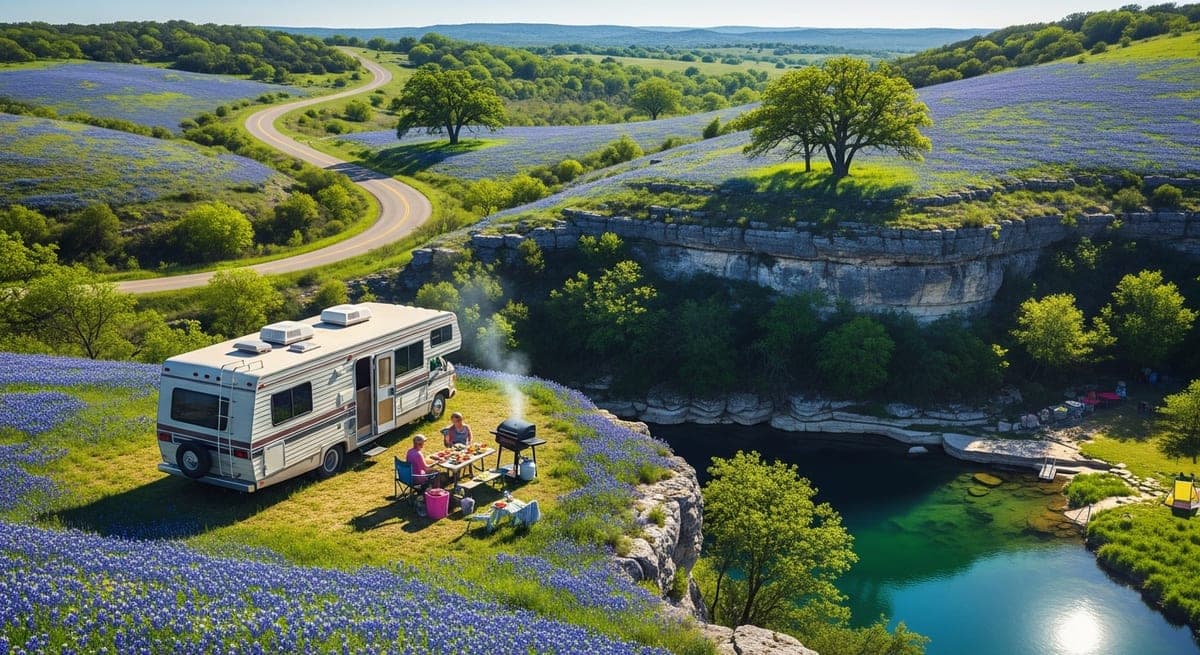
Highway 290 between Austin and Johnson City is one of the only stretches of American highway where state crews have actively planted wildflowers for over fifty years — a program Lady Bird Johnson championed in the mid-1960s that now turns the roadsides into something you have to see to believe. I drove it for the first time in 2018 and pulled over six times before I'd gone twenty miles. Last March was my third time through this loop. I still pulled over four times. Some roads don't get old.
The window is mid-March through late April — and this is the route that makes the most of it. Five days. Five campgrounds. An embarrassing amount of brisket.
The Route at a Glance
This loop starts and ends in Austin, covering roughly 350 miles through the heart of the Hill Country. The sweet spots for this time of year: the wildflower corridors along US-290 and TX-16, the spring-fed rivers at Wimberley and Kerrville, and the quiet backroads around Utopia and Vanderpool that most RV travelers skip entirely. Don't skip them.
Keep rigs under 35 feet for the FM roads. Most state park sites accommodate up to 40 feet on the main loops, but some of the best sites have 30-foot soft caps. When in doubt, call ahead — the park rangers are usually candid about what actually fits.
Day 1–2: Austin to Fredericksburg via the Wildflower Corridor
Leave Austin heading west on US-290. This is ground zero for bluebonnets — the 70-mile stretch between Austin and Johnson City is where Lady Bird Johnson's Highway Beautification Act did its finest work. Slow down. Stop at every turnout. The mistake I see most first-timers make is treating this stretch like a drive-through instead of the destination it actually is.
Pedernales Falls State Park, near Johnson City on the US-290 corridor between Austin and Fredericksburg, makes an ideal first night. It sits right on the Pedernales River, and the Electric Loop offers 69 RV sites with water and 30-amp electric hookups. Spring 2026 rates run approximately $20-25/night plus the daily per-person entrance fee, which is typical for Texas state parks; confirm current pricing at booking. The riverfront setting and the wildflower meadows on the park grounds rival anything you'll see from the highway. Book through Texas State Parks; availability opens 90 days out, and spring weekends fill fast. Worth a day-use detour nearby: the Lyndon B. Johnson State Park and Historic Site in Stonewall (day use only, no camping), with the Texas White House and the Sauer-Beckmann living-history farm.
Day 2 is for Fredericksburg. Main Street is Texas Hill Country's answer to a European village: German bakeries, wine tasting rooms, antique shops, and that specific mix of Texas twang and Old World charm. The National Museum of the Pacific War deserves a full two hours. Opa's Smoked Meats on Main is where you want to be at noon. Pick up groceries at the HEB for the next stretch — there aren't many options once you head south.
Day 2–3: Fredericksburg to Kerrville
Take TX-16 south from Fredericksburg toward Kerrville. This stretch trades bluebonnets for Hill Country cedar and live oak, and the views across the limestone ridges are outstanding. Stop at the Enchanted Rock State Natural Area if you don't mind a moderate detour — the 1,825-foot pink granite dome is one of the most otherworldly landscapes in Texas, and the sunrise from the summit is something you'll remember for years.
Kerrville-Schreiner Park on the Guadalupe River is one of the best campgrounds in the state park system. Sites run approximately $20-25/night with electric hookups (spring 2026 rates), and the riverfront sites are genuinely special — you're camping 30 feet from the Guadalupe, with the sound of moving water and the occasional canoe drifting past. The swimming hole at the park beach is cold and perfect by 2pm on a March afternoon.
Kerrville itself surprised me the first time through. For a city of around 25,000 people, it carries a deeper live music scene, better weekend farmers market options, and more Saturday afternoon pull than towns twice its size on the more-traveled routes. The Hill Country Arts Foundation is worth an hour if you want something beyond brisket and river swimming — though brisket and river swimming is a pretty solid afternoon.
Day 3–4: The Backroads — Kerrville to Wimberley via Utopia
This is the part of the route that separates the people who did a Hill Country trip from the people who did the Hill Country trip. Head south from Kerrville on TX-173 toward Bandera, then west on TX-470 through Utopia. This is genuine Texas backcountry — ranches, deer blinds, live oaks arching over one-lane bridges, and almost no other tourists.
Garner State Park on the Frio River is worth the extra miles. The campground is beautiful, the river is perfect for swimming, and the nightly jukebox dances on the pavilion have been a Hill Country institution long enough to have their own mythology — ask any longtime Texas RVer and you'll get a story. Sites with water and electric run approximately $25-30/night (spring 2026 rates). The park fills in summer but stays manageable in late March.
From Garner, head northeast through Concan and Leakey, then pick up the Lone Star Scenic Drive (RR-337) toward Vanderpool. This is one of the most spectacular roads in Texas — limestone canyon walls, hairpin turns, and a silence so complete you'll pull over just to listen to it. The Lost Maples State Natural Area near Vanderpool is world-famous for fall foliage, but the spring wildflowers on the limestone slopes are equally worth stopping for.
Day 4–5: Wimberley and the Final Leg
Wimberley sits at the confluence of Cypress Creek and the Blanco River, and it's become one of the Hill Country's most-visited stops — the draw is real, and it earns the reputation. Jacob's Well Natural Area offers swimming in a deep artesian spring that stays a constant 68°F year-round. The Blue Hole Regional Park is another stunning swimming spot surrounded by ancient bald cypress trees.
Camp in the area at Blanco State Park (on the Blanco River, 30 minutes from Wimberley) — sites with water and electric run approximately $20-25/night (spring 2026 rates). It's a smaller park, so book early. Wimberley's market square on Saturdays is excellent for local food, art, and getting completely lost among the antique dealers and galleries. Market Days happens the first Saturday of each month and draws hundreds of vendors.
Day 5 is a leisurely return to Austin on RR-12 through Dripping Springs — more wildflowers, more livestock on limestone hillsides, and the obligatory pit stop at Salt Lick BBQ before civilization swallows you back up.
Wildflower Viewing Tips
Bluebonnets typically peak mid-March to late April, but exact timing can shift by two to three weeks depending on winter rainfall. The Lady Bird Johnson Wildflower Center in Austin maintains a bloom tracker on their website — check it before you leave to confirm which corridors are peaking. Texas Parks & Wildlife also posts current conditions as the season gets going.
The best photography window is 7-9am when the flowers are fully open but the light is still golden. Midday is fine for views but harsh for photos. Many roadside spots don't have formal pullouts — use your hazards, pull completely off the pavement, and watch for snakes in tall grass.
Campground Summary
Pedernales Falls State Park (Johnson City): Approx. $20-25/night, water/electric, reservations at texasstateparks.reserveamerica.com. Kerrville-Schreiner Park: Approx. $20-25/night, water/electric, riverfront sites require booking 4-8 weeks ahead in spring. Garner State Park (Concan): Approx. $25-30/night, water/electric, books up fast — reserve 6-8 weeks out. Blanco State Park: Approx. $20-25/night, water/electric, smaller park so book early. All rates are approximate spring 2026 figures — confirm current pricing at the Texas State Parks reservation site before you go.
The Best Time to Go
The window between mid-March and late April is when everything aligns: peak wildflowers, comfortable temperatures (typically 60-80°F), campgrounds that aren't summer-crowd packed, and the Hill Country's quiet, unhurried rhythm that disappears by Memorial Day. I've done this loop in summer — it's fine. Spring is a different thing entirely. If you're reading this in March or early April, stop overthinking and go.
— RVMapper editorial team, driving Hill Country roads since 2018.
From the RVmapper team
Fishing along your route?
Hooked Fisherman publishes fishing reports for all 50 states, species guides, and honest gear reviews. Know what's biting before you park the rig.