
This article contains affiliate links. If you make a purchase through these links, we may earn a small commission at no extra cost to you. Learn more.
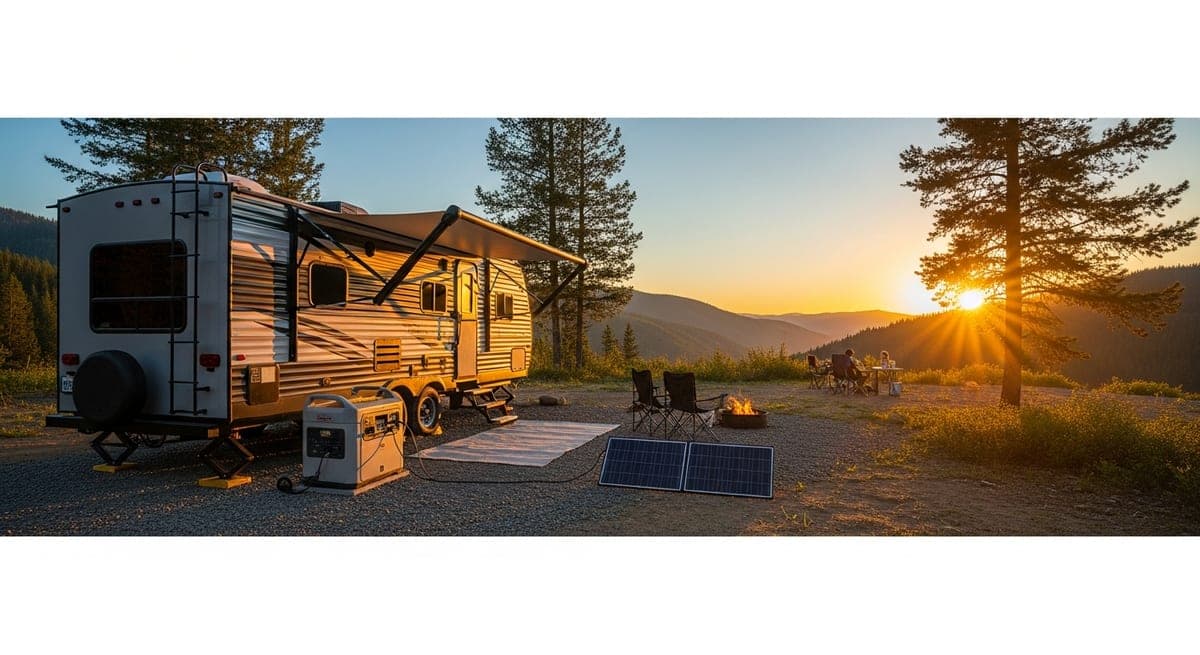
Memorial Day weekend at a packed state park campground is when many RVers first discover their generator is a liability, not an asset. Quiet hours typically kick in between 10 PM and 8 AM at most state and national park campgrounds — and at crowded holiday sites, enforcement is real. Feedback from full-timer forums and campground host reports consistently shows that owners who relied exclusively on their generator arrive at that 10 PM cutoff running a CPAP machine, a mini-fridge, and a phone bank with no fallback plan. Demand for a reliable portable power station for RV camping spikes every spring for exactly this reason — and so does the buyer frustration that follows when owners discover the gap between advertised watt-hour ratings and what units can realistically sustain over eight hours of overnight use.
Why generator quiet hours make portable power stations essential at holiday campgrounds
Most established campgrounds — national parks, Army Corps of Engineers sites, state parks, and many private RV parks — enforce quiet hours that fall squarely over sleeping hours. KOA's network-wide policy runs 11 PM to 7 AM; National Park Service campgrounds commonly enforce 10 PM to 6 AM. During Memorial Day, Labor Day, and Fourth of July weekends, campground host reports and social media threads from RV communities indicate that generator violations are among the most common sources of campsite conflict — not just from formal noise complaints, but from the social friction of disturbing neighboring campers who turned in early.
The practical result: any electrical load that needs to run overnight — CPAP machines, fan-assisted ventilation, a 12V fridge compressor, device charging, a baby monitor — either needs to draw from shore power, the RV's house batteries, or a standalone portable station. For campers without a 50-amp hookup, or those deliberately boondocking in overflow areas to secure a spot during a high-demand weekend, a portable unit becomes the only quiet option.
Owner threads across Reddit's r/vandwellers, r/fulltimervliving, and product review aggregators note a consistent pattern around holiday weekends: owners who purchased a portable station specifically for quiet-hour coverage often discover they undersized the unit for their actual overnight load. The common error is buying based on the headline watt-hour number without modeling nightly draw across all devices running simultaneously. A unit that looks impressive at 1,000 watt-hours on a store shelf can fall short of sustaining a CPAP plus a compressor fridge from 10 PM to 6 AM, especially when overnight temperatures drop.
Holiday weekends also introduce a recharging challenge that solo weeknight camping doesn't. At peak-season sites, shore power hookups can deliver inconsistent voltage, or the campsite may not offer electrical service at all. Daytime solar recharging becomes the only recovery option, and feedback from owners who've tried this at forested state park sites notes that tree shade dramatically cuts solar input, a variable that doesn't appear in rooftop-panel marketing materials.
Understanding capacity ratings: what owner reports say about real-world RV loads
The watt-hour number on the box describes maximum stored energy under laboratory conditions. Owner feedback and independent teardowns posted across YouTube review channels and hobbyist forums document several factors that erode usable capacity in real camping conditions:
- Temperature derating: Lithium iron phosphate (LiFePO4) cells, which dominate the mid-to-premium portable station market, deliver meaningfully less usable capacity when temperatures drop below 50°F. Owners in r/overlanding and full-timer Facebook groups report 10–20% capacity loss on cold spring nights — directly relevant during Memorial Day camping in higher elevations or northern states.
- Inverter efficiency losses: AC output passes through an inverter, and owner-measured data shared in review threads suggests real-world inverter efficiency runs 85–92% for quality units. A 1,000 Wh pack doesn't deliver 1,000 Wh of AC power to connected devices; it delivers closer to 850–920 Wh before other losses are factored in.
- Battery management system (BMS) cutoffs: Most units reserve a bottom margin of usable capacity to protect cell longevity. Manufacturer documentation for several major brands confirms cells don't discharge to zero; usable capacity in practice is typically 90–95% of rated capacity, and this protection band tends to widen as the unit ages.
- Simultaneous load stacking: Running a CPAP at 30–60W, a 12V compressor fridge cycling at an average of 40–60W, and keeping two phones charging via USB-C adds up to roughly 110–150W of continuous draw. At that rate, a 1,000 Wh unit in temperate conditions provides approximately 6–7 hours of runtime — often short of an eight-hour overnight window once all efficiency losses are included.
Community consensus, aggregated from product review comment threads on Amazon, Best Buy, and Camping World product pages, consistently flags the 1,000–1,200 Wh range as the practical minimum for a single-night RV load covering CPAP plus fridge plus phone charging. Full-timers who rely on portable stations as a primary quiet-hours battery report targeting 2,000 Wh minimum, or pairing two mid-range units for both redundancy and load flexibility.
One detail that surfaces repeatedly in CPAP user threads: machines with heated humidifiers and climate-control features draw significantly more power than units running in basic mode. Several CPAP models offer a 12V DC input that bypasses the inverter entirely and recovers 8–15% efficiency. This workaround is widely shared in CPAP forum threads but is rarely surfaced by power station brands in their own marketing materials.
How top models compare across budget, mid-range, and premium tiers based on user feedback
Owner reports sort the portable power station market into three practical tiers for RV use. The comparisons below are drawn from aggregated review data, forum discussions, and third-party testing coverage in outdoor gear publications — not from independent hands-on testing by this publication.
Budget tier (under $400, typically 500–700 Wh)
Units like the Jackery Explorer 500 or Bluetti EB55 attract strong reviews for weekend car campers and day-trippers. For overnight RV use, owner feedback is more mixed:
- Adequate for phone charging, a small 12V fan, and LED lighting
- Frequently described as undersized for CPAP plus fridge combinations running simultaneously through the night
- Lithium NMC chemistry in many budget units draws concern from full-timers about long-term cycle life compared to LiFePO4 alternatives
- Owners running CPAP machines without heated humidifiers — the lowest-draw configuration — report borderline overnight performance on a single charge
Mid-range tier ($400–$1,000, typically 1,000–1,500 Wh)
This is the tier that generates the highest volume of RV-specific owner feedback. Products like the Jackery Explorer 1000 Pro, EcoFlow Delta, and Bluetti AC180 appear frequently in full-timer packing lists and campground group recommendations. Key owner observations:
- The 1,000–1,200 Wh units cover a typical quiet-hours overnight load with margin to spare in warm weather, but run close to limits on cold spring or fall nights
- Fast recharging via solar input is the most frequently cited reason full-timers prefer mid-range units over budget options — recovering capacity during daytime hours dramatically extends the usefulness of a single unit across consecutive camping days
- Display clarity and app connectivity are flagged consistently in review threads; owners report that units with real-time watt meters are significantly easier to manage than those showing only a percentage indicator
- Owners in high-altitude locations note that temperature swings between afternoon heat and overnight cold affect performance noticeably; storing units inside the RV during peak afternoon heat is a commonly shared workaround
Premium tier ($1,000+, 2,000 Wh and above)
Units from EcoFlow (Delta Pro), Bluetti (AC200P, AC300), and Goal Zero (Yeti 3000X) are the most common recommendations in full-timer forums for households running medical equipment, residential-style appliances, or multiple family members' devices simultaneously. Owner-reported advantages:
- LiFePO4 chemistry is near-universal at this tier, translating to 2,000–3,500 lifecycle claims and meaningfully lower long-term cost per usable cycle
- Expandable battery architecture — adding external packs to the base unit — is cited as the defining feature for couples and families who don't want to replace the entire system when load requirements grow
- Dual charging inputs, combining shore power and solar input simultaneously, are noted as a practical advantage for mixed-use campground days: charging from the pedestal in the morning and running on stored capacity after quiet hours begin
The consistent caveat across premium tier reviews: weight. Units in the 2,000+ Wh class range from 45 to 95 lbs depending on chemistry and form factor. Full-timers with weight-sensitive builds and fifth-wheel owners watching GVWR headroom frequently flag that premium units require permanent mounting solutions or a two-person lift — a real constraint that spec sheets don't communicate.
What full-timers and weekend campers consistently flag as dealbreakers
Forum threads specifically asking "what do you wish you knew before buying" surface a consistent set of owner regrets. Synthesized from r/fulltimervliving, RV.net's Power and Solar board, and campground-focused Facebook groups, the recurring flags include:
- Watt-hour capacity is not the whole story; continuous output wattage matters equally. Owners who purchased units rated at 1,000 Wh but with only a 600W continuous inverter found they couldn't run a CPAP with heat and humidity simultaneously with a compressor fridge without triggering overload protection. Inverter wattage caps the instantaneous load the unit can handle, regardless of how much capacity is stored.
- Surge wattage matters for compressor fridge startup. 12V compressor fridges have startup surge draws that can hit 3–5x their running wattage for a fraction of a second. Units with low surge ratings trip on compressor startup. Owners recommend confirming the peak surge rating exceeds the fridge's startup specification before purchasing.
- Pass-through charging behavior varies and is often underdocumented. Some units charge from solar or shore power while simultaneously powering connected devices; others pause output or reduce longevity under simultaneous charge and discharge. Owner reviews on multiple models flag that pass-through behavior is frequently discovered only after the purchase is made.
- Solar input compatibility is a real consideration, not a checkbox feature. Maximum solar input wattage, accepted voltage ranges, and whether the unit uses MPPT or PWM charge controllers determine how efficiently rooftop panels charge the unit during the day. Owners who paired high-wattage panels with units that had narrow voltage acceptance windows report significant charging underperformance that product marketing gave no indication of.
- Cooling fan noise is underreported in product specifications. Most portable stations use active cooling fans that engage under load or during recharging. Review thread feedback notes that some units run fans audibly enough to be noticed inside a small trailer at night — partially defeating the quiet-hours purpose they were purchased to solve. Full-timers recommend checking YouTube real-world noise demonstrations before buying.
- Warranty and customer service responsiveness are consistent differentiators in long-form owner reviews. Cell degradation, BMS faults, and inverter failures are not uncommon after one to two seasons of heavy use. Brands with responsive US-based warranty support receive measurably higher repeat-purchase intent in owner surveys cited in outdoor gear publications.
The aggregate advice from owner communities, distilled across years of forum discussion and product review threads: size one capacity tier larger than load calculations suggest, verify inverter and surge wattage against the specific appliances being powered, and confirm solar input compatibility with existing roof panels before assuming they'll work together. At crowded holiday campgrounds where quiet hours are actively enforced, a properly sized portable power station isn't a convenience upgrade — it's the infrastructure that keeps a site functional and comfortable from generator cutoff to morning coffee.
From the RVmapper team
Fishing along your route?
Hooked Fisherman publishes fishing reports for all 50 states, species guides, and honest gear reviews. Know what's biting before you park the rig.