The Appalachian Range as an RV Destination
The Appalachian Mountains extend from northern Georgia through to Maine — over 1,500 miles of forested mountain terrain within 1-3 hours of 60% of the US population. For East Coast RVers, this is the most accessible mountain camping destination, offering everything from sprawling national forest campgrounds to full-service state park resorts.
The range has distinct sub-regions, each with its own character: the Great Smoky Mountains in Tennessee/North Carolina (most visited national park in the country), the Blue Ridge Parkway (469 miles of no-commercial-traffic scenic road), Shenandoah National Park in Virginia, and the less-visited ranges of West Virginia, western Maryland, and the Berkshires in Massachusetts.
Blue Ridge Parkway: The Scenic Drive
The Blue Ridge Parkway runs from Shenandoah National Park in northern Virginia south to the Great Smoky Mountains in North Carolina — 469 miles of some of the most beautiful driving in the eastern US. No billboards, no commercial vehicles, no traffic signals. The road follows the spine of the Blue Ridge Mountains with overlooks, hiking trails, and visitor centers throughout.
RV considerations: The Parkway was built in the 1930s and has length and height restrictions that affect larger rigs. Tunnels on the North Carolina section have height restrictions (the lowest is 11 feet 9 inches). The road also has many curves and grades that require careful driving in a large motorhome or with a trailer. Maximum recommended vehicle length is 35 feet in some sections. Check the Parkway's website for current restrictions and road status before planning a long section drive.
Campgrounds: The Parkway operates campgrounds throughout its length — primitive sites with no hookups, pit toilets, and water. Reservations at recreation.gov for peak season (June-October). First-come-first-served off-peak. The lack of electric hookups means these are generator-dependent or solar sites — plan accordingly.
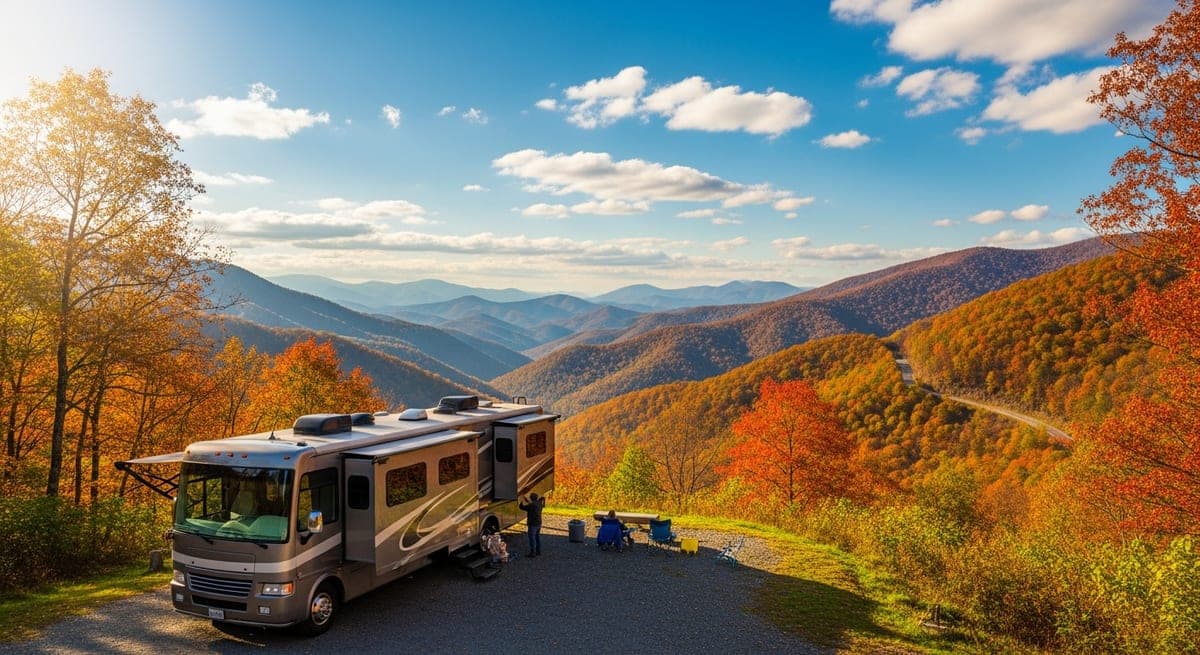
Best timing: Fall foliage along the Blue Ridge Parkway (typically late September through mid-October) is spectacular. October weekends are very crowded; midweek fall visits are the sweet spot.
Shenandoah National Park
Shenandoah offers 200,000 acres of forested Appalachian ridge in northern Virginia, 105 miles of Skyline Drive (the Parkway's northern terminus), and excellent black bear and whitetail deer wildlife viewing. It's the most accessible national park to Washington DC and Baltimore, which makes it very crowded on summer weekends — but surprisingly quiet midweek.
Campgrounds: Four main campgrounds (Big Meadows, Lewis Mountain, Mathews Arm, Loft Mountain) offer tent and RV sites up to 35 feet with limited hookups (Big Meadows has some electric sites). Big Meadows has the best services but fills first. Reservations are essential for summer and fall at recreation.gov.
Wildlife: Black bear encounters are common in Shenandoah — store food properly (bear boxes at each campsite), don't leave anything scented in your tow vehicle overnight, and follow all food storage regulations. The wildlife viewing here — deer, turkey, bear, and occasional bobcat sightings — is excellent.
Great Smoky Mountains: The Crown Jewel (and Most Crowded)
Great Smoky Mountains National Park is the most visited national park in the US by a significant margin — over 12 million visitors annually. The Smokies are spectacular: deep mountain forests, wildflower fields, historic Appalachian homesteads, and reliable wildlife viewing including over 1,500 black bears.
RV-specific notes: Cades Cove Loop Road (an 11-mile one-way loop through a historic valley) has a 20-foot vehicle length restriction — no trailers, no Class A motorhomes. This is the best wildlife-viewing drive in the park. If you have a larger rig, bring a car or rent a small vehicle for Cades Cove.
Campgrounds: Elkmont, Cades Cove, and Smokemont are the major campgrounds with RV sites (no hookups). All fill well in advance for summer through fall — book the maximum advance window at recreation.gov.
Avoiding the crowds: The Smokies are most crowded in July-August and during October foliage. Spring (April-May for wildflowers) and early June are excellent times with smaller crowds. Most visitors concentrate on the Gatlinburg/Pigeon Forge entrance — the less-visited Cataloochee Valley entrance on the North Carolina side has elk and significantly fewer visitors.
West Virginia: The Underrated Option
The New River Gorge became West Virginia's first national park in 2020, bringing long-overdue attention to one of the most dramatic river gorges in the eastern US. The gorge has 73,000 acres of forest, outstanding whitewater rafting, historic coal mining structures, and excellent RV camping at Grandview and Sandstone campgrounds.
Seneca Rocks and Spruce Knob in the Monongahela National Forest offer mountain camping that's comparable in scenery to Virginia and North Carolina but with much smaller crowds. The Spruce Knob area reaches 4,861 feet — the highest point in West Virginia — with views across the Appalachian ridges.
Ready to Plan Your Trip?
Put this knowledge to work. Let our AI build a personalized RV itinerary for your next adventure, or browse community trips for inspiration.
Keep Reading
Colorado RV Camping: Rocky Mountain National Park, Mesa Verde & the Million Dollar Highway
15 min read
Destination GuidesAcadia National Park RV Camping: Size Limits, Campgrounds & the Best Way to See Mount Desert Island
13 min read
Destination GuidesGrand Canyon RV Camping: South Rim, North Rim, and the Best Approach Routes
14 min read