This article contains affiliate links. If you make a purchase through these links, we may earn a small commission at no extra cost to you. Learn more.
Two Rims, Two Completely Different Experiences
Most people who visit the Grand Canyon see only the South Rim — it's open year-round, closer to major highways, and has the full tourist infrastructure. The North Rim, accessible only from mid-May through mid-October, receives about one-tenth the visitors and offers a dramatically different, less crowded experience of the same canyon.
For RVers choosing between them or planning to visit both, understanding the practical differences matters as much as the scenery differences.
South Rim: What to Know for RVers
The South Rim sits at 6,800 feet elevation and is open year-round. Williams (58 miles south) and Flagstaff (80 miles south) are the nearest significant towns. The Village area has gas, a grocery store, restaurants, lodges, and full visitor services.
Mather Campground: The main South Rim campground, located near the Village. 327 sites with no hookups (electric available at a separate section for $5 premium). Accepts RVs up to 30 feet. Sites are close together with limited privacy — this is not a wilderness experience. Reservations absolutely essential from March-November at recreation.gov; some sites released as first-come-first-served off-season.
Trailer Village: The only hookup campground at the South Rim. Adjacent to Mather. Pull-through sites with 30/50-amp electric and water hookups (no sewer). Managed by the park concessioner — reservations through a separate system. More expensive than Mather but significantly more comfortable for summer when running AC matters.
Crowds management: South Rim implemented a shuttle bus system years ago because private vehicle traffic had completely gridlocked the rim road. Park your RV at Mather or Trailer Village and use the shuttles to access the rim viewpoints — don't try to drive the rim road with a large rig.
North Rim: The Road Less Traveled
The North Rim sits at 8,200 feet — 1,400 feet higher than the South Rim — and is accessible only via a 45-mile spur road from Jacob Lake, AZ. The extra 1,400 feet of elevation means 10°F cooler summer temperatures and significantly more precipitation. The canyon views from the North Rim are different than the South — you're looking south instead of north, and the canyon feels more enclosed and intimate.
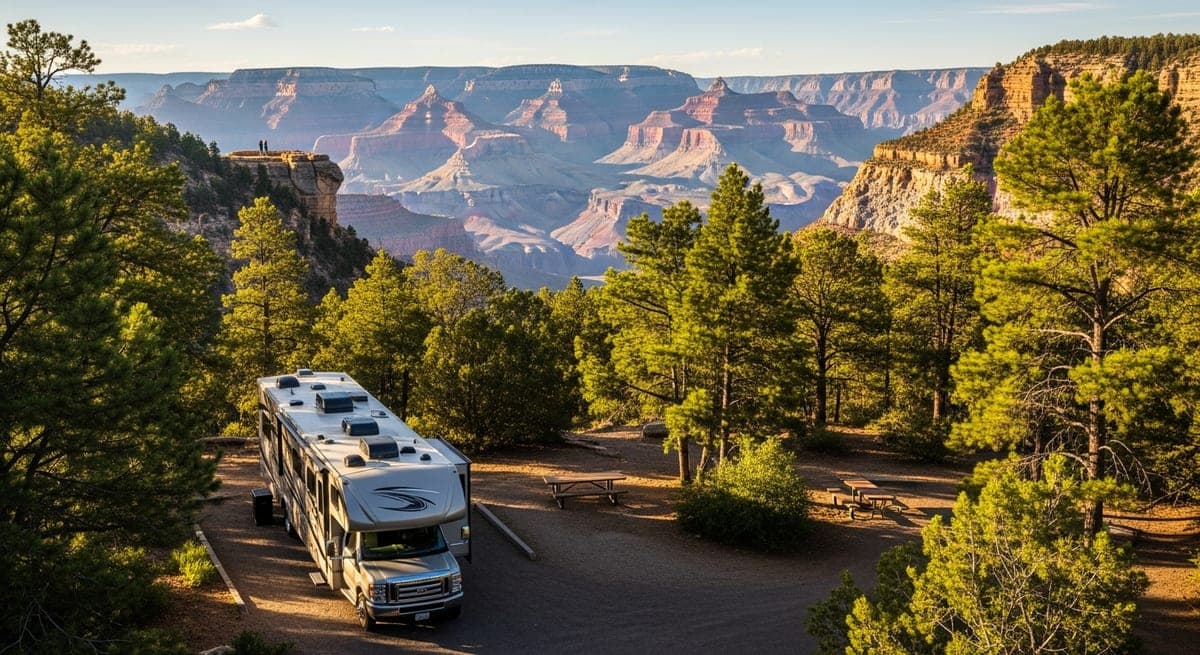
North Rim Campground: 87 sites including hookup sites with electric/water. Located near the rim in ponderosa pine forest. Significantly more spacious and private than South Rim campgrounds. Reservations at recreation.gov — essential for July/August, possible to get a site on arrival in late September/October.
The drive: The road to the North Rim from Jacob Lake is 45 miles through the Kaibab Plateau — beautiful driving through ponderosa and aspen forest. The road has no height or length restrictions for the main section to the campground, but the spur to Cape Royal (a spectacular viewpoint) has a 22-foot height restriction and recommends vehicles under 35 feet.
Services: The North Rim has a lodge, small general store, and gas station. There is no Walmart nearby, no big-box stores within 70+ miles. Stock up in Jacob Lake or before entering the area.
Doing Both Rims in One Trip
The rims are only 10 miles apart as the crow flies but over 200 miles by road (you have to drive around the canyon). The standard loop: enter from the south, camp South Rim 2-3 nights, drive north through the Navajo Nation and Marble Canyon area (spectacular drive in its own right), camp North Rim 2-3 nights, and return the same way or continue north to Utah.
The drive between rims passes through the East Entrance of the park, the Navajo Bridge over Marble Canyon (open to foot traffic — walk across for a view of the Colorado River 467 feet below), and the Vermilion Cliffs National Monument. Condors are frequently spotted from the Vermilion Cliffs pullouts.
Ready to Plan Your Trip?
Put this knowledge to work. Let our AI build a personalized RV itinerary for your next adventure — or browse community trips for inspiration.
Keep Reading
RV Camping in the Appalachian Mountains: Blue Ridge, Shenandoah, and Beyond
10 min read
Destination GuidesColorado RV Camping: Rocky Mountain National Park, Mesa Verde & the Million Dollar Highway
15 min read
Destination GuidesAcadia National Park RV Camping: Size Limits, Campgrounds & the Best Way to See Mount Desert Island
13 min read