This article contains affiliate links. If you make a purchase through these links, we may earn a small commission at no extra cost to you. Learn more.
Why Campground Etiquette Matters More Than You Think
Most campground arguments don't start with loud music — they start with a generator cranking up at 6:30 AM while the neighbor just got their kids asleep at 1 AM. The gap between a trip you rave about and one you try to forget is often the people next to you — and whether they know the informal rules that keep shared outdoor spaces bearable. Most conflicts come down to noise, light, site boundaries, and generators. None of these rules are posted anywhere. That's exactly the problem.
Quiet Hours: They Vary More Than You Think
Assuming a standard 10 PM–8 AM quiet window will get you in trouble — hours vary significantly by location and are worth checking at every new campground. KOA locations typically run 10 PM–8 AM and enforce it actively with on-site hosts. Florida state parks often start at 11 PM but enforce strictly and consistently. BLM dispersed camping frequently has no posted quiet hours at all — but that doesn't mean your neighbors won't walk over at midnight. Always confirm your specific park's rules at check-in or on their website.
Within quiet hours, the expectations are consistent regardless of location:
- No generator use
- Conversations at low volume — voices carry dramatically at night in campgrounds
- Music off or headphones only
- No slamming vehicle doors or storage compartment latches
- Dogs not barking — bring them inside if they're reactive to nighttime sounds
If a late arrival is unavoidable, skip outdoor setup until morning. One gear swap that most RVers don't make until someone tells them: ditch the standard white headlamp and get one with a dedicated red-light mode. The Black Diamond Spot 400 (~$45) has a dedicated red mode that won't destroy your neighbors' night vision the way white light does. It's a small thing that immediately signals you know what you're doing.
Generator Etiquette
Generators are the most contentious noise source at campgrounds, and the rules vary more than most RVers realize. Many national forest campgrounds allow generator use roughly 8 AM to 8 PM. Most KOA locations post explicit windows, often 8 AM to 9 PM. Some private parks near resort areas are stricter. When in doubt, check your park's posted signage — don't guess. Beyond the hours:
- Never run overnight unless it's a genuine emergency. Exhaust and noise while neighbors are sleeping is the fastest path to a campground host visit.
- Face the exhaust away from neighboring sites. You can't always control placement, but angling the generator away shows consideration that neighbors notice.
- Consider asking your neighbor if they want to coordinate generator windows. One runs while the other doesn't — it's a low-friction conversation that defuses conflict before it starts and usually results in both parties feeling good about the stay.
Pro tip on going generator-free: The EcoFlow Delta 2 (~$999) paired with a 200W flexible solar panel handles a full RV fridge and device charging through most fair-weather trips without touching a generator. For higher-draw appliances — microwave, AC top-offs — the Jackery Explorer 2000 Pro (~$1,599) covers it. The upfront cost pays back in campground goodwill quickly, and it opens up quieter, more remote sites where generators aren't welcome at all.
Site Boundaries and Space Respect
Your campsite is yours — and so is your neighbor's. The invisible line between sites is more important than it looks:
- Don't park vehicles, run awning tie-downs, or place chairs so they encroach on adjacent sites
- Don't walk through other people's sites as a shortcut — go around
- Ask before letting pets approach neighbor sites — not everyone wants a strange dog in their space
- If campfire smoke drifts toward neighbors and wind won't cooperate, a brief acknowledgment goes a long way
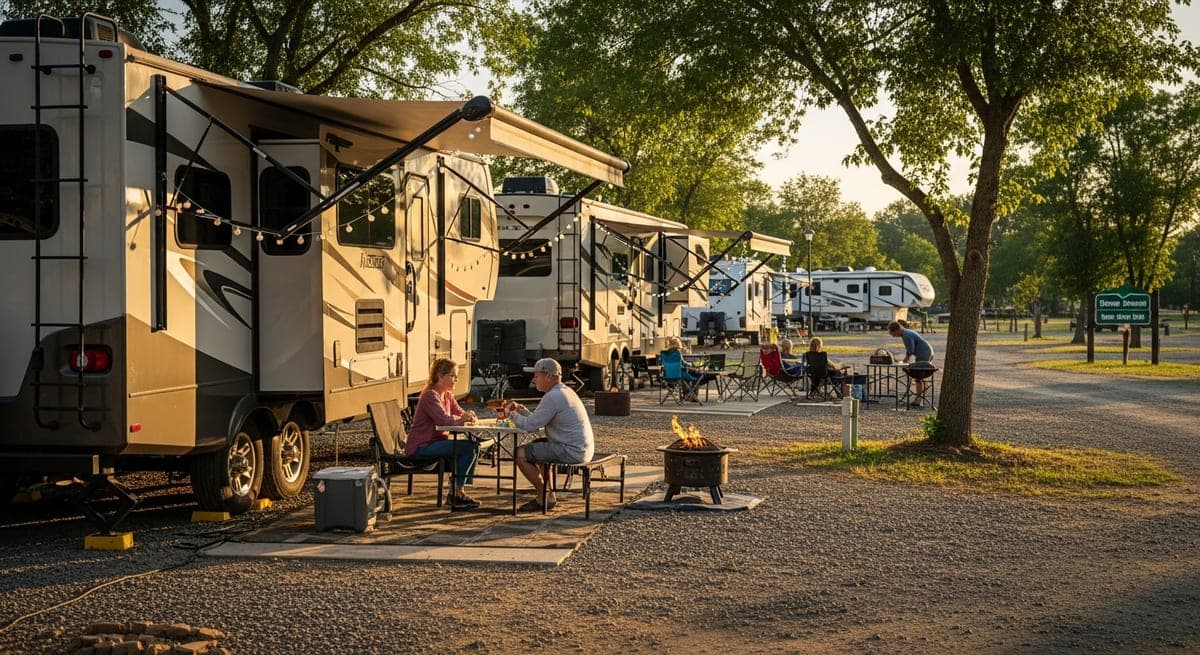
At high-density campgrounds like Jellystone Parks or busy KOA locations near national parks, sites are close enough that these courtesies determine the entire tone of your stay. At more dispersed sites — BLM land near Moab or national forest campgrounds in the Cascades — you have more buffer, but the principles still apply.
Kids and Pets
Kids: Campgrounds are genuinely kid-friendly environments, and children running and playing is expected. That said, kids at full volume at 7 AM next to a neighbor who arrived at 1 AM is inconsiderate. Teach kids to stay in your site and be aware of quiet hours. Most campground hosts are reasonable if you're visibly managing the situation rather than ignoring it.
Pets: Pick up waste immediately and dispose of it properly — burying it near sites is not acceptable. Don't leave pets unattended if they bark. Keep them leashed where required. In bear country — Colorado's Eleven Mile State Park, Oregon's Bend-area campgrounds, or anywhere in the Greater Yellowstone corridor — a dog alerting all night stresses wildlife corridors and draws unwanted attention. It's a real problem, not just an annoyance.
Campfire Courtesy
- Only burn locally purchased, approved wood — burning wood brought from home spreads invasive insects and is banned at most campgrounds across the Northeast, Great Lakes region, and Pacific Northwest
- Don't leave fires completely unattended, even briefly
- Extinguish fully before bed — don't "bank" a campfire at a public campground
- A dying, smoldering fire produces far more smoke than an active one — let it burn down or pour water, and don't let it smoke for hours while neighbors try to sleep with their windows open
- When fire bans are in effect, they apply — this is increasingly relevant across California, the Pacific Northwest, and Mountain West states during summer and fall
Move-In and Move-Out
Arriving at a campsite: leave it better than you found it is the standard, and "better" has a specific meaning — no previous-occupant debris, no gray water dumped on the ground, no trash left behind. Before you pull in, clear any debris the previous occupant left. When you leave, break down completely — no stakes, no food scraps, nothing.
Check-out time is real. At high-demand campgrounds inside Zion, near Glacier during peak season, or at popular state park loops with waitlists, other campers may be scheduled to arrive in your site minutes after you're supposed to leave. Overstaying creates a cascade of problems for people who drove hours to get there.
Related: RV campground etiquette guide · RV campsite setup guide · RV travel with dogs
Ready to Plan Your Trip?
Put this knowledge to work. Let our AI build a personalized RV itinerary for your next adventure, or browse community trips for inspiration.