The National Park Service's Junior Ranger program operates at more than 400 parks nationwide, and families who've run the grandparent-grandchild RV circuit — Yellowstone to Rocky Mountain to Acadia and back — report that the badge collection becomes its own propulsive motivation: grandkids working toward a new badge hike farther and complain less than grandkids who aren't. That dynamic, an activity creating genuine investment in the place, is the throughline in what multi-generational RV travelers consistently describe as their most-recalled trips. Here are 10 activities that show up repeatedly in those accounts.
1. Junior Ranger Programs
Every national park and many state parks run Junior Ranger programs: kids complete a booklet of activities tied to that park's specific ecosystems and history, then receive an official badge in a swearing-in ceremony from a ranger. Families who've collected badges across multiple parks report that the accumulation becomes a driving goal — grandkids track which parks they still need to visit.
Age eligibility varies by park. Many programs start at age 4 and run through 12 or 13, though some parks have no upper limit and offer separate adult versions. Grand Canyon, Yellowstone, and Acadia are frequently cited by RV families as having particularly memorable ceremonies. Check each park's Junior Ranger page before arrival — some parks require in-person booklet completion, while others accept partially self-guided work.
2. Fishing
Multi-generational RV travelers consistently place fishing near the top of what grandkids recalled from their trips — not necessarily because of the catch, but because of the pace. A morning of fishing creates conversation that more activity-dense days don't. State parks with stocked ponds are the most accessible entry point: Virginia's Douthat State Park, Georgia's Vogel State Park, and Wisconsin's Peninsula State Park all have easily fished water a short walk from their campgrounds, with no boat required.
Families who fish regularly on RV trips suggest a kids' spinning combo (under $30 at most outdoor retailers), a small tackle box with bobbers and size-6 hooks, and either worms or PowerBait for stocked trout. Fishing license requirements vary by state and age — most states offer free licenses for anglers under 16, but the specific cutoff and any required registration differ, so verify with the state fish and wildlife agency before the trip.
3. Campfire S'mores and Storytelling
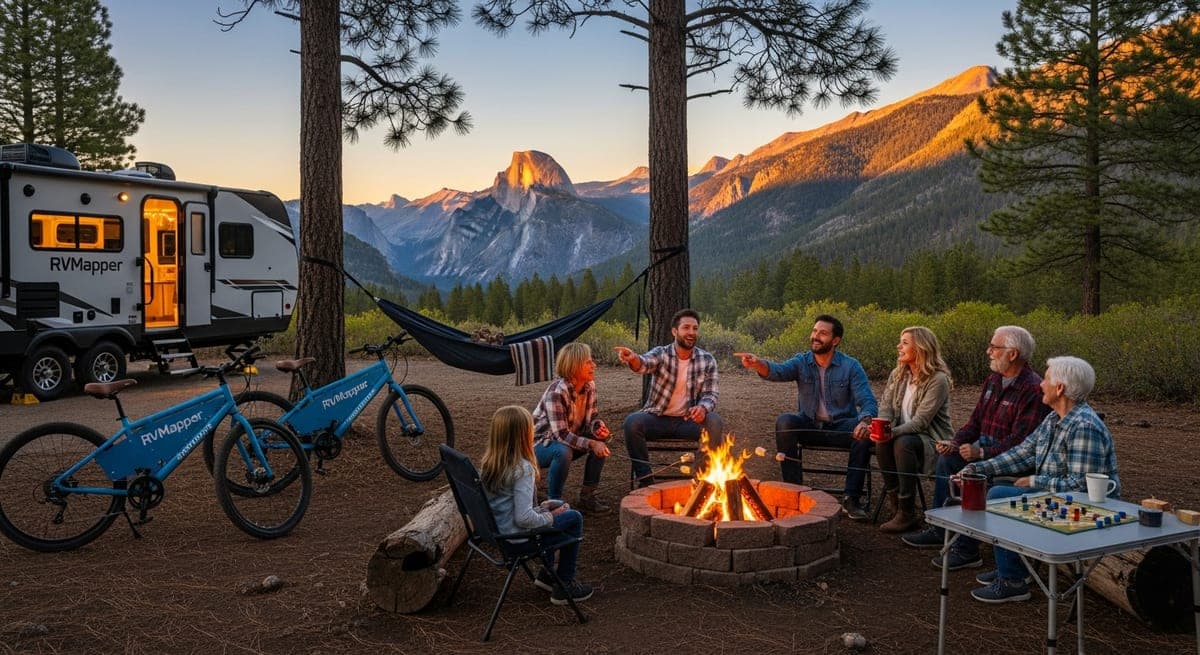
S'mores function as a campfire ritual more than a snack, and multi-generational RV families report that the ritual itself — the process of toasting, assembling, the inevitable marshmallow catching fire — is what grandkids hold onto. The storytelling that happens around the fire often outlasts the s'mores: grandparent accounts of the kid's parents as children are reliably and specifically popular.
Campfire rules vary significantly by campground and season. Many western campgrounds operate under fire bans during dry periods; some allow fire rings only, others prohibit ground fires entirely. Families traveling through the Southwest in summer report using camp stoves as a workable substitute when fire bans are active. Check current fire restrictions at any western campground before arrival — the Recreation.gov listing page and the campground's own ranger station line are both reliable sources.
4. Stargazing
RV families who've reached a genuine dark sky site — far enough from city light pollution to see the Milky Way as a distinct band — consistently describe it as a trip-defining moment for grandkids. Cherry Springs State Park in Pennsylvania is one of the most accessible certified dark sky preserves on the East Coast, with a dedicated astronomical observing field within the campground itself. In the Southwest, the area around McDonald Observatory in Texas's Davis Mountains and the rim campgrounds at Bryce Canyon National Park offer exceptional conditions.
Stellarium is free on all platforms and works well for constellation identification. SkySafari offers a free base version; the editions with detailed planetary features — Saturn's ring detail, Jupiter's moons — run $2.99–$9.99 depending on version and platform. A clear, moonless night is the primary variable. International Space Station passes are trackable in advance at heavens-above.com and provide a specific, time-anchored event grandkids can anticipate and watch for together.
5. Scavenger Hunts
Families who've built scavenger hunts into multi-day RV trips report that it shifts how grandkids move through a place — instead of general looking, there's directed searching with a shared stake in the outcome. A list built around that specific park's species (regional bird species, tree types, animal track shapes, cloud formations) works better than a generic list. Small completion prizes — a national park patch or a regional sticker — are frequently mentioned as motivating without being elaborate.
Audubon Society free bird identification guides and regional wildlife cards (available at many park visitor centers) double as scavenger hunt reference materials. Shenandoah National Park and Olympic National Park sell laminated regional species cards in their visitor centers that families report work particularly well for this purpose. Building the list together with grandkids the night before — asking them what they want to find — is a consistent recommendation from families who've done this across multiple trips.
6. Cooking Together
RV families with older grandkids report that campsite cooking crosses age groups more effectively than most activities. Scrambling eggs on a camp stove or making pancakes carries more novelty outside than the same task at home. Dutch oven cooking — cobblers, chili, cornbread — is a frequently cited multi-generational favorite because the long cook time involves multiple people across the whole process, from prep through checking and stirring.
Campfire cooking is subject to the same fire regulations as any campfire, so knowing the camp-stove version of any recipe is worth the preparation. Families who've done multi-week trips suggest assigning grandkids a specific recurring meal or task each day rather than a one-off — the ownership over a repeated responsibility is part of what distinguishes it in memory from a novelty activity.
7. Kayaking or Canoeing
Calm lake paddling accessible to grandparents and grandkids alike is one of the most consistently reported shared-enjoyment activities in multi-generational RV accounts. Many state park campgrounds offer paddle craft rentals on-site or through adjacent concessions: Myrtle Beach State Park in South Carolina, Itasca State Park in Minnesota, and campgrounds along Lake Tahoe's western shore all have rental operations families report as easy to access without advance logistics.
A relaxed pace on flat water is what the activity requires — families report that one to two hours on the water produces more unstructured conversation than almost any structured activity. Life jackets are required for children in all states; specific age and weight requirements vary, and most campground rental operations provide appropriately sized PFDs as part of the rental. Confirm this when booking rather than assuming.
8. Wildlife Watching
Families who've traveled through Yellowstone, Rocky Mountain National Park, and the Great Smoky Mountains describe wildlife watching as becoming competitive and collaborative simultaneously — who spots the elk first, where the bears were reported this morning at the ranger station, whether the bighorn sheep are on the ridge. At ordinary campgrounds, deer, chipmunks, and bird species become more engaging when there's a shared reference point: a pair of kids' binoculars (under $20) and a regional wildlife identification card give grandkids a specific framework for what they're searching for.
Cades Cove loop road in Great Smoky Mountains National Park is one of the most frequently cited family wildlife-watching destinations — it's driveable at a slow pace, tends to produce deer and black bear sightings particularly in early morning and late afternoon, and keeps everyone in the vehicle together. Note that Cades Cove has vehicle size restrictions; check the park's current guidance before entering with a larger rig, as these have changed seasonally.
9. Map Navigation
Giving older grandkids (roughly 8 and up) a paper park map and a specific navigation responsibility — "tell me when we need to turn for the trailhead" — is a recurring recommendation in multi-generational RV trip accounts. The responsibility is real, not token, and families report that grandkids respond to it differently than to passive role assignments. Marking trail progress on a map, circling campsites, noting wildlife sighting locations — these create a physical record of the trip that the journal entry alone doesn't capture.
Paper park maps are free at every national park entrance station and most state park offices. NPS also makes them available for download in advance on each park's website, which families find useful for a pre-trip orientation session with grandkids — going over where they're headed before the trip builds anticipation in a way that route descriptions alone don't.
10. Journal or Sketchbook
Multi-generational RV families who've encouraged grandkids to keep trip journals report that the journals regularly become significant keepsakes — both for the grandkids and, in several accounts, for grandparents who were later given copies. A small bound notebook or sketchbook at the trip's start, with no requirement beyond "record something each day if you want to," produces a wide range: illustrated trail maps, pressed wildflowers, one-sentence weather observations, detailed bear encounter accounts.
Some families pair a journal with a dedicated SD card for a grandkid's use on a spare device — the combination of written and visual records creates a more complete document of the trip. Families who've tried mandatory daily entries report compliance but no enthusiasm; optional journals, consistently, get used more than expected and at greater depth. Keep the format low-stakes. The entries that seem trivial at the time — "We saw a deer. It just looked at us." — are often the ones people want most twenty years later.
Related: Grandparent RV trip planning guide · RV travel with kids · RV camping with toddlers
From the RVmapper team
Fishing along your route?
Hooked Fisherman publishes fishing reports for all 50 states, species guides, and honest gear reviews. Know what's biting before you park the rig.