
This article contains affiliate links. If you make a purchase through these links, we may earn a small commission at no extra cost to you. Learn more.
Why Leveling Matters More Than You Think
Most absorption refrigerators are designed to operate within roughly 3 degrees of level — and an extended stay parked off-angle can, in some cases, compromise the cooling unit in ways that don't surface until you're 200 miles from home in 95-degree heat. That's the expensive version of skipping setup. The cheap version is just a miserable night's sleep as gravity slowly introduces you to your travel partner.
Beyond comfort and fridge health, leveling affects how your slides extend and retract, whether water drains toward or away from your tank sensors, and the long-term stress on your frame. A practical target: within 1–3 degrees in both directions (side-to-side and front-to-back), though your owner's manual will have the spec for your specific rig. A built-in bubble level or a $20 digital inclinometer gets you there.
When Leveling Gets Harder
Spring is when most new RVers get humbled. Soft ground at sites like Jellystone Park Luray in Virginia or along the outer tent loops at Moab Valley RV Resort means your blocks — and stabilizer jack feet — can sink an inch overnight on grass. Concrete pads solve this; dirt and gravel don't. In wet spring conditions, add rubber stabilizer pads under every jack foot and recheck your level in the morning.
The other tricky scenario is a site that slopes on both axes simultaneously — common in Pacific Northwest campgrounds and Appalachian sites carved into hillsides. You'll end up blocking two wheels and working the tongue jack in an unconventional position. Go slowly, check each axis independently, and don't assume that nailing side-to-side means front-to-back is close.
The Gear That Actually Matters
Leveling blocks (Lynx Levelers, Camco Fasten): Interlocking plastic blocks you drive onto to raise the low-side wheels. The teeth keep them locked together — loose blocks sliding under a moving tire are a real hazard. Stack to the height you need and have a spotter watching. Ten to fourteen blocks is a realistic starting inventory; a deeply sloped site can eat through your stack fast.
Built-in auto-leveling (Lippert OneControl, Power Gear, HWH): Hydraulic or electric systems that handle leveling automatically. Press a button, walk away. They're genuinely convenient, but they need periodic maintenance — hydraulic fluid levels and annual calibration — and they fail in the field more than the brochure suggests. Always carry manual blocks as backup.
Tongue jack (fifth wheel / travel trailer): Your primary front-to-back adjustment for towed units. Most have a built-in level indicator. If yours doesn't, tape a bubble level to a flat interior shelf — same information, zero extra gear.
Digital inclinometer: A $15–$30 gadget that reads exact degrees in both axes simultaneously. Faster and more consistent than eyeballing a bubble, especially when you're chasing a stubborn half-degree. Several free RV leveling apps are available in both app stores; just be consistent about where you place the phone each time or your readings will vary.
Step-by-Step: Towed Units (Travel Trailers and Fifth Wheels)
- Pull into the site and read the slope — use your built-in level or set a digital inclinometer on a flat interior surface before stepping outside
- Place leveling blocks in front of the low-side tires; do side-to-side correction first
- Pull forward onto the blocks slowly with a spotter watching. Add or pull blocks until side-to-side is within spec.
- Chock all wheels on both sides before you unhitch — the tongue jack is not a parking brake
- Unhitch and use the tongue jack to dial in front-to-back level
- Deploy stabilizer jacks last — snug to the ground, not used for lifting
Step-by-Step: Motorhomes
- Pull in slowly and read the slope before committing to a position — you may need to reposition so the low side lands near your hookups
- For side-to-side correction, drive onto leveling blocks or stage the auto-leveling system with the park brake set
- If using auto-leveling: engage the park brake first, then activate the system and let it complete its full cycle before extending any slides
- If leveling manually: extend jacks on the low side first, then the remaining corners, checking level between each adjustment
- Set the park brake and chock the wheels before extending slides — skip this on a sloped site and the RV will try to move when the slide motor engages
- Lower stabilizer pads and snug the rear stabilizer jacks to reduce interior movement
Leveling Jacks vs. Stabilizer Jacks: The Mistake That Bends Things
This is the most common (and most expensive) setup error new RVers make:
Leveling jacks are engineered to support the RV's weight and lift it off its suspension. They stay engaged for the duration of your stay and can handle the load.
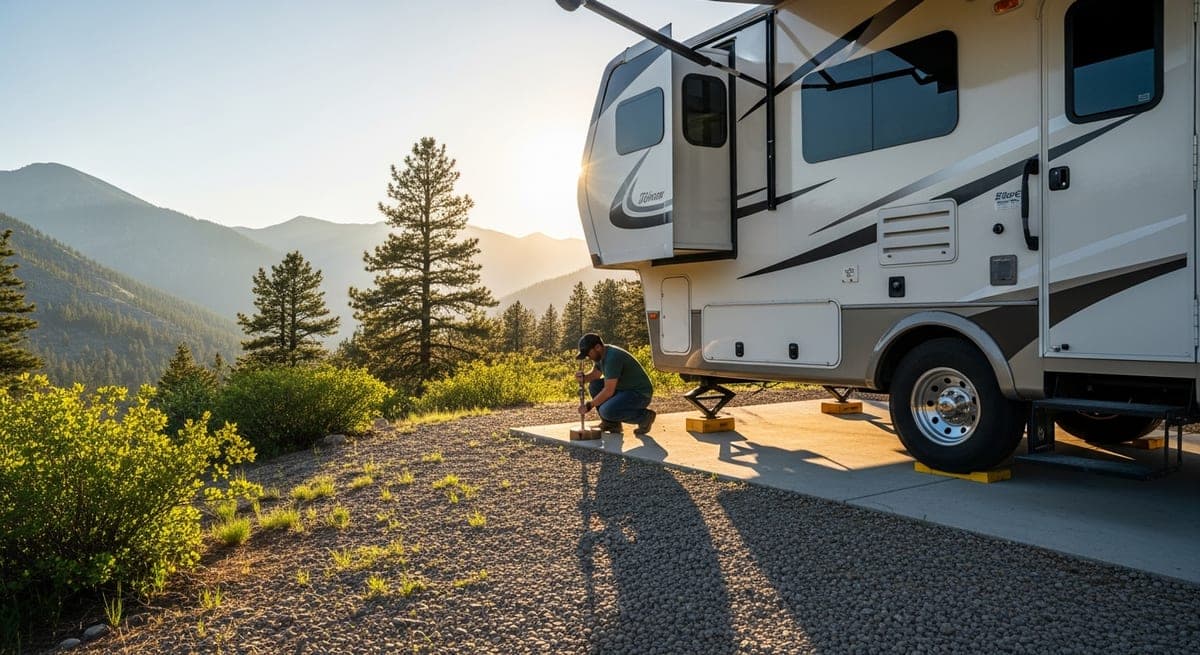
Stabilizer jacks — the scissors-style or X-jacks at the corners of most travel trailers — are not weight-bearing in the same way. They exist to reduce sway and bounce while you're moving around inside. Attempting to level a tilted rig using stabilizers can bend the mechanism, crack the mounting weld, and still leave you with a tilted rig. Level with blocks and the tongue jack first, then bring stabilizer jacks down to firm contact — snug, not cranked hard.
Stabilizer pads: Place a plastic or rubber pad under each stabilizer foot before extending, especially on grass, gravel, or dirt. Without one, the foot sinks slowly overnight and by morning you're rocking again regardless of how well you set up.
Troubleshooting: When Something Goes Wrong
Tongue jack won't extend: Check the fuse first — on most trailers it's a 30-amp blade fuse near the battery compartment. If the fuse is fine, check battery charge; tongue jacks draw significant current and won't run reliably on a weak battery. If power is good and the motor won't engage, find the manual crank override in your owner's manual before you need it in the dark.
Auto-leveling won't complete or throws an error: Most systems have a correction limit — typically around 6–8 degrees. If the site is outside that range, pre-level manually with blocks, then re-engage. On hydraulic systems, also check fluid level; low fluid causes slow, erratic extension behavior.
Still rocking after stabilizers are down: The jack feet likely aren't making full contact — they're resting on a high point and the rest of the pad is airborne. Retract, reposition the pad, and re-extend until contact is solid. Persistent rocking at the rear usually means rear leveling jacks aren't engaged, only stabilizers.
Leveling blocks shifting when you drive onto them: Place a chock or wedge on the downhill side of the stack before pulling forward. A rock, a wheel chock, or a purpose-built curb block all work. Blocks on smooth concrete are more prone to sliding than on gravel — something to watch at full-hookup sites with paved pads.
Related: RV campsite setup guide · First RV trip checklist · RV slide-out maintenance
From the RVmapper team
Fishing along your route?
Hooked Fisherman publishes fishing reports for all 50 states, species guides, and honest gear reviews. Know what's biting before you park the rig.