
This article contains affiliate links. If you make a purchase through these links, we may earn a small commission at no extra cost to you. Learn more.
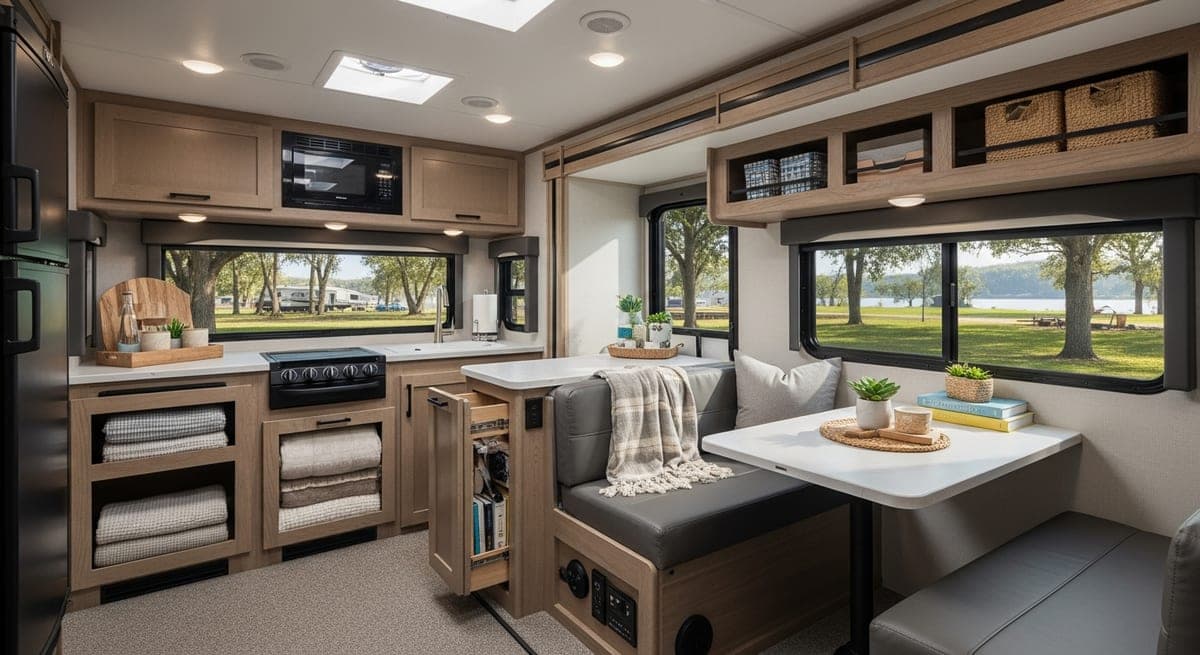
Threads across iRV2 and the Full-Time RV Families Facebook group surface the same pattern: first-timers return from trip one with a shopping list of organizers, while full-timers with 100-plus nights on the road typically own fewer storage products than beginners — because they waited to understand their actual problems before buying solutions. That gap is the whole lesson.
The Trip That Tells You Everything
The community consensus is firm on this point: don't buy a single organizing product before your first real trip. The temptation is strong — RV storage systems look satisfying in photos — but experienced owners report that pre-trip purchases almost universally miss the mark. After one trip, you'll know whether your problem is kitchen cabinet overflow, bathroom shelf chaos, exterior bay disorder, or under-bed clutter. Fix the specific problems you actually encountered.
Full-timers on iRV2 who describe this process say the list of actual pain points almost always surprises them. The kitchen is a near-universal friction point. The exterior bays are a near-universal mess. The bathroom is smaller than expected. But the exact failure mode varies by rig and by family — there's no shortcut past the diagnostic trip.
The Kitchen: What Community Experience Points To
RV forum discussions about kitchen organization reliably converge on a short list of products that hold up and a longer list of things owners wish they hadn't bought. What appears consistently in full-timer recommendations:
Collapsible cookware: The OXO Good Grips collapsible colander appears in more owner packing lists than any other single kitchen item. Silicone collapsible mixing bowls and measuring cups work on the same principle — flat storage versus rigid bulk. The tradeoff owners note: some collapsible silicone bowls feel unstable when full. Full-timers recommend testing before the first trip.
Nesting cookware sets: GSI Outdoors nesting cookware and similar designs from the Ozark Trail and Lodge camping lines appear repeatedly in full-timer gear threads. A 3–5 piece nesting set occupies a fraction of the cabinet space of individual pans that don't stack.
Spice organization: Magnetic spice tins on the side of the refrigerator are the dominant approach in owner discussions. The Kamenstein and SpiceStor magnetic systems are frequently cited; others adapt standard magnetic knife-strip mounting. The consensus: loose bottles migrate and break in transit. Whatever system is used, it needs to secure bottles against movement on the road.
Cabinet door organizers: The inside of RV cabinet doors is almost universally underused. Over-door organizers hold foil, plastic wrap, and small tools without occupying shelf space. Full-timers commonly flag that adhesive mounting systems — including Command-brand strips — can loosen under the heat and vibration of extended travel. Owner reports on RV forums recommend testing adhesion in your specific climate before relying on these for heavier items, and checking periodically after long highway days.
Drawer dividers: The Yamazaki and OXO drawer organizer lines both appear in owner discussions. Without dividers, RV drawers become tangled tool collections after any significant transit.
Exterior Bays and Under-Bed Storage: The Forgotten Cubic Feet
Owner consensus on exterior storage bays: they become cluttered on the first trip and stay that way unless categorical discipline is imposed early. The approach full-timers describe — dedicate each bay to a single category — sounds obvious but requires committing to the assignment before the trip starts. Common assignments in owner threads: outdoor equipment (chairs, folding table, stakes) in one bay; connections (sewer hose, power cord, adapters) in another; tools and maintenance items in a third.
Within each bay, milk crates and open-top bins that slide out completely are preferred over deep containers that require reaching to the back. Bright-colored connectors and velcro cable organizers make identification faster in poor light — several owners specifically recommend Camco's colored sewer hose fittings for exactly this reason.
Under-bed storage gets mentioned less often but is frequently underused. Most RV beds have meaningful storage beneath them. Shallow stackable bins — the Sterilite and IRIS brands appear most often in owner photos — allow access without removing everything stacked on top. Full-timers add one consistent note: label the bins. Unlabeled bins store things you forget you own.
The Bathroom: Minimalism Is the Strategy
The RV bathroom doesn't reward organizing products the way the kitchen does. The community approach is almost universally subtractive — fewer items, not better organization for more items.
What does appear consistently in owner packing lists: a hanging shower organizer that hooks over the showerhead (the iDesign and Zenna Home versions are most cited), and a small magnetic strip inside a medicine cabinet or under-sink door for nail clippers, tweezers, and similar items. Beyond that, the recurring advice is to switch toiletries to travel sizes and treat the bathroom as a space to minimize rather than organize.
One practical note that owners raise about under-sink organizers: RV plumbing routing varies significantly by model. Full-timers recommend measuring actual usable under-sink space before purchasing any organizer — many find the rated capacity is cut substantially by pipe routing specific to their rig.
Clothing on Longer Trips
Clothing storage is where full-timers diverge most sharply from first-timer instincts. The instinct is to bring more and organize it better. The approach that shows up in long-term owner discussions is to bring significantly less and do laundry more often.
Vacuum compression bags — SpaceSaver and Ziploc Space Bags are the two most commonly named brands in owner gear lists — work well for seasonal items: extra blankets, winter coats, gear that doesn't travel on every trip. Full-timers generally report meaningful volume reduction for bulky items, though results vary by fabric type and how thoroughly air is removed.
For clothing actively in rotation, RV closets have a structural problem: they're short, with dead vertical space above a short hang. A hanging fabric organizer with multiple compartments — the Whitmor and Seville Classics models appear in full-timer discussions — addresses this better than adding more hangers.
On laundry frequency: full-timers targeting roughly a week's worth of clothing in rotation plan their travel accordingly, though actual frequency depends on trip type, climate, and rig size. The broader principle owners agree on in forum threads is to think in terms of rotation cycles rather than total clothing volume brought.
The Packing List as a Living System
The permanent packing list is consistently described in full-timer communities as the highest-leverage organization tool in long-term RV travel — more valuable than any storage product — yet it's almost never discussed in beginner resources.
Full-timers who've refined their lists across many trips tend to organize them into three sections: what lives in the rig permanently (bedding, tools, kitchen equipment, connections gear); what comes from home for each specific trip (personal clothing, food, medications, devices); and the trip-specific reminder column built from previous failures — "phone charger for the truck," "park reservation printout," "rain jacket for the kids."
That third column is where the list earns its value. Full-timers on threads in the r/GoRVing community describe the list as a living document that gets edited after every trip — things added when forgotten, things removed when they proved unnecessary. After 10 to 15 trips, owners report that the pre-departure anxiety of "did we forget something" largely disappears. The list becomes institutional memory for the rig.
A practical format that appears in owner discussions: a shared Notes or Google Sheets document organized by physical location in the rig — kitchen, bedroom, exterior bays, cab — so packing can be done compartment by compartment rather than trying to work through every category at once. It takes one afternoon to build and pays back on every subsequent trip.
Related: First RV trip checklist · RV maintenance checklist · RV meal planning guide
Is that campground membership actually worth it?
Plug in your camping nights and typical nightly rate. Our free calculator does the break-even math for Good Sam, Passport America, Thousand Trails, and KOA Rewards.