This article contains affiliate links. If you make a purchase through these links, we may earn a small commission at no extra cost to you. Learn more.
Why Water Is the Boondocking Constraint
Forty gallons sounds like plenty until your partner takes a 10-minute shower and you realize you've burned through a quarter of your tank before noon on day one. At a remote BLM site in the Owens Valley or deep in the Coconino National Forest, that's not just inconvenient — it means a 40-mile drive out before dark to find potable water. With intentional water management, that same 40 gallons can last 5–7 days comfortably. The math changes everything about how long you can stay out.
What Your 40 Gallons Actually Buy You
Knowing where your water goes makes it easier to cut where it counts. A couple in an RV burns through water roughly like this over three days:
- Two showers per person: 8–15 gallons (standard shower head, 5–7 min)
- Handwashing and face washing: 3–5 gallons
- Dishwashing: 4–8 gallons
- Toilet flushing (freshwater): 2–4 gallons
- Cooking and drinking: 2–4 gallons
Showers and dishes are where conservation effort pays off most. Toilet flushing and handwashing come next.
The Navy Shower
A navy shower is the biggest single water-conservation technique for boondocking. The method: wet down (30 seconds), turn water OFF, soap up completely, turn water back ON and rinse (60–90 seconds). This typically uses around 1–2 gallons per shower — versus 6–8 gallons or more for a continuous-flow shower. With two people doing navy showers, you can recover 8–12 gallons per shower day.
A low-flow RV showerhead (1.5 GPM or less) combined with the navy shower method makes both hot water and tank capacity stretch dramatically. Many RVers also pre-rinse hair in a small bowl before stepping in — knocks out the heaviest buildup with a fraction of the water.
Dishwashing Without Waste
The two-basin method works well: one basin with hot soapy water for washing, one with clean rinse water. Wash everything, then rinse in sequence. Total water runs 1–2 gallons versus 4–6 gallons for continuous running-water dishwashing.
A few more moves that add up fast:
- Pre-wipe dishes with a paper towel before washing — removing all food first means your rinse water stays clean longer
- Use a small spray bottle for rinsing rather than running the tap
- Reuse cooking water — water used to cook pasta or vegetables works great for washing dishes before it cools
- Plan one-pot and foil-pack meals during boondocking trips — fewer dishes, dramatically less washing
Toilet Management
Most RV toilets use roughly 1/4–1/2 gallon per flush, though this varies by model. For liquid waste, many boondockers use a brief 1-second flush rather than a full one. For solid waste, a full flush plus a small amount of RV holding tank treatment keeps things under control without needing extra water to compensate for odor.
For committed boondockers, a portable composting toilet (Nature's Head is the most popular) eliminates the fresh water and black tank equation entirely — no water needed, and the compost bin empties easily off-grid.
Tank Monitoring and Top-Offs
Know your tank level: Many RV tank sensors are notoriously inaccurate. A simple workaround: fill the tank, note the reading, and monitor as you use water. Most RVers learn their sensor's quirks within a trip or two and build a reliable mental model from there.
Plan top-offs strategically: A trip to a dump station or water source when you're at 1/3 tank — rather than empty — prevents the stress of running out. On longer boondocking stints, build in a water run every 4–5 days rather than waiting until you're down to nothing.
Water caches and carriers: Five-gallon water jugs ($5–10 each) are the simplest backup. Carry 2–3 filled jugs when venturing into remote areas. A 20-gallon portable water tank ($40–80) provides more capacity when you need it. Water weighs 8.3 lbs/gallon — factor that into your weight budget before loading up.
Gray Tank Management
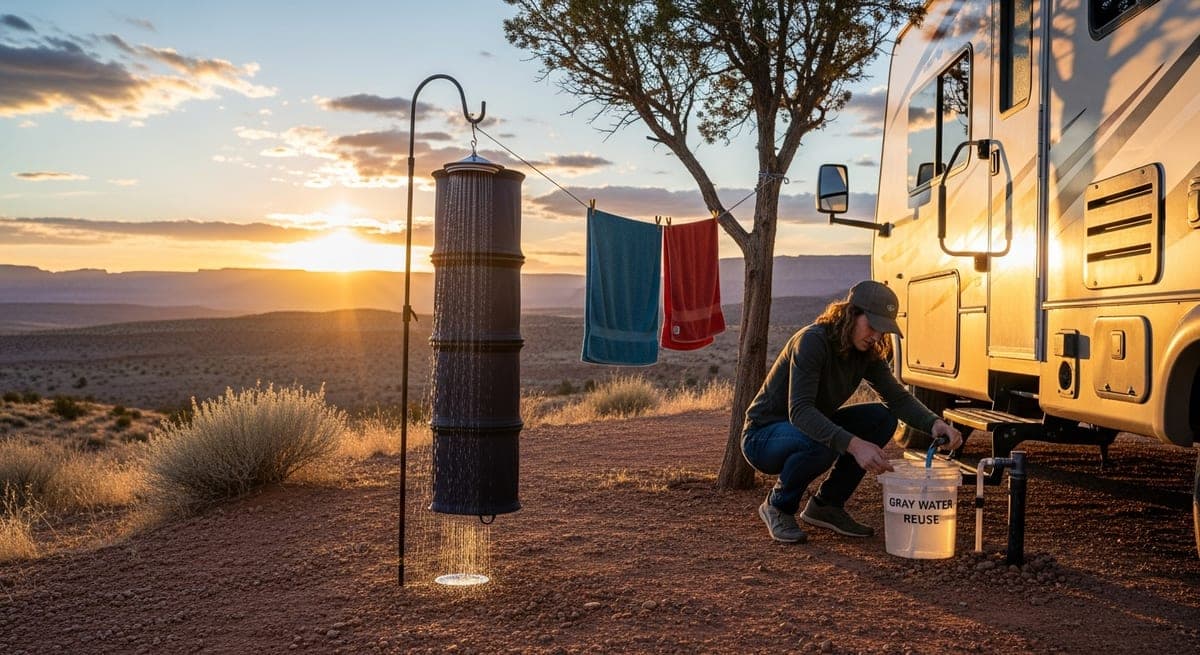
Conservation also means managing gray water. Your gray tank (from sinks and shower) fills at roughly the same rate you consume fresh water. Once it's full, you must dump or stop using water — whichever comes first.
A portable gray water holding tank ($50–100) connects to your drain and holds additional overflow, buying you extra days between dump runs. Some boondockers use a sealed bucket placed under a drain outlet for short stints — not legal to dump on the ground, but it can hold a few extra days of gray water until you reach a dump station.
Related: Boondocking beginner's guide · RV solar system sizing · RV water system guide
From the RVmapper team
Fishing along your route?
Hooked Fisherman publishes fishing reports for all 50 states, species guides, and honest gear reviews. Know what's biting before you park the rig.