
This article contains affiliate links. If you make a purchase through these links, we may earn a small commission at no extra cost to you. Learn more.
A Few Surprises Before You Buy Anything
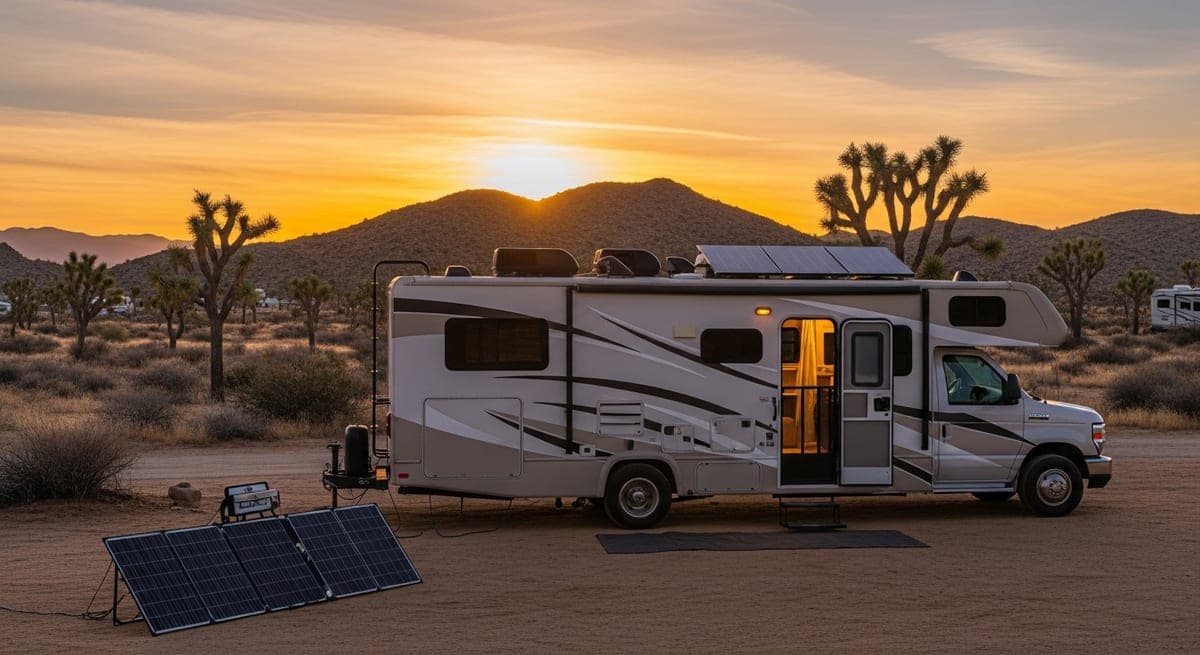
A single 200W panel pointed at a clear Arizona sky in July generates enough power to run LED lights, a roof vent fan, and charge two laptops for a full day. Park that same rig under a pine tree at a dispersed site and you'll pull maybe 60–80W. Shade kills solar output faster than any equipment failure — and it was the first thing I underestimated on my first install, well before I started worrying about battery chemistry or controller specs.
I've put solar on three different rigs over the past six years. The first system was overbuilt in the wrong places and underpowered where it counted. The second taught me what lithium batteries actually change about boondocking. The third — running a residential fridge, a Victron SmartSolar charge controller, and 400Ah of Battleborn batteries in a 2021 Forest River Georgetown — is the one I finally got right. What follows is what I've learned, not a spec sheet.
The Four Components (and Where Installers Cut Corners)
Solar Panels: Convert sunlight to DC electricity, mounted on the roof and rated in watts. A 200W panel in direct, unshaded sun produces around 200 watts of continuous power — not a fixed 200Wh per hour as some product listings loosely imply. Real-world output is typically 70–85% of rated capacity once you account for temperature, roof angle, and shading. Flexible panels are tempting for low-profile rigs but run hotter and degrade faster. Rigid monocrystalline panels from Renogy or Rich Solar are where I'd put the money.
Charge Controller: Regulates power flow from panels to batteries. MPPT (Maximum Power Point Tracking) controllers — the Victron SmartSolar line is what I've used on my last two installs — recover significantly more energy than older PWM controllers, especially on partly cloudy days. For any system over 100W, MPPT is the only choice worth discussing.
Battery Bank: Where your harvested power lives until you need it. Capacity — measured in amp-hours (Ah) or kilowatt-hours (kWh) — determines how long you can run your loads between charges. This is where most people underbuild and then blame their panels.
Inverter: Converts DC battery power to 120V AC for standard appliances. A 2,000W pure sine wave inverter handles most RV loads; modified sine wave units are cheaper but can damage motor loads and sensitive electronics. Don't cut corners here.
Lithium vs. AGM: What the Long-Term Math Shows
I ran AGM batteries for three seasons before switching to Battleborn 100Ah lithium cells, and the numbers made the decision obvious:
| Factor | AGM | Lithium (LiFePO4) |
|---|---|---|
| Usable Capacity | ~50% (don't discharge below 50%) | 80–90% |
| Cycle Life | 200–500 cycles | 2,000–5,000 cycles |
| Weight (100Ah) | ~60 lbs | ~25–30 lbs |
| Cost (100Ah, early 2026 market) | $150–$250 | $600–$1,000 |
| 10-Year Cost Reality | 4–5 replacements = $600–$1,000+ | 1 battery = $600–$1,000 |
The 10-year cost row is what flipped me. I replaced my first AGM bank after two seasons of hard boondocking use. A 100Ah lithium battery gives you roughly the same usable storage as a 200Ah AGM bank — at about half the weight and lower long-term cost if you're using it regularly.
If you're weekend camping at hookup sites twice a month and rarely boondocking, AGM is genuinely fine. But if you're spending weeks at a stretch in places like the BLM land outside Quartzsite, AZ or dispersed sites in the Coconino National Forest, the lithium math closes fast.
Calculating What You Actually Use Each Day
Stop guessing and add it up. A typical RV's daily electrical load breaks down like this:
- LED lights: 10–20W each, 3–5 hours/day = 30–100Wh total
- 12V water pump: 40–60W, intermittent = roughly 10–20Wh/day
- Refrigerator: 30–50Wh/day for propane with electric ignition; 200–400Wh/day for a 12V residential compressor fridge
- Laptop charging: 45–100W, 1–3 hours/day = 45–300Wh/day
- Phone charging: 10–18W, 1–2 hours = 10–36Wh/day
- Roof vent fan (12V): 15–25W, 6–8 hours = 90–200Wh/day
Most rigs running LED lights, a 12V compressor fridge, device charging, and a vent fan land in the 400–700Wh/day range. A 200W panel array in a solid sun location typically generates 800–1,000Wh on a clear summer day — comfortable margin paired with 100–200Ah of lithium. In winter or at northern latitudes (I've run this setup near Bend, OR in November), expect output to drop 30–40% from those summer numbers.
Air conditioning changes the math entirely. A 15,000 BTU rooftop AC typically draws somewhere around 1,400–1,600W under load — a rough estimate that varies considerably by unit age, ambient temperature, and compressor condition. Running it four hours burns somewhere in the neighborhood of 5,600–6,400Wh, which is more than most solar setups generate in a full day. Running AC from solar alone requires large panel arrays (1,200W or more) and substantial battery banks (400Ah+ lithium, minimum). It's achievable, but budget accordingly.
Three System Builds for Three Kinds of Traveler
These ranges reflect market pricing in early 2026 — component costs shift, so get current quotes before committing:
- Entry-level boondocking: 200W panels + 40A MPPT controller + 100Ah AGM = roughly $500–$700. Handles lights, a fan, device charging, and a small 12V fridge. Good starting point before you know your real usage patterns.
- Comfortable off-grid: 400W panels + 40A MPPT (Victron 75/15 or similar) + 200Ah LiFePO4 (Battleborn or Ampere Time) = roughly $1,800–$2,500. The setup I'd recommend for anyone planning more than two weeks per year off-grid.
- Serious boondocker: 800W+ panels + 60A MPPT + 400Ah LiFePO4 + 2,000W pure sine inverter = $4,000–$6,000+. Handles nearly everything short of AC. Close to what I run now, and it's changed how long I stay in one place.
The mistake I see most often: people buy quality panels and a controller, then undersize the battery bank to save money — and wonder why they're running low by 9pm. If you're going to compromise somewhere, compromise on panels. Never on storage.
— The RVMapper editorial team, boondocking and upgrading systems since 2019
Related: RV propane safety guide · RV backup camera guide · RV water system guide
Ready to Plan Your Trip?
Put this knowledge to work. Let our AI build a personalized RV itinerary for your next adventure, or browse community trips for inspiration.