
This article contains affiliate links. If you make a purchase through these links, we may earn a small commission at no extra cost to you. Learn more.
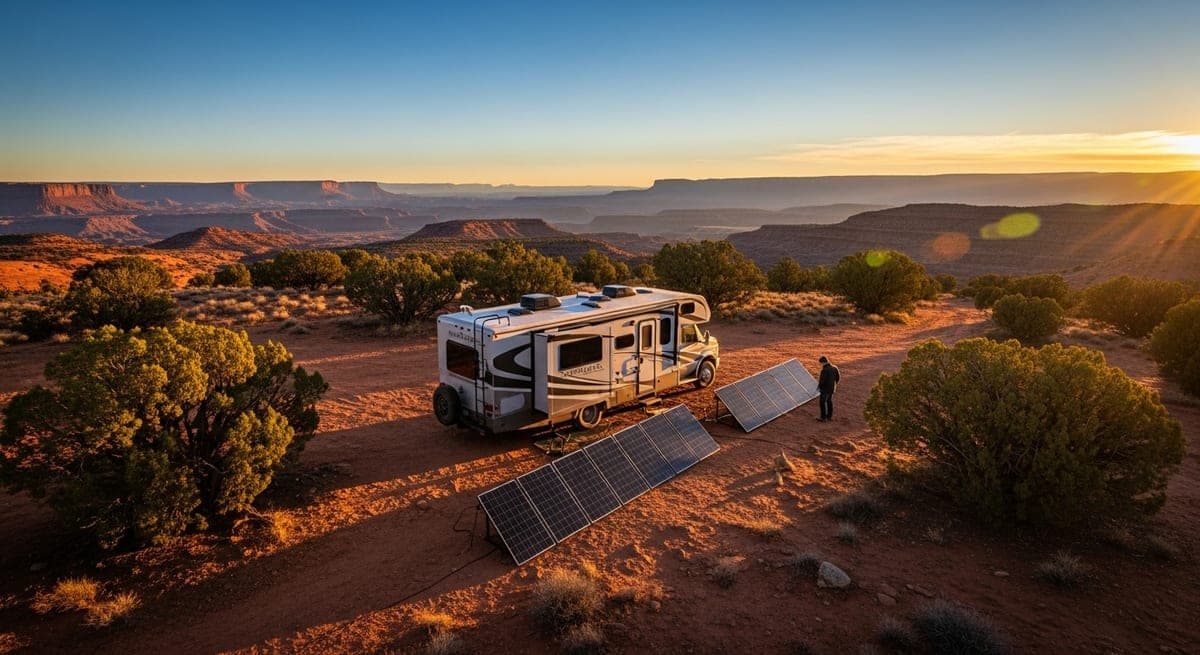
Off-grid camping forums consistently surface the same complaint: an RVer invests in a solar generator rated at 1,000Wh, pairs it with a single 100W panel, and discovers the unit is exhausted by mid-evening. The problem is rarely the hardware itself — it's the mismatch between daily power draw, usable capacity, and the recharge rate the panel can realistically deliver during a six-hour sun window. Pulling from manufacturer specifications, independent capacity tests published by RV content channels, and aggregated feedback from owner communities on Facebook groups and dedicated RV forums, this guide identifies which portable solar generator units consistently meet real-world expectations — and explains the pairing decisions that determine whether your setup actually works.
What separates a capable boondocking generator from an underpowered one
Not all watt-hour ratings translate equally to real-world performance. Owners frequently report that lithium iron phosphate (LiFePO4) units deliver more of their advertised capacity than lithium NMC alternatives, partly because LiFePO4 chemistry tolerates deeper discharge cycles without the same degradation risk. When evaluating a unit for RV boondocking specifically, forum consensus points to four factors that matter most:
- Usable capacity vs. rated capacity: Many units throttle output below 20% state of charge to protect battery chemistry. A 1,000Wh unit may reliably deliver 800–850Wh in practice.
- Continuous inverter output: A 1,000W continuous inverter can run most residential refrigerators (typically 100–200W running, 600–1,200W startup surge) — but a 600W inverter will trip on compressor startup.
- Maximum solar input rate: This determines how fast the unit refills during daylight. A unit accepting 800W solar input refills roughly twice as fast as one capped at 400W.
- AC charging speed: For hybrid setups where shore power or a generator provides occasional top-ups, higher AC input wattage (1,200W+) means meaningfully shorter recharge windows.
The inverter type also matters. Pure sine wave inverters — now standard on every reputable unit in this category — are required for sensitive electronics like CPAP machines, laptops, and compressor-based fridges. Modified sine wave should be a disqualifier for any unit marketed toward RV use.
Top picks under 1 kWh: lightweight and weekend-ready
Units in the 500–999Wh range suit weekend boondockers with modest loads: LED lighting, phone and device charging, a small fan, and occasional laptop use. They are not candidates for running a residential refrigerator overnight or powering air conditioning.
EcoFlow River 2 Pro (768Wh): Owner reports from van and truck camper communities highlight the River 2 Pro's 800W AC charging rate — it refills from near-empty in under an hour via shore power, which distinguishes it from most competitors in the sub-1kWh tier. Solar input is capped at 220W, which pairs cleanly with a single 220W portable panel. Owners note the app integration is functional but not essential to daily use.
Jackery Explorer 1000 v2 (1,070Wh): Jackery's second-generation Explorer 1000 improved on the original with LiFePO4 chemistry — rated for 4,000 cycles to 70% capacity versus the original's roughly 500 — and a higher solar input ceiling of 800W when daisy-chaining panels. Forum reviewers consistently note the carry handle is genuinely comfortable for its weight class, which matters for frequent setup and breakdown.
Bluetti EB70S (716Wh): Feedback from weekend campers consistently describes the EB70S as a reliable entry point — compact, LiFePO4 chemistry, and a 700W inverter that handles most weekend loads without issue. The 200W solar input cap is flagged as a limitation for faster recharging, particularly on overcast days when panel efficiency drops significantly.
The 1–2 kWh tier: the sweet spot for most rigs
Owners of Class B vans, teardrops, and small travel trailers consistently report that the 1–2 kWh tier handles most non-AC loads across a full weekend or several weekdays. A unit in this range — paired correctly with 400–600W of panels — can sustain a 12V compressor refrigerator, LED lighting, device charging, and a CPAP machine without aggressive rationing.
EcoFlow Delta 2 (1,024Wh): The Delta 2 has accumulated extensive feedback across boondocking communities, and the pattern is consistent: owners describe it as the most versatile single-unit solution at its price point. The 500W solar input (expandable to 1,000W via additional accessories) and 1,800W inverter — with an X-Boost mode that briefly handles loads up to 2,200W — make it viable for most travel trailer loads except air conditioning. Multiple owner reports cite the companion app as genuinely useful for monitoring state of charge during daytime solar recharge.
Jackery Explorer 2000 Pro (2,160Wh): Despite the name suggesting the next capacity tier, this unit is commonly purchased as a primary unit for small-to-medium travel trailers. Owners in boondocking Facebook groups frequently describe it as "the unit they wish they'd bought first" after outgrowing smaller options. The 2,400W inverter and 1,400W solar input ceiling are the key differentiators at this price point. Reported complaints cluster around weight (19.5 kg) and proprietary panel connectors that require Jackery's SolarSaga panels or a third-party adapter.
Anker SOLIX C1000 (1,056Wh): Anker's entry into the portable power station market has generated notable owner feedback for its dual AC charging ports and LiFePO4 chemistry at a competitive price. Full-timer forums note that the 1,500W inverter handles most everyday loads reliably, and the 600W solar input ceiling — while not class-leading — is adequate when paired with two quality 200W panels under reasonable sun conditions.
The 2 kWh+ tier: serious power for extended stays
Full-timers, extended-season campers, and owners of larger Class A or Class C rigs who rely on solar as a primary power source consistently migrate toward units in the 2–5 kWh range. These setups can sustain a 12V refrigerator, multiple devices, a CPAP, and occasional high-draw appliances like an Instant Pot or induction cooktop, though air conditioning remains power-hungry enough to require substantial panel arrays even at this capacity tier.
Bluetti AC200MAX (2,048Wh, expandable to 8,192Wh): Owner reports from the full-timer community describe the AC200MAX as a pivot point — capable enough for most non-AC loads as a standalone unit, and expandable enough to scale with changing needs via external battery modules. The 900W solar input ceiling and dual MPPT charge controllers are cited as meaningful advantages over single-MPPT competitors. Owners frequently pair it with two 200W foldable panels from Bluetti or compatible third-party alternatives.
EcoFlow Delta Pro (3,600Wh base, expandable to 25kWh): Among portable solar generator platforms, the Delta Pro has generated more sustained owner feedback than nearly any competitor in this tier. Forum reports describe it as the closest equivalent to a residential battery backup in a portable form factor. The 1,600W solar input ceiling and 3,600W inverter (6,000W surge) handle most RV loads without restriction. Common owner caveats: at 45 kg, "portable" is relative — it requires a hand cart or dedicated bay storage, and multiple owners describe it as a semi-permanent install rather than a grab-and-go unit.
Jackery Explorer 3000 Pro (3,024Wh): Owner reports highlight the 3,000 Pro's 6,000W surge capacity and its 46V solar panel compatibility as practical strengths for off-grid setups where fast recharge windows matter. The LiFePO4 cells are rated for 4,000 cycles, which forum contributors note addresses long-term cost concerns about premature battery replacement at this price point.
Pairing solar panels to your generator: wattage, portability, and compatibility
A common mistake documented across owner communities is purchasing a generator rated for high solar input and then pairing it with panels that can't deliver anywhere near that ceiling. A unit accepting 1,000W of solar input is theoretically impressive, but a single 200W panel under ideal conditions delivers roughly 170–180W of real-world output, meaning five such panels would be needed to approach the generator's maximum. Practical boondocking setups rarely exceed two to three portable panels given space and deployment constraints.
Key pairing considerations owners consistently raise:
- Voltage matching: Most portable generators accept panels in the 12–60V input range. Higher-voltage panels charge faster because resistive losses over cable runs are smaller at higher voltage. Check the generator's MPPT input voltage ceiling before purchasing third-party panels.
- Connector compatibility: Many manufacturers use proprietary connectors. Third-party panels typically ship with MC4 connectors, which require an adapter for proprietary ports. Owner forum reports consistently note that low-quality adapters introduce resistance and measurable efficiency loss — worth spending a few extra dollars on a quality adapter.
- Foldable vs. rigid: Foldable briefcase-style panels (100–200W) are consistently preferred by weekend boondockers who set up and break down regularly. Full-timers who park for extended periods more often migrate to semi-rigid or rollable panels that can be ground-deployed at a fixed optimal angle.
- Real-world derating: Owner forum data consistently shows that portable panels deliver 70–80% of their rated wattage under real conditions — accounting for angle, temperature, partial shading, and atmospheric haze. The practical guideline from experienced boondockers: size your panel array to generate 115–125% of your generator's daily consumption target, not 100%.
What owners report after months of real use
Aggregated feedback from boondocking communities surfaces a consistent set of patterns that rarely appear in manufacturer marketing materials.
Run-time reality checks: Owners frequently note that capacity estimates based on spec sheets are optimistic. Real-world performance depends heavily on inverter efficiency losses (typically 10–15%), ambient temperature (cold weather reduces LiFePO4 output by 10–25% below 32°F), and the actual measured watt draw of appliances versus their labeled maximums — which often differ substantially.
Durability flags: EcoFlow and Jackery both receive consistent long-term durability feedback. Owners describe units surviving three or more years of regular boondocking use without meaningful cell degradation, provided sustained operation in extreme heat (above 95°F ambient) is avoided. Bluetti units in the AC200 line have drawn periodic complaints about display module reliability, though owner forum reports describe the company's warranty service as generally responsive.
Firmware and app reliability: Units with companion app connectivity receive mixed software feedback across brands. Owners who use apps primarily for state-of-charge monitoring report generally satisfactory experiences; owners who rely on scheduling or automation features describe inconsistency between iOS and Android versions and across firmware update cycles.
The upgrade pattern: A recurring observation in boondocking forums is that most owners underestimate their actual power needs on the first purchase. The documented pattern is predictable: start with a sub-1kWh unit, outgrow it within one to two seasons, and step up to the 1–2 kWh tier — or, for full-timers making the commitment, buy directly into the 2 kWh+ range from the start. Owners who purchased in the 1.5–2 kWh range initially report significantly higher long-term satisfaction than those who started with a smaller unit and upgraded under pressure.
Ready to Plan Your Trip?
Put this knowledge to work. Let our AI build a personalized RV itinerary for your next adventure, or browse community trips for inspiration.