
This article contains affiliate links. If you make a purchase through these links, we may earn a small commission at no extra cost to you. Learn more.
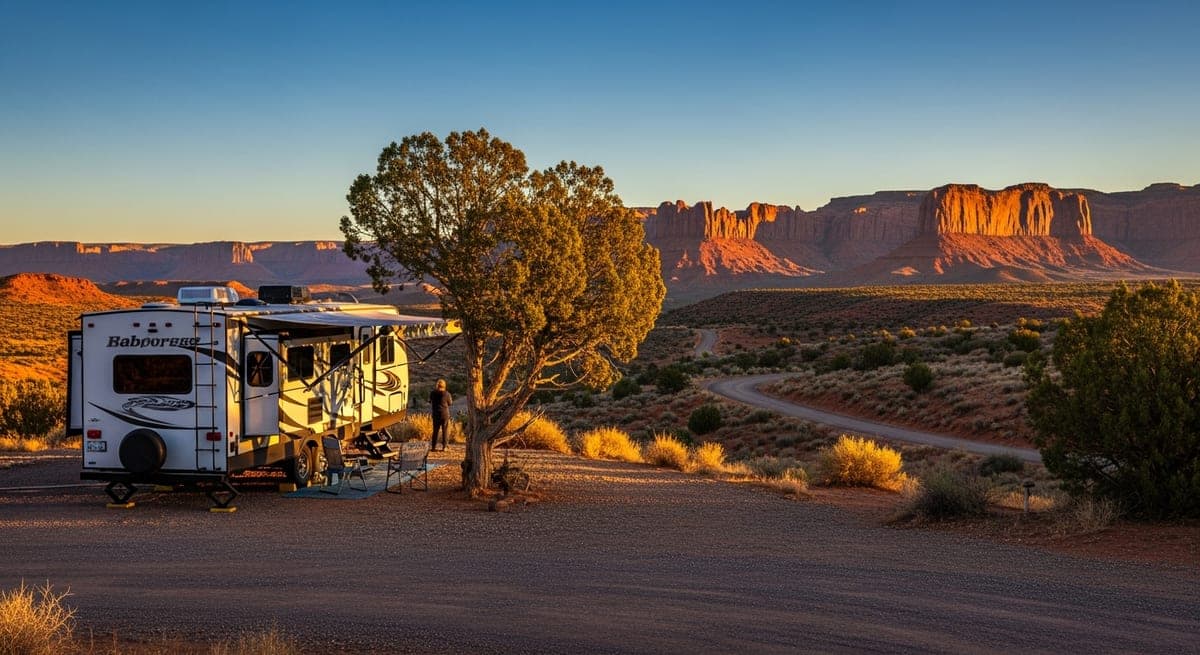
The dream of selling everything and hitting the road full-time is more popular than ever, but the financial reality varies wildly depending on your lifestyle. Some full-timers spend less than $1,500/month while others exceed $5,000. Here's an honest breakdown of every cost, based on real numbers from full-time RVers in 2026.
Campsite Fees: Your Biggest Variable
This is where budgets diverge most. Boondockers who primarily use free BLM land, Walmart lots, and Harvest Hosts spend $0-200/month on campsites. Campground hoppers using state parks and mid-range RV parks typically spend $600-1,200/month. Resort-style full-timers at premium parks with pools, fitness centers, and social activities spend $1,200-2,500/month.
Many full-timers use a hybrid approach: boondock in scenic areas, then pull into a full-hookup park every week or two for laundry, showers, and tank dumps. Monthly rates at RV parks (typically $400-900 depending on region) offer significant savings over nightly rates. Workamping — exchanging part-time labor for a free campsite — is another popular way to slash this cost to zero.
Fuel: $200-800/Month
Fuel costs depend on how much you move. "Slow travelers" who relocate every 2-4 weeks might spend $200-400/month. Active travelers covering 1,000+ miles per month in a Class A getting 8 MPG can easily spend $500-800. At current diesel prices around $3.80/gallon, a fill-up in a typical Class A (100-gallon tank) costs roughly $380. Towable RV owners spend less on fuel but need to factor in the tow vehicle's separate maintenance costs.
Insurance: $150-400/Month
Full-time RV insurance costs more than recreational coverage because it replaces a homeowner's policy. Expect $150-250/month for a mid-range rig with full-timer coverage, liability, and personal belongings protection. High-value diesel pushers can run $300-400/month. You'll also need health insurance ($0-800/month depending on your situation), vehicle registration, and potentially a mail-forwarding service ($15-30/month) for your domicile state.
Food: $400-800/Month
Cooking in your RV saves enormous money compared to restaurants. Budget-conscious full-timers who cook most meals spend $300-500/month per couple. Those who eat out frequently or shop at Whole Foods rather than Walmart will spend $600-1,000. Grocery prices vary significantly by region — stock up when you're in affordable areas. A good Instant Pot and cast iron skillet are worth their weight in gold for RV cooking.
Maintenance & Repairs: $100-400/Month
Budget at least $100-200/month for routine maintenance even if nothing breaks. Oil changes, tire rotations, generator service, and roof inspections add up. Set aside an emergency fund of $2,000-5,000 for unexpected repairs — because on a long enough timeline, everything on an RV breaks. Common expensive repairs include refrigerators ($1,000-3,000), slide-out motors ($500-2,000), and roof leaks ($500-5,000 depending on severity).
Communication: $100-200/Month
Reliable internet is non-negotiable for most full-timers, especially remote workers. A typical setup includes two cell phone plans on different carriers ($60-80 each), a mobile hotspot or Starlink ($120-135/month), and a cell booster ($300-600 one-time cost). Campground WiFi is almost universally terrible — don't count on it for anything beyond checking email.
The Bottom Line
Budget full-timers (boondocking, cooking in, minimal travel): $1,500-2,500/month for a couple. Mid-range full-timers (mixed camping, moderate travel, occasional dining out): $3,000-4,500/month. Comfortable full-timers (resort parks, active travel, regular restaurants): $4,500-6,500/month. These numbers don't include the RV purchase itself or its eventual depreciation. Most financial advisors recommend having no RV payment before going full-time, or at minimum, having a reliable income stream that comfortably covers all expenses plus savings.
Is that campground membership actually worth it?
Plug in your camping nights and typical nightly rate. Our free calculator does the break-even math for Good Sam, Passport America, Thousand Trails, and KOA Rewards.