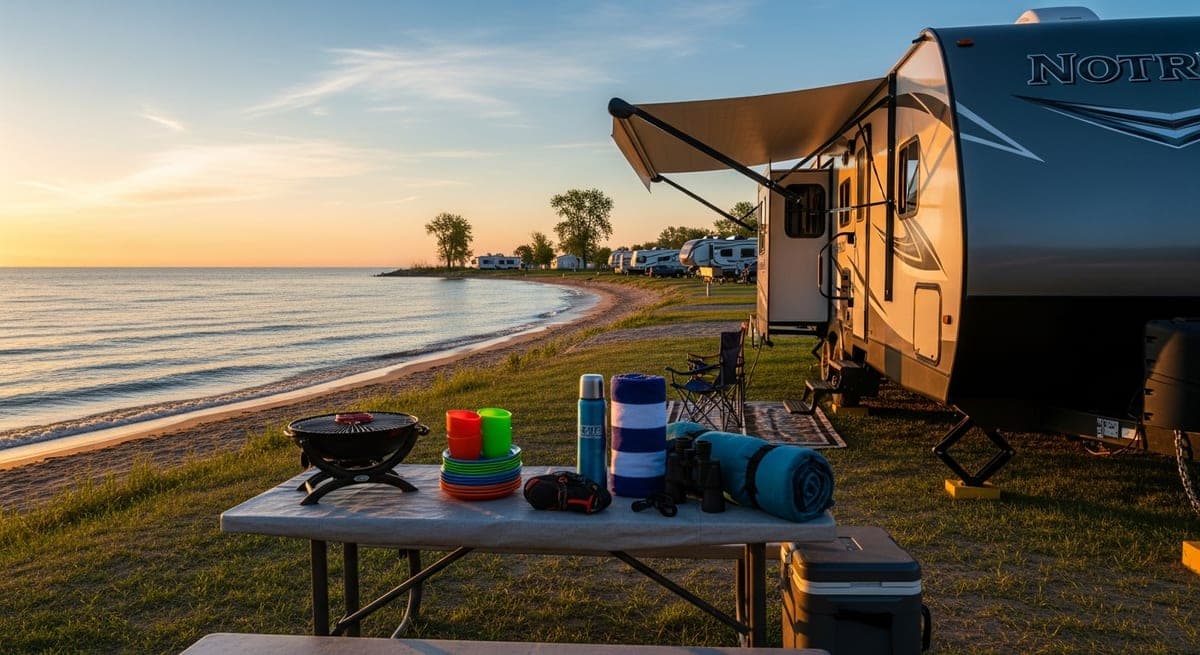
Campers who pull into shoreline sites at Sleeping Bear Dunes National Lakeshore, Kohler-Andrae State Park in Wisconsin, or any of Minnesota's Superior-side campgrounds quickly discover that the gear list they used at an inland reservoir the summer before falls noticeably short. Feedback from full-timers and seasonal Great Lakes campers consistently identifies the same culprits: sustained onshore wind that builds off open water by midday, fine quartz sand that migrates into every hinge and mechanism, ambient humidity that hovers above 70 percent even on sunny afternoons, and the practical reality that the lake is right there, accessible and cold, drawing everyone toward the water multiple times a day.
Why Great Lakes shoreline sites punish gear that handles inland camping just fine
The physical environment at a Great Lakes shoreline site differs from most freshwater campgrounds in ways that affect equipment systematically, not by chance.
Wind persistence. Michigan's Upper and Lower Peninsulas, Wisconsin's Door County coast, and Minnesota's North Shore generate sustained onshore winds that routinely run 15 to 25 mph through midday and evening hours. Full-timers report that pop-up canopies rated for "occasional gusts" fail at Great Lakes sites within a season or two, and that standard awning stakes pull free from sandy soil during afternoon squalls that build quickly off miles of open fetch.
Sand abrasion and infiltration. Great Lakes beach sand is overwhelmingly fine-grained quartz, which behaves differently from the coarser or clay-mixed soils at most campgrounds. Owners consistently describe it infiltrating slide-out seals, door tracks, fan intakes, and generator air filters at rates that surprise first-timers. RV forum discussions document premature slide mechanism wear tied specifically to extended stays on sandy shoreline sites without added protection.
Chronic humidity. Even when daytime temperatures are comfortable, relative humidity near Great Lakes shorelines rarely drops below 65 to 75 percent. Seasonal campers note that gear stored in exterior bays between visits accumulates mildew faster than the same items stored at home or at drier inland campgrounds. Fabric awnings, woven camp chairs, rope, and anything with open-cell foam or unsealed stitching are particularly susceptible over a multi-week stay.
Cold lake temperatures. Lake Superior averages below 50 degrees Fahrenheit even in late summer. Lake Michigan and Lake Huron run warmer but remain cold enough that owners with children report burning through dry towels, wetsuits, and warming layers far faster than they would at a warm-water beach. The cold-water factor reshapes the water-access gear list in ways most general packing guides overlook.
The interaction of these four stressors produces a gear profile that experienced Great Lakes campers refine over multiple seasons and that general-purpose RV packing resources rarely address specifically.
Water and beach access gear that stores efficiently in a standard RV bay
The proximity of the lake is the entire point of a shoreline site, and the gear that enables comfortable water access has to live somewhere on the rig. Storage-bay efficiency matters as much as the gear itself, since Great Lakes state park sites typically offer no storage sheds and minimal ground space beyond the site pad.
- Compact wetsuits or shorty layers. Given Lake Superior's consistently cold water and the variability across Lake Michigan and Lake Huron, full-timers who kayak or swim regularly carry 2 to 3mm shorty wetsuits rather than relying on cold tolerance. Users report that shorties compress small enough to store flat under a wet-bay bench or in a mesh bag, and that children's versions are particularly worthwhile for extending swim time without constant warming breaks.
- High-pressure inflatable standup paddleboards. Hard-shell kayaks and canoes solve the paddling problem but create storage challenges that owners with standard-length bays describe as impractical without a dedicated trailer or truck bed. The consensus among Great Lakes-focused RV groups is that high-pressure inflatable SUPs at 15 PSI or above, in the 10 to 11-foot range, offer the best tradeoff: they pack down to roughly 30 by 12 inches deflated, handle shoreline chop acceptably for recreational use, and work for both adults and older children. Owner feedback across multiple seasons points to double-layer drop-stitch construction as the minimum standard worth buying; single-layer inflatables delaminate faster in Great Lakes conditions.
- A wide-tire beach cart. Sandy shoreline walks of 100 to 400 yards between the campsite and the waterline are common at Great Lakes state parks that include dune or dune-grass buffer zones. Owners with young children consistently cite a balloon-tire beach cart as one of the single highest-value additions for a Great Lakes trip. Standard narrow-wheel utility carts sink in dry dune sand; balloon-tire carts with 10 to 13-inch diameter wheels roll over it without significant effort. Models that fold flat store in a single bay alongside other gear without a dedicated footprint.
- Waterproof dry bags instead of soft coolers at the waterline. Full-timers note that dragging a soft cooler to the shoreline and back creates a mildew problem when humidity is persistent. The approach that appears repeatedly in owner accounts is carrying waterproof roll-top dry bags (20 to 40 liters) for beach-day food, consumables, and electronics, while reserving the soft cooler for the campsite under the awning.
- Spiral sand anchors for beach umbrellas. Standard spike umbrella anchors pull free from Great Lakes sand in wind. Owners describe the spiral sand anchor, a corkscrew stake requiring rotation to set, as significantly more reliable in these conditions. Reports from Wisconsin and Michigan campers indicate that pairing a spiral anchor with a single guy line tied to a nearby post or tree holds a beach umbrella through most afternoon blow without constant repositioning.
Wind and weather protection for exposed lakefront sites
Standard RV awnings and pop-up canopies generate the most persistent wind complaints in Great Lakes camping forums. The failure modes are consistent enough that experienced shoreline campers treat wind management as a standalone gear category with its own preparation checklist.
- Awning tie-down upgrades. Manufacturer awning stakes are designed for typical campground soil and wind loads. Owners at exposed Great Lakes sites recommend at minimum two aftermarket tie-down straps anchored to screw-type ground anchors driven at a 45-degree angle rather than straight down. Several full-timers report doubling the tie-down count after a single squall bent or broke standard hardware. The consistent advice across owner communities when winds exceed forecast: retract the awning entirely rather than trusting upgraded strapping.
- A freestanding canopy with weighted bases. For the campsite dining and cooking area, owners who have tried multiple solutions over several seasons converge on a few principles: steel or heavy aluminum frame over fiberglass, crossbar wind-venting panels that reduce uplift rather than catching full wind load, and sandbag bases in addition to staking. Sandy soil's stake-pull problem is severe enough that staking alone will not hold a canopy in a sustained onshore breeze. Owner reports indicate 6 to 8 pounds per leg via sandbags, combined with stake backup, holds reliably up to roughly 30 mph sustained.
- Open-weave ground mats. Mats that absorb moisture trap sand against the RV's steps and transfer it inside on every entry. The preference pattern in Great Lakes-focused owner groups is for perforated polypropylene or open-weave mats that let fine sand fall through rather than accumulate on the surface. These shake clean and rinse in under a minute, which matters when sand contact is continuous throughout a stay.
- Rain gear at the door, not in a bay. Great Lakes afternoon storms develop faster than most radar apps update. Seasonal campers describe keeping lightweight rain jackets and a compact umbrella hung just inside the entry door rather than packed in storage, to avoid the mid-squall scramble through bays.
Cold-water preparedness beyond the towel pile
The cold-water factor at Great Lakes sites creates a preparedness gap that owners describe as consistently underestimated by first-timers, especially families with children who want to maximize time in the water.
- Warming layers staged at the towel station. Owners at Lake Superior and northern Lake Michigan sites describe staging a hooded fleece or synthetic insulated vest per person at the same point where towels hang outside. This lets swimmers warm up immediately without going back through the RV door, which also eliminates repeated sand-tracking entry cycles.
- Cold-shock awareness and PFD upgrades for paddlers. Owner groups emphasize that even experienced paddlers benefit from a personal flotation device upgrade at Great Lakes sites. Open-water paddling on these lakes is categorically different from calm-lake paddling on smaller bodies of water. Feedback from paddling-focused full-timers points to inflatable PFDs rated for open-water use as the worthwhile upgrade: they stow to a fraction of the volume of foam vests and are worn more consistently because they don't feel bulky during a paddle.
- Waterproof phone cases separate from the main dry bag. Cold water and wind combine to reduce hand dexterity at a point when people are most likely to drop things. Owners report carrying a dedicated waterproof phone case for the beach, kept on the person rather than in a central bag, to keep the phone accessible at the waterline without exposing it to full submersion risk.
Sand and moisture management: the two systems that determine comfort
This final category is less about any single product and more about containment protocols that prevent the two dominant stressors from compounding over a multi-day stay.
- A two-step RV entry protocol. A stiff-bristle boot brush mounted at the bottom step handles dry sand before entry. A small portable foot rinse station, a collapsible 5-gallon container with a spigot and drip tray positioned at the door, handles wet sand and lake residue. Owners report this combination reduces tracked sand dramatically over a multi-day Great Lakes stay compared to a doormat alone.
- A dedicated wet bay. The storage bay that starts a trip organized will be sandy and damp within 24 hours without deliberate setup. Full-timers consistently describe designating a single bay exclusively for beach gear, lined with a removable plastic tray or vinyl-backed mat and equipped with hooks and a collapsible drying rack. This containment approach is cited across multiple owner communities as the most effective way to prevent shoreline conditions from degrading gear stored in adjacent bays.
- Desiccant management in exterior bays. Full-timers who do extended Great Lakes stays report that bay-stored gear, rope, electronics, and cooking supplies degrade measurably faster over a season without moisture control. Rechargeable silica gel packs in exterior bays, combined with a compact 30-pint dehumidifier in the living area during cool overcast stretches when running air conditioning is unnecessary, appear regularly in the gear lists of owners who return to these sites year after year.
The gear list that emerges from aggregated Great Lakes owner experience is not dramatically longer than a standard RV packing list, but the emphasis is sharply different. Wind resistance, sand containment, and humidity management are the three recurring axes that every experienced Great Lakes camper eventually optimizes around, regardless of which lake, which state, or which site configuration they prefer.
Ready to Plan Your Trip?
Put this knowledge to work. Let our AI build a personalized RV itinerary for your next adventure, or browse community trips for inspiration.