
This article contains affiliate links. If you make a purchase through these links, we may earn a small commission at no extra cost to you. Learn more.
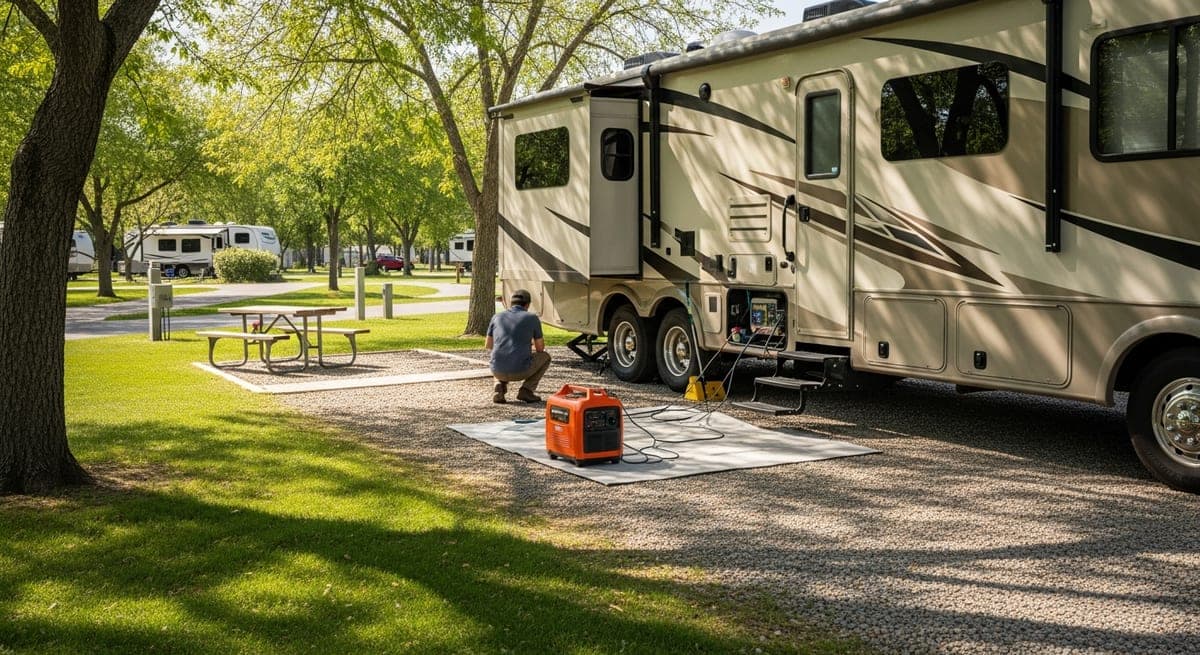
When Your Generator Won't Start at 10pm in August
Picture this: it's mid-August in the Sonoran Desert, 104°F outside, and your generator — the one that's been sitting untouched since last October — refuses to turn over. That's the moment most RVers become religion about maintenance. Don't wait for that moment.
Generator failures follow a predictable pattern: old fuel, skipped oil changes, and the 8-month storage gap between fall and spring. Get ahead of those three things and you'll almost never deal with a generator that won't run when you actually need it.
Onan and Built-In Generator Maintenance (Gas/Diesel)
Most Class A and many Class C motorhomes run Cummins Onan built-in generators — diesel units in pusher coaches, gas units in gas-chassis rigs. Before your first spring trip is the right time to knock this out, and again before winterizing in the fall.
Oil changes: The baseline is every 100 hours of runtime or annually — check your hour meter on the control panel and go by whichever comes first. Oil weight varies by unit, so pull your owner's manual rather than guessing — Onan typically calls for 15W-40 or 5W-30 depending on the model. It's a 30-minute job with a drain pan and the right filter, and it's the single maintenance task that buys you the most reliability.
Air filter: Inspect around the 50-hour mark, replace when it looks dirty (often around 200 hours). A clogged filter shows up as hard starting, weak output, and higher fuel burn — all symptoms that are easy to misread as bigger problems.
Spark plugs (gas units): Plan on replacing them every 150 hours or once a year. Worn plugs mean rough starts and rough running. The plug spec is in your manual — stick to it.
Fuel filter: Swap it annually. Sediment and old fuel residue accumulate here faster than most people expect, and a clogged filter is one of the more common "won't start in spring" culprits.
Coolant (liquid-cooled units): Check the level at the start of every season. Full flush intervals vary by model — most manuals call for every two years or around 500 hours, but always confirm against your specific unit's schedule.
Portable Generator Maintenance (Champion, Honda, Generac)
Fifth wheels and travel trailers typically run air-cooled portables — Honda EU series, Champion, Generac. Smaller displacement means shorter service intervals, and the consequences of skipping them are faster and more punishing than on a built-in.
Oil changes: First change at 20 hours to flush break-in metal particles, then every 50–100 hours depending on brand. Honda recommends 50-hour intervals; Champion's schedule runs to 100. The more important habit: check the oil level before every single use. Small air-cooled engines will consume oil under load, and a low oil shutdown in the middle of nowhere is a frustrating and avoidable situation.
Spark plug: Inspect at 100 hours, replace at 300 hours or annually, whichever lands first.
Air filter: Clean the foam element every 50 hours, replace it around the 200-hour mark or when it won't come clean.
Carburetor: This is where most portable generator problems live, especially after storage. Old ethanol fuel leaves varnish deposits in the jets that block fuel flow — the engine will crank but won't catch, or will start and then die under load. The fix at the end of every season is one of two things: run the generator dry (close the fuel valve, let it run until it starves out, emptying the carb bowl), or add fuel stabilizer and run it for 10 minutes to treat what's in the carb. If you skipped that last fall and you're dealing with the consequences now, carburetor cleaner spray is worth a try — and a full carb cleaning kit runs about $15. Many RVers have saved a generator that seemed dead with nothing more than that.
The Fuel Problem (Most Common Failure)
Ethanol-blended gasoline (E10) is particularly hard on small engines that sit unused. Ethanol pulls moisture from the air, the fuel separates, and the water-ethanol layer settles into the carb bowl where it corrodes jets and deposits varnish. In humid climates, this can happen in as little as 30–60 days.
Option 1 — Fuel stabilizer: Add Sta-Bil, Star Tron, or a comparable product before storage, then run the generator for 5–10 minutes to get the treated fuel into the carb. Most stabilizers protect for 12–24 months.
Option 2 — Run dry: Close the fuel valve with the engine running and let it die from fuel starvation. This empties the carb bowl completely and eliminates the varnish problem at the source.
Option 3 — Non-ethanol fuel: Where you can find it, pure gasoline stores far longer and doesn't phase-separate. The premium per gallon is real, but for the small quantity generators actually consume, it's usually worth it.
Monthly Exercise (Critical During Long Storage)
One habit that pays off every season: run the generator under real load for at least 30 minutes every month it's sitting. Not just idling — actually run your AC unit or a high-draw appliance. Idling alone doesn't exercise the fuel system the same way, and it won't tell you whether the generator can actually carry a load when you need it to.
Built-in units benefit doubly because the generator also trickle-charges the house batteries when it runs. The oil stays conditioned, seals and gaskets stay exercised, and you find out about developing problems in your driveway instead of at a campsite 300 miles from a service center.
The pattern that keeps coming up in campground parking lots: someone pulls in after a long winter storage, fires up the genny for the first time since October, and it runs rough for 20 minutes before smoothing out — or doesn't smooth out at all. A monthly 30-minute run erases most of those problems before they have a chance to set in.
Related: RV electrical hookup guide · RV solar system sizing · RV maintenance checklist
From the RVmapper team
Fishing along your route?
Hooked Fisherman publishes fishing reports for all 50 states, species guides, and honest gear reviews. Know what's biting before you park the rig.