
This article contains affiliate links. If you make a purchase through these links, we may earn a small commission at no extra cost to you. Learn more.
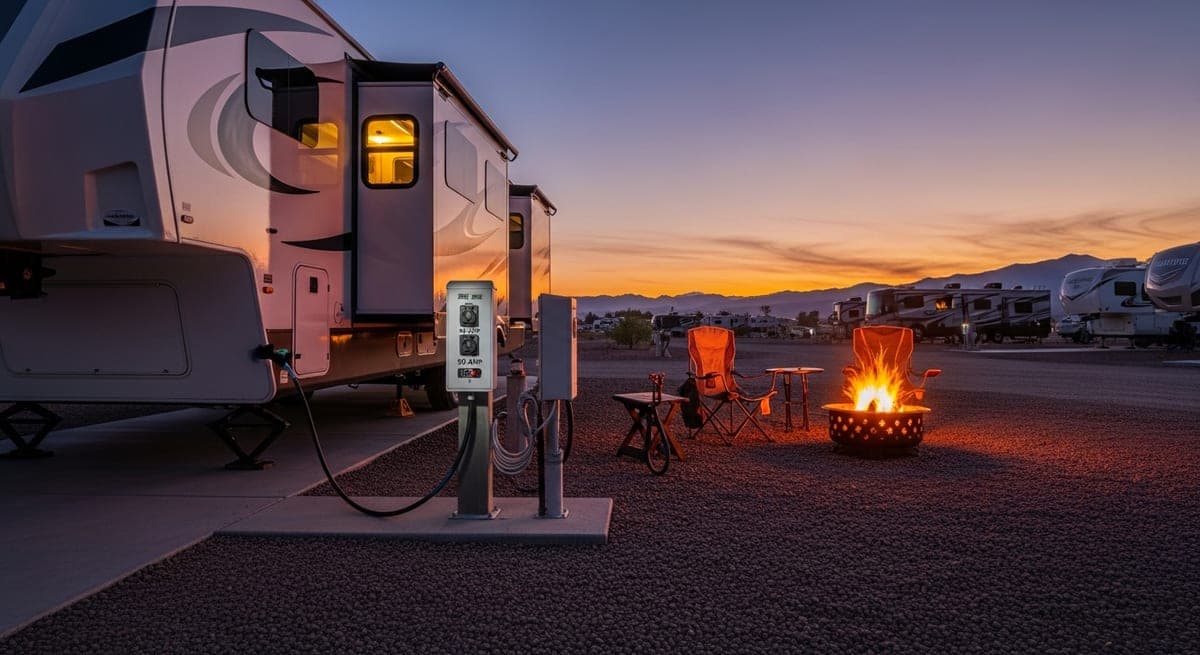
Why Campground Electrical Trips Up New RVers
More RV air conditioner compressors die from low-voltage brownout on a hot July weekend than from any other single cause — and a $300 piece of gear prevents almost all of it. That's the thing about RV electrical: the stakes feel high, the plugs look alien, and nobody explains it clearly at the dealership. But once you understand what's actually happening at that pedestal, campground hookups go from nerve-wracking to routine.
30-Amp vs 50-Amp: The Core Difference
Your RV runs on one of two service ratings, and this shapes every hookup decision you'll make:
30-amp service: Standard on most Class B vans, smaller Class C motorhomes, and travel trailers under 30 feet. A 30-amp RV runs a single 120V line, giving you roughly 3,600 watts to work with. That's enough for one AC plus your fridge, TV, and a few lights — but the moment you fire up a second AC or hair dryer while the microwave's running, you're tripping the breaker. If your RV came with one roof AC, it's almost certainly 30-amp.
50-amp service: Standard on larger Class A motorhomes, fifth wheels, and most travel trailers over 35 feet. A 50-amp RV draws power across two 120V legs, which adds up to roughly 12,000 watts — more than triple the headroom. Running two or three ACs simultaneously in 100-degree Arizona heat? That's what 50-amp is built for. If your rig has dual roof ACs from the factory, it's 50-amp.
The plugs are shaped differently on purpose — a 30-amp cord has 3 prongs, a 50-amp has 4. You can't accidentally plug one into the other without an adapter.
Shore Power Adapters (and Why You Need Both)
Real-world campgrounds don't always have what you need. Texas state parks like Pedernales Falls and Inks Lake mix 30- and 50-amp pedestals freely. KOA campgrounds typically offer both but older sites may only have 30-amp. Thousand Trails network parks are hit-or-miss. You'll need adapters — not eventually, on your second trip.
- 50-amp RV to 30-amp pedestal: Uses what the RV community calls a "dog bone" adapter — named for the shape. The Camco 55155 ($18–22) is the one most full-timers keep on hand. Your 50-amp rig drops to roughly 3,600 watts. Nothing breaks, but you'll need to stagger your AC usage. Don't run both ACs and the microwave simultaneously — you will trip the pedestal breaker and annoy your neighbors.
- 30-amp RV to 50-amp pedestal: Easy. The Camco 55185 30M/50F adapter ($15–20) handles it. Your RV draws only what it needs — no danger of overloading. You get your full 30-amp capacity, which is all your rig can use anyway.
- 30-amp or 50-amp RV to 20-amp household outlet: Possible, but don't expect AC. A standard 20-amp outlet delivers around 2,400 watts — enough to charge batteries, run lights, and power a laptop, but your air conditioner won't start. This is a "better than nothing" option, not a real hookup.
Carry both dog bone adapters in a ziplock bag in your hookup kit. You'll reach for them constantly. The upgrade that actually protects your RV is an Electrical Management System (EMS) — either the Progressive Industries EMS-PT30C/EMS-PT50C ($230–350) or the Hughes Power System HP-50C ($280–400). Both monitor incoming voltage, test for wiring faults, and cut power before damage reaches your RV. I won't connect to a campground pedestal without one.
Pedestal Power Quality: The Real Hazard
Campground electrical infrastructure is often decades old and inconsistently maintained. Three problems show up repeatedly:
- Low voltage (brownout): Peak summer afternoons — every site running two ACs — drag pedestal voltage down to 105V or lower. AC compressors trying to run at low voltage draw excess current and overheat. Nothing kills a July weekend in Sedona like a dead compressor. An EMS monitors this in real time and disconnects before damage occurs.
- Miswired pedestals: Rare, but the consequences are serious. A pedestal with swapped neutral and ground can energize your RV's chassis and create shock hazard in the water around your campsite — a condition called Electric Shock Drowning. An EMS tests for this before power connects. This alone justifies the cost.
- Overloaded circuits: At packed holiday weekend campgrounds, you may find yourself sharing a circuit with several other sites. Watch your voltage meter — if it dips below 108V consistently, consider running your generator instead. Many newer EMS units log voltage history so you can see what happened overnight.
Your RV's Two Electrical Systems
An RV runs two parallel systems that serve completely different purposes:
120V AC system: Powered by shore power, a generator, or an inverter. Runs air conditioners, microwave, hair dryer, standard wall outlets, and the refrigerator in electric mode. Unplug from shore power with no generator running, and this system shuts down entirely (unless you have an inverter).
12V DC system: Powered by your house batteries. Runs LED lighting, water pump, refrigerator in 12V mode, vent fans, slides, and leveling jacks. This system works completely independently — it's what keeps your RV functional when you're boondocking without any hookups.
When you plug into shore power, your converter/charger automatically tops off the house batteries while running the 12V system simultaneously. Disconnect shore power, and the 12V side seamlessly transitions to battery-only. Most RVers never notice the switchover.
Generator Basics
Generators bridge the gap when shore power isn't available. For a 30-amp RV, a 2,000W portable like the Honda EU2200i handles one AC plus modest loads — it's the standard choice for weekend boondockers. A 3,500W model runs an AC more comfortably with headroom for a microwave. For 50-amp rigs with two ACs, you're looking at 5,500W minimum, and built-in chassis-mount generators in larger motorhomes typically run 7,500–10,000W.
Generator maintenance runs on hours, not calendar time. Most manufacturers call for an oil change every 100–150 hours. Check your hour meter — a generator that runs 4 hours a day needs service roughly every month of heavy use, not annually. Neglect this and you'll discover the problem at the worst possible moment, typically a Friday night arrival at a full campground.
Related: RV solar system sizing · Boondocking beginner's guide
Ready to Plan Your Trip?
Put this knowledge to work. Let our AI build a personalized RV itinerary for your next adventure, or browse community trips for inspiration.