
This article contains affiliate links. If you make a purchase through these links, we may earn a small commission at no extra cost to you. Learn more.
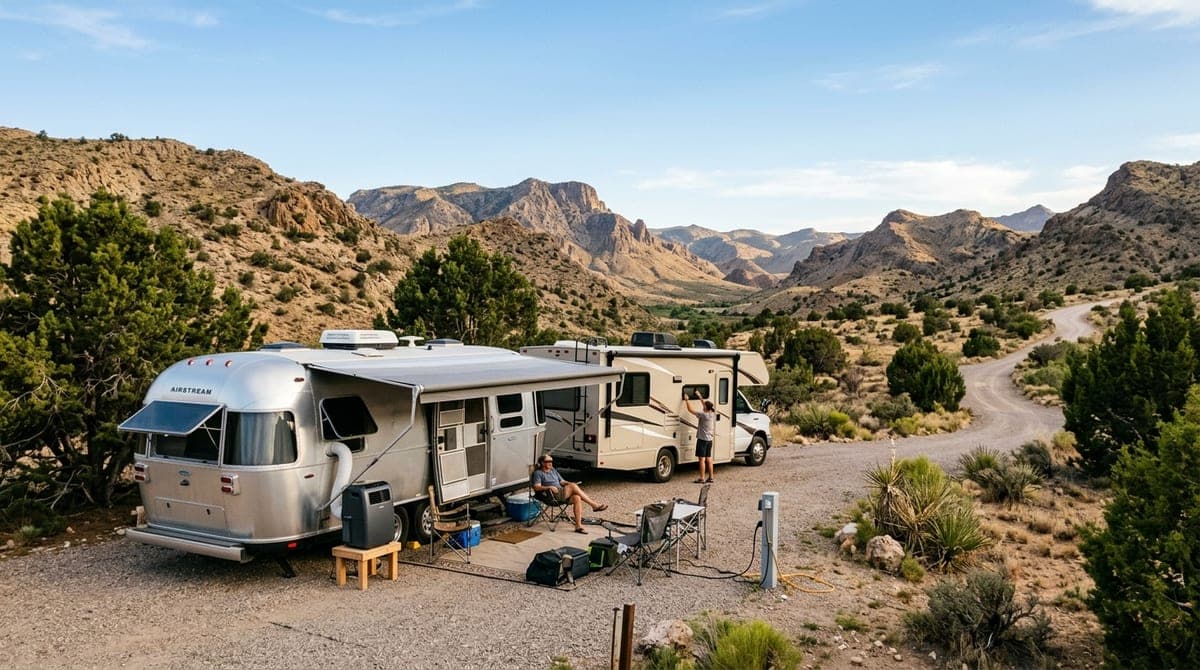
Furnace Creek in Death Valley National Park regularly records July highs near 120°F, and RVers who've parked there through a full summer describe factory rooftop air conditioners struggling by early afternoon no matter how many BTUs the unit is rated for. The same pattern shows up with less drama across the desert around Quartzsite, Arizona, and along the humid stretch from Corpus Christi to the Florida Panhandle, just for different reasons: dry heat in one case, overwhelming humidity in the other.
Owner forums and full-time RV communities describe a consistent seasonal pattern. The factory unit runs constantly, the thermostat never satisfies, and the interior still sits in the low 80s by mid-afternoon. It's a complaint that spikes every June and July as new full-timers hit their first real heat wave. Whether the fix is a portable unit, better airflow, or both depends on rig size, insulation, and which of those two climates a route runs through.
Why factory rooftop units run out of capacity
Several factors compound the problem, and the same short list keeps surfacing in long-term owner discussions:
- Roof heat gain. A parked RV roof runs considerably hotter than the surrounding air in direct sun, and that heat radiates straight into the living space just inches below the AC unit.
- Thin insulation. Most travel trailers and Class C rigs use insulation values well below residential standards, so conditioned air leaks out nearly as fast as the unit can produce it.
- Single-zone limitations. One rooftop unit trying to cool a 30-plus-foot rig with a bedroom slide, a kitchen, and a front cab area struggles to push air evenly, leaving hot pockets even when the thermostat reads comfortable near the unit itself.
- Voltage sag on generators and older campground pedestals. Compressors draw a heavy startup surge, and rigs running on marginal power tend to see units cycling off, tripping breakers, or underperforming their rated capacity.
None of this means factory AC is defective. It was engineered for average conditions, not the extremes that full-timers and desert-route travelers actually encounter.
Snowbird communities that overwinter and then get caught by a late spring around Quartzsite or Yuma, Arizona describe the same moment: the AC that felt fine at the dealer lot in March can't keep up once daytime highs climb past 100°F. Coastal Texas and Florida owners report the opposite trigger, humidity that makes an 88°F afternoon feel unbearable rather than raw heat. Either way, that seasonal mismatch is one of the most common reasons owners start shopping for supplemental cooling in the first place.
Portable AC options that come up most in RV forums
Standalone portable units, the kind that sit on the floor and vent through a window or wall port, show up repeatedly in these threads as the fix for rigs where the rooftop unit can't keep pace. A portable unit needs no roof penetration and can be moved to whichever zone is hottest that day. That flexibility is the main reason it beats a permanent second rooftop AC in most owner comparisons.
Patterns that show up across owner feedback:
- 8,000-10,000 BTU units, compact single- or dual-hose models such as the Honeywell MN10CESWW, are the range most often mentioned for supplementing a single-zone trailer or truck camper bedroom, based on reports from weekend and part-time users.
- 14,000 BTU-and-up units, including dual-hose designs like the Whynter ARC-14S, get mentioned more by full-timers cooling larger fifth wheels or rigs parked long-term in dry desert regions, though those units draw meaningfully more power and take up more floor space.
- Dual-hose designs, the EdgeStar AP14001HS is a commonly cited example, are consistently recommended over single-hose models in owner comparisons, since a single-hose unit pulls replacement air from inside the RV, including hot attic and cabinet air, which owners describe as reducing real-world cooling efficiency.
- Placement near a slide-out or bedroom is a common workaround for uneven cooling from a centrally mounted rooftop unit.
Floor space and noise are the two complaints that surface again and again. A portable unit takes up footprint in living areas that are already tight, and compressor noise at close range is more noticeable than a rooftop unit's hum from overhead.
Some forum threads describe running the portable unit only at night in the bedroom, leaving the rooftop unit and fans to handle the main living area during the day. Portability itself keeps coming up as a selling point too: a single unit can move between a bedroom, a slide-out, or even outside under an awning for shaded shoulder-season use, more flexible than a second rooftop AC tied to one zone.
12V fans and roof vent fans: the supplemental layer
Fans don't lower the actual air temperature, but most setups treat them as a near-essential complement to AC rather than a substitute for it. Circulation and humidity relief are cheap compared to running a compressor harder, and forum advice generally treats fans as the first line of defense before the AC even kicks on.
- 12V fans mounted near the bed, dinette, or cab area are widely reported to run efficiently off battery or solar without pulling from shore power or a generator, making them a go-to for boondockers and dry campers who don't want to run AC off-grid.
- Powered roof vent fans, the reversible kind that can exhaust hot air or pull in cooler night air, get consistent praise in owner discussions for evacuating heat that builds up near the ceiling, especially in rigs with dark-colored or older, less-insulated roofs.
- Running a vent fan on exhaust while a window fan pulls in shaded-side air is a cross-ventilation technique that comes up repeatedly in full-timer advice threads for cooling a parked rig before the AC even kicks on.
- Running a fan alongside AC, rather than AC alone, lets many rigs hold a thermostat setting a few degrees higher without losing comfort, a real power saving when a generator's fuel budget is the limiting factor.
Sequencing shows up again and again in this advice: run vent fans in early morning and evening to exhaust built-up heat and pull in cooler air, then let AC, rooftop, portable, or both, carry the load during peak afternoon heat when outside air offers no relief.
What to check before buying: BTU, amp draw, power compatibility, and noise
Owner regret threads on portable AC purchases trace back to a small number of specs that got overlooked at purchase time. Checking them upfront is the recommendation that comes up most often for anyone shopping this category.
- BTU rating versus square footage. Manufacturer charts typically assume standard residential insulation, so owners consistently report needing to size up from the sea-level BTU recommendation to compensate for an RV's thinner walls and single-pane windows.
- Amp draw at startup, not just running amps, matters more than most buyers expect. A unit's startup surge as the compressor kicks in can run well above its rated running amperage, and owners on a 30-amp electrical system report tripped breakers when that surge stacks on top of a running rooftop AC, water heater, or microwave.
- Generator compatibility and starting wattage. Portable units with a hard-start compressor draw a large inrush current that many smaller inverter generators can't handle without a soft-start add-on, a gap owners frequently discover only after a unit won't start on generator power in the field. Checking a generator's surge rating against the AC's starting-watts figure on the spec sheet, not just its running-watts number, is the check owners recommend most.
- Shore power amperage. 30-amp rigs, wired to the same 30-amp RV pedestal standard used across most public campgrounds, have less headroom than 50-amp rigs for running a portable AC alongside existing appliances, so confirming what else draws power on the same circuit before adding a unit is standard advice.
- Noise level in decibels. Because portable units sit at floor level in the living space rather than overhead, owners describe the noise as more intrusive than rooftop AC at the same rated volume, worth checking the manufacturer's decibel spec against reviews from owners who've actually run the unit indoors.
- Drainage and condensate handling. Long-term users flag condensate drainage as an underrated annoyance. Some units need manual bucket-emptying, while others offer a hose-out option worth seeking out for extended stays.
Matching a cooling setup to RV size, insulation, and climate
The right supplemental cooling combination looks different depending on rig size, insulation quality, and whether the climate is dry desert heat or humid coastal heat. Owner feedback is fairly consistent on how those variables change the recommendation.
- Small rigs (truck campers, teardrops, Class B vans) generally do well with a single 12V fan plus a compact 8,000 BTU portable unit or upgraded roof vent fan, since the enclosed volume is small enough that a modest unit keeps pace.
- Mid-size travel trailers and Class C rigs more often need a portable unit in the 10,000-12,000 BTU range paired with the factory rooftop AC running simultaneously, with owners in hot climates like central Texas or the Mississippi Gulf Coast describing the rooftop unit as no longer sufficient on its own by mid-summer.
- Large fifth wheels and multi-slide rigs show up most often in threads recommending a second AC source entirely, either a bedroom-zoned portable unit or a second rooftop unit, since a single unit rarely reaches every zone evenly in a floor plan over 35 feet.
- Desert and dry-heat regions such as the Mojave Desert around Quartzsite and Yuma, the high desert near Bishop, California, and the high plains of eastern Colorado favor units and setups that emphasize raw cooling capacity, since low humidity means evaporative accessories and fans do comparatively more work. Some full-timers in these regions report supplementing with a small evaporative cooler alongside AC, since dry air makes evaporative cooling genuinely effective there.
- Humid regions, the Mississippi and Alabama Gulf Coast, the Carolina Lowcountry, and Chesapeake Bay summers among them, get different advice: dehumidification capacity and dual-hose portable units matter more than sheer BTU count, since humid heat feels worse at the same temperature and evaporative add-ons do little in that environment.
- Insulation quality matters as much as square footage. Owners of older or budget-built rigs report needing more supplemental cooling capacity than the floor plan alone would suggest, while owners of four-season or higher-insulation models report getting by with lighter setups even in similar climates.
Size, insulation, and climate are the three variables that show up most consistently across owner recommendations, more so than any single "best" unit. A well-insulated Class B parked near Bishop, California in dry summer heat needs a very different setup than an older, uninsulated travel trailer parked on the Alabama Gulf Coast in August, and that mismatch is the most common reason a supplemental AC purchase disappoints.
From the RVmapper team
Fishing along your route?
Hooked Fisherman publishes fishing reports for all 50 states, species guides, and honest gear reviews. Know what's biting before you park the rig.