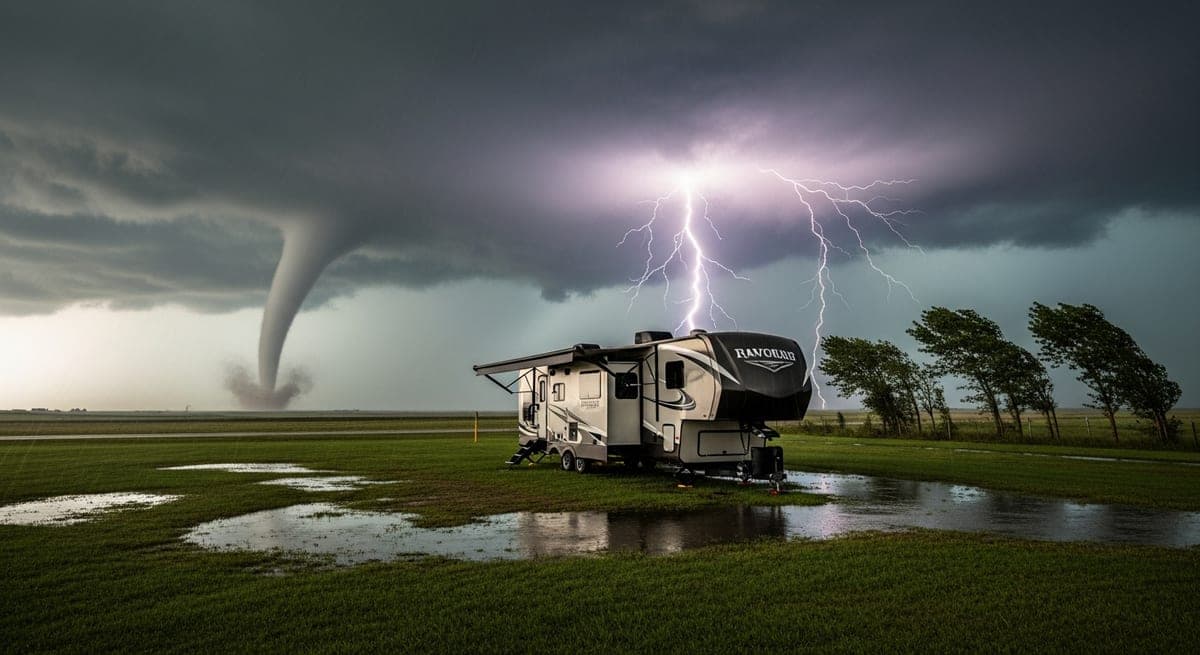
RVers who camp regularly in Tornado Alley (Kansas, Oklahoma, Nebraska, Texas, Missouri) share a consistent first move when a tornado watch is issued: they scout the campground bathhouse location before they even unhitch. The rig offers almost no protection from tornado-force winds, and experienced RVers in those regions treat the permanent restroom building the same way a hotel guest treats the fire exit map.
What the RV Won't Protect You From
Owner forums and full-timer communities are unusually candid about this: a recreational vehicle is not a safe structure in severe weather. The community's consistent position is that tornado and flash flood scenarios require leaving the rig and finding a substantial structure. The rig's protective value is primarily limited to lightning and high-wind events, and even those come with real conditions attached.
Tornado Country: What Experienced RVers Do First
Full-timers who spend seasons in tornado-prone states describe a consistent protocol when a tornado warning is issued for their area.
Ask about shelter at check-in: Full-timer communities across Oklahoma and Kansas, where tornado watches are a regular occurrence from April through June, describe the same habit: ask campground staff at check-in where the tornado shelter or permanent restroom building is located. RVers at Turner Falls Park in Davis, OK report that staff there proactively direct campers to the concrete bathhouse during storm season. Block-construction bathhouses and permanent restroom facilities are the de facto community shelters at most campgrounds in tornado country, and staff at well-run parks expect the question.
If no building is available: The fallback described consistently across RV forums and full-timer blogs is a low-lying area away from trees. A culvert or road ditch that sits below the surrounding terrain offers more protection than staying in the rig. A hard-sided vehicle with seatbelts, positioned below the level of surrounding terrain, is the last-resort option when no structure exists within reach.
Technology full-timers rely on: NOAA's official weather app and Wireless Emergency Alerts (WEA) are the tools most consistently mentioned in RV community discussions about storm preparedness. WEA sounds your phone even on silent, and experienced RVers in storm country describe disabling those alerts as a serious mistake.
The Flash Flood Problem Nobody Talks About Enough
NOAA consistently identifies flash floods as among the deadliest weather hazards in the United States, placing flood-related fatalities at or near the top of its annual weather death summaries for more than a decade of published records. RVers face particular exposure because campgrounds are disproportionately sited near rivers and streams, which are both the most scenic locations and the most flood-vulnerable.
The hazard that full-timers who camp near water emphasize most: flash floods arrive from storms you cannot see. An afternoon thunderstorm 15 to 20 miles upstream in the mountains above Moab, UT, or along the drainages feeding the Poudre River corridor near Fort Collins, CO, can send a surge downstream to a campsite where the local sky is still partly clear. Experienced RVers along the Colorado River corridor consistently note that clear skies overhead are not a safety signal when upstream terrain is out of view.
How fast water rises: In narrow canyon drainages and slot canyons, water can rise with very little warning. Antelope Canyon near Page, AZ, saw a fatal flash flood in 1997 that killed 11 people in a slot canyon with clear skies at the entrance. In open-terrain campgrounds the rise is less extreme but still faster than most people expect. The principle experienced RVers act on: once water is rising visibly and rapidly, the window to move is shorter than it feels.
The elevation check before unhooking: The consensus among full-timers who camp near rivers is to assess the vertical distance between the campsite and the waterway before unhooking the rig. NWS flash flood watches should prompt moving to higher ground proactively. By the time a warning is issued, the flood may already be in motion.
If flooding begins: Move to high ground immediately. NWS guidance, widely circulated in RV safety resources, notes that as little as 6 inches of fast-moving water can knock a person off their feet and 12 to 18 inches can carry away a vehicle. Driving the rig through flowing water is a risk that experienced RVers describe as almost never worth taking.
Lightning in an RV: Safer Than a Tent, With Real Limits
The RV community broadly agrees that a hard-sided RV offers more protection from lightning than a tent, primarily because the metal exterior can help disperse some electrical charge. That said, RV frames are not constructed as true grounding systems and do not provide the protection of a properly grounded building. Manufacturer materials and RV safety resources consistently hedge this point: some protection is real, but the rig is not a substitute for a grounded structure during a severe electrical storm.
The practices experienced RVers consistently follow during an active lightning storm:
- Stay inside the RV and away from windows and exterior walls
- Avoid contact with metal surfaces, plumbing fixtures, and the stove
- Unplug corded electronics, as a surge through a power hookup is a real risk at an electrified campsite
- Do not shelter under trees, which can conduct a strike to the ground around you
- If caught outside when lightning is close, return to the RV or a hard-sided vehicle immediately; open-sided shelters like picnic pavilions are not protection
High Winds and the Physics of a Big Rig
High winds present a different risk profile than acute weather events. Sustained winds of 40 mph or gusts above 55 mph are the thresholds RV communities cite most often, but the real concern varies by rig size, profile height, and terrain exposure.
- Awning thresholds: Manufacturer wind ratings vary by awning model, but owner experience across RV forums consistently points to retraction well before conditions get serious. Most owners describe anything above 20 to 25 mph as a meaningful risk for damage or loss, depending on the specific awning. If weather is approaching and the awning is out, get it in before the front arrives.
- Stabilizer jacks: Lowering stabilizer jacks reduces rocking in moderate wind. Full-timers are direct about the limits: jacks do not prevent a rig from tipping in truly extreme conditions and should not be treated as an anchor against severe weather.
- Orientation matters: Where site layout allows, parking with the front or rear of the rig facing the expected wind direction reduces the broadside profile. RVers who camp frequently in open terrain across Wyoming or the Texas Panhandle describe this as a habit that develops quickly after one rough night.
- Outdoor gear becomes projectiles: Community post-storm reports consistently document chairs, rugs, outdoor kitchen setups, and decorations as the first things lost in high wind. Stow everything before a front arrives, not after it starts.
- High-profile driving: Tall rigs, particularly Class A motorhomes and fifth wheels over 13 feet, are well-documented in RV communities as susceptible to crosswind instability on open highway. The I-80 corridor through Wyoming, the Texas Panhandle on I-40, and exposed stretches of US-50 across Nevada are among the routes RVers most frequently cite for serious wind events. NOAA and state DOTs issue corridor-specific wind advisories, and checking those before departure is a practice full-timers treat as routine.
The Weather Habits of Full-Timers
RVers who live on the road year-round develop systematic weather-checking routines that part-time campers often skip. The pattern described consistently across full-timer communities before each travel day:
- Check weather for the full route, including counties between origin and destination, not just the endpoints
- Look up any active NWS watches or warnings for counties on the route
- Check destination campground weather for the next 48 hours, not just the arrival day
Weather.gov is the source full-timers cite most often. The NWS Forecast Discussion, available for any location on weather.gov, shows the meteorologist's actual reasoning rather than just icon summaries. Experienced RVers describe it as the tool that helps judge whether a borderline forecast warrants changing plans before unhitching at the destination.
Related: First RV trip checklist · Winter RV camping guide · RV campground etiquette
From the RVmapper team
Fishing along your route?
Hooked Fisherman publishes fishing reports for all 50 states, species guides, and honest gear reviews. Know what's biting before you park the rig.