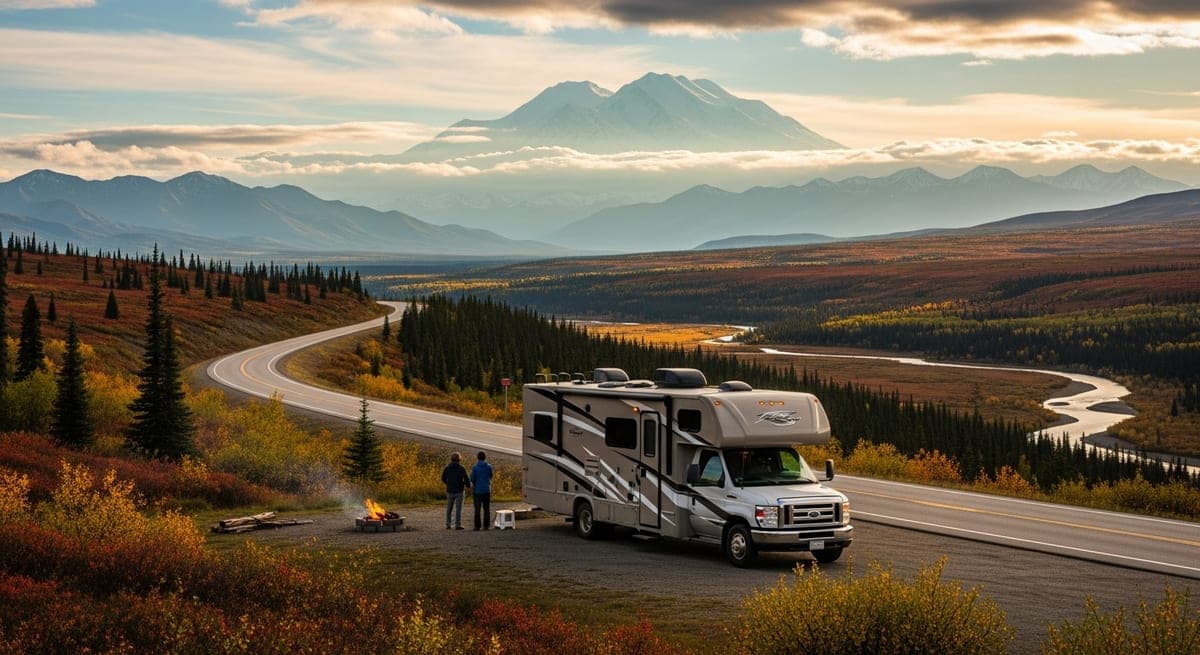
Alaska is the one RV trip that changes how you think about RV travel. 3 million acres of wilderness accessible by road. Denali rising 20,310 feet on a clear day visible from 100 miles away. Grizzly bears fishing salmon out of a river 50 feet from the road. Midnight sun in June. The Alaska Marine Highway System connecting coastal towns with no road access at all. There's nothing else like it in North America — and the logistics are unlike anything else you've planned.
This guide covers the two ways to get to Alaska with your RV, the main routes, the essential campgrounds, and what to realistically plan for in terms of timeline, cost, and conditions.
Getting to Alaska: Drive or Ferry?
There are only two ways to get an RV to Alaska: drive through Canada on the Alaska-Canadian Highway (Alcan), or take the Alaska Marine Highway System ferry from Bellingham, Washington. Both have real advantages and real trade-offs.
The Alcan Highway (driving): The Alaska Highway runs from Dawson Creek, British Columbia (Mile 0) to Delta Junction, Alaska — 1,387 miles of highway through British Columbia, Yukon Territory, and Alaska. The full drive from Seattle to Anchorage via the Alcan is approximately 2,300 miles (3 days minimum driving, 7–10 days if you stop at anything). The highway is fully paved but sections are rough — frost heaves, gravel shoulders, and road construction are constant features, especially in spring. Carry two spare tires. The Alcan is an experience in itself: Stone Mountain Provincial Park, Muncho Lake, Liard Hot Springs, Kluane National Park. For most RVers, driving the Alcan is a bucket-list segment, not just transit.
Alaska Marine Highway (ferry): The AMH ferry from Bellingham, WA sails the Inside Passage to Skagway or Haines (with stops at Ketchikan, Wrangell, Petersburg, Juneau, and other Inside Passage communities). One-way sailing time is approximately 3–4 days. You park your RV on the vehicle deck and sleep in a cabin or on deck. It's a spectacular route through fjords, glaciers, and rainforest coastline inaccessible by road. Cost is significant — vehicle + cabin passage for an RV can run $1,500–$3,000+ one-way. The trade-off: you arrive in Skagway or Haines and drive the Klondike Highway or Haines Highway to connect to the Alaska Highway system, seeing some of the most dramatic mountain scenery in North America. Many RVers drive the Alcan one-way and take the ferry the other, getting the best of both routes.
The Parks Highway and Denali
The George Parks Highway (AK-3) runs from Anchorage north 237 miles to Fairbanks, passing within 45 miles of Denali's summit. The section between Wasilla and Denali National Park is the most dramatic highway drive in Alaska and arguably in North America — when the mountain is out (it's socked in cloud roughly 70% of the time), you can see it from 100 miles away rising above the horizon like a continent. Clear days in late May and early September produce the most frequent summit views.
Denali National Park: Denali NP has one road — the 92-mile Park Road — and private vehicles are only allowed on the first 15 miles to Savage River. Beyond Savage River, access is by park bus only. This is an important planning note for RVers: you drive your rig to the park, camp at Riley Creek Campground or Savage River Campground, and take the park bus for wildlife viewing. This is the only way to see the heart of the park.
Riley Creek Campground (near the park entrance, accepts RVs up to 40 feet, no hookups but a dump station and potable water on-site) is the largest and most accessible campground. No campground inside Denali has electric or water hookups, so plan to run self-contained. Book through recreation.gov 6 months in advance — Denali NP campgrounds fill nearly as fast as Yellowstone for summer dates. Teklanika River Campground (29 miles in on the Park Road, requires a 3-night minimum stay) is accessible to RVs and puts you much deeper into the park with wildlife activity all around. This is the one Denali campsite most visitors never know about — it's worth planning your entire trip around.
Essential Alaska Campgrounds
Tok RV Village (Tok, AK): The first significant stop after entering Alaska on the Alcan. Full hookups, clean facilities, and a legitimate welcome to Alaska. After days of rustic Yukon campgrounds, it feels like civilization.
Liard Hot Springs Provincial Campground (BC, Canada): En route on the Alcan. The natural hot springs at Liard are the best roadside attraction on the entire Alcan route. Camp here, soak in the hot springs at midnight under the Northern Lights (in fall), and take a day before pushing on.
Kluane National Park (Yukon): Spectacular glacier country. Congdon Creek Campground on Kluane Lake is one of the most scenic campgrounds in the world — a turquoise glacial lake ringed by the St. Elias Mountains. This is the highest coastal mountain range on Earth and it's immediately off the highway.
Kenai Peninsula: South of Anchorage, the Kenai Peninsula is Alaska's recreational playground. Sterling Campground (Kenai National Wildlife Refuge) and Cooper Landing area campgrounds provide access to the world-class Kenai River salmon fishing and Resurrection Pass trail system. If you have time for only one area beyond Denali, the Kenai Peninsula is the choice.
Chena Hot Springs (near Fairbanks): A 57-mile road north of Fairbanks leads to Chena Hot Springs Resort with RV hookup sites and hot spring pools. In fall and winter, it's the best Northern Lights viewing base in Alaska accessible by road.
Timeline and Season
Season: The practical Alaska RV season is late May through early September. Before late May, roads into Denali's interior may still have seasonal closures and many campgrounds aren't open. After early September, temperatures drop fast, some facilities close, and snowfall is possible at any elevation. The sweet spot: mid-June through late August for maximum access and wildlife activity.
Minimum trip length: A meaningful Alaska RV trip requires at least 3 weeks for most people driving from the Pacific Northwest. If you fly to Anchorage and rent an RV (rentals are available from several Anchorage outfitters), 10–14 days covers the Anchorage–Denali–Fairbanks–Kenai circuit well.
What to budget: Alaska is expensive. Campsite fees, fuel (prices are higher than the lower 48), food, and ferry passage (if used) add up. Budget $150–$250/day for a couple, not counting major planned activities like fishing charters or flightseeing. A 3-week Alaska RV trip from Seattle driving both directions totals roughly $5,000–$8,000 in direct trip costs for most rigs.
Essential Preparation Notes
- Two spare tires: The Alcan is hard on tires. Two mounted spares is the standard advice from anyone who's driven it. Rock chips on windshields are also common — consider a windshield protection film before the trip.
- Bug protection: Interior Alaska in June and July has legendary mosquitoes and no-see-ums. Head nets, DEET, and screen rooms for outdoor seating are necessities, not luxuries.
- Bear canisters and food storage: Alaska campgrounds in bear country have specific food storage requirements. Most campgrounds have bear-proof boxes. Know the rules before you go.
- Cell service: Plan for no cell service for long stretches of the Alcan and rural Alaska. Download offline maps (Gaia GPS is recommended for Alaska) and carry a satellite communicator (Garmin inReach or SPOT) for emergency communication.
- Canadian NEXUS or passport: You'll cross from the US into British Columbia and Yukon and back into Alaska. A US passport is required. The Enhanced Driver's License works for land border crossings.
Related: Pacific Northwest RV route: Olympic Peninsula and Oregon Coast · Boondocking guide for off-grid camping
Ready to Plan Your Trip?
Put this knowledge to work. Let our AI build a personalized RV itinerary for your next adventure, or browse community trips for inspiration.
Keep Reading
RV Camping in the Appalachian Mountains: Blue Ridge, Shenandoah, and Beyond
10 min read
Destination GuidesColorado RV Camping: Rocky Mountain National Park, Mesa Verde & the Million Dollar Highway
15 min read
Destination GuidesAcadia National Park RV Camping: Size Limits, Campgrounds & the Best Way to See Mount Desert Island
13 min read