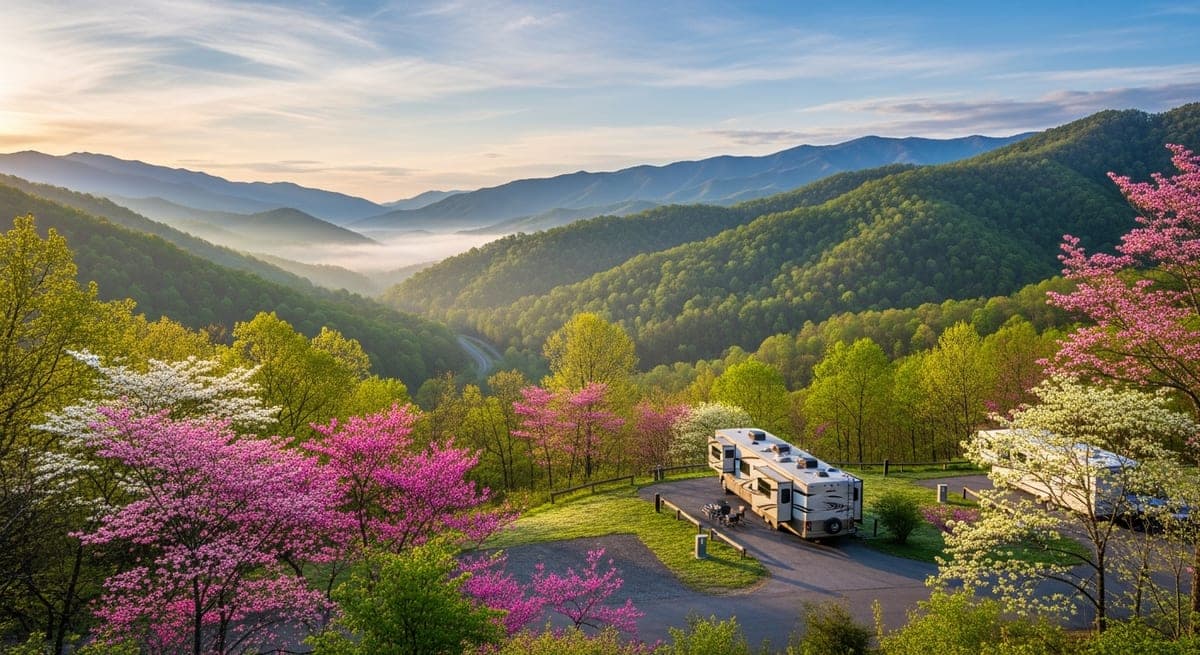
Great Smoky Mountains National Park sees more visitors than any other national park in America — about 13 million per year. And yet, spring manages to feel like a secret. The summer crowds that pack Cades Cove and Newfound Gap in July haven't arrived yet. The waterfalls are running at peak from snowmelt and spring rains. The wildflower bloom in the Smokies — which encompasses over 1,500 plant species — is one of the most spectacular in eastern North America. And the black bears, after five months of relative hibernation, are out and hungry.
If you've always wanted to RV the Smokies but dreaded the summer chaos, spring is your window. Here's everything you need to plan it right.
Spring Timing: When to Go
The Smokies have a staggered bloom because of elevation. At lower elevations (below 2,000 feet), spring arrives in late March — hepatica, bloodroot, and trout lily are usually showing by late March. The famous wildflower peak at mid-elevation happens mid-April through early May. The best all-around window is the last week of April: wildflowers are peaking across a wide elevation range, waterfalls are still full from spring rains, temperatures are comfortable (50s–70s in the valley), and the summer school-break crowds haven't started.
Bear activity peaks in spring as well — bears emerge from dens in late March and early April ravenous, and sightings in Cades Cove and along roadsides are frequent in April and May. This is a highlight, not a hazard, if you practice proper food storage (which is mandatory in the park).
The RV Size Reality Check
The Smokies are not a big-rig-friendly park, and you need to know this before you drive in. The most popular scenic roads — Cades Cove Loop (11 miles, one-way), Roaring Fork Motor Nature Trail, and Heintooga Ridge Road — are either closed to RVs entirely or have tight restrictions. Roaring Fork is closed to all vehicles over 25 feet. Cades Cove Loop allows vehicles up to 35 feet but makes for a stressful drive in anything larger.
Inside-the-park campgrounds accept rigs up to 35 feet (some sites 40 feet). If you're running 40+ feet, your best strategy is to base camp at one of the larger private campgrounds just outside the park boundary and use a tow vehicle or the free Smokies Area Regional Transit (SMART) bus system to access park roads. This isn't a workaround — it's genuinely how many RVers do the Smokies best.
Inside the Park: Campground Options
Elkmont Campground is the largest and most accessible campground in the park, sitting in a gorgeous valley along Little River on the Tennessee side. 220 sites, water and flush toilets available (no hookups — this is a national park). Sites run about $30-35/night. The walk to the Alum Cave Trail trailhead is doable from camp. Spring firefly season (late May through mid-June) draws a lottery crowd, but in late March through early May, Elkmont is bookable 6 months out on recreation.gov — book the moment the window opens.
Cades Cove Campground sits at the entrance to the Cades Cove Loop, which is arguably the most iconic wildlife-viewing drive in the eastern US. White-tailed deer, wild turkeys, and black bears are all commonly seen from the road in spring. The campground has 161 sites, no hookups, water and flush toilets available. $30-35/night. Some sites have 35-foot length limits. The campground store and bike rentals open for the season in spring.
Cosby Campground is the least-known of the three main campgrounds, tucked in a remote valley on the northeast corner of the park. 157 sites, no hookups. It's quieter than Elkmont or Cades Cove, the creek is beautiful, and the hiking from camp (Hen Wallow Falls trail is outstanding) is less crowded than on the Tennessee side. This is the local's pick for spring camping in the Smokies.
Outside the Park: Hookup Options
If you need water/electric/sewer hookups (or have a rig too large for park sites), the gateway towns of Gatlinburg and Pigeon Forge on the Tennessee side are saturated with private campgrounds and RV parks. Quality varies wildly, but Jellystone Park at Smoky Mountains in Pigeon Forge and Twin Creek RV Resort in Gatlinburg are well-reviewed for spring stays. Expect to pay $50-80/night for full hookups during peak spring weekends.
On the North Carolina side, the Cherokee/Great Smokies KOA in Cherokee sits at the park's south entrance, accepts big rigs up to 65 feet, and offers full hookups at around $65-75/night. The location is ideal for accessing Newfound Gap Road (the scenic main artery through the park) and the Oconaluftee Visitor Center.
The Must-Do Spring Drives and Hikes
Newfound Gap Road (US-441) is the only road crossing the park from Tennessee to North Carolina, and it's open to all vehicle sizes. The 33-mile drive from Gatlinburg to Cherokee gains over 3,000 feet in elevation — you'll drive through three distinct ecological zones and often through a snow flurry near the summit even in late April. Stop at the Newfound Gap overlook (5,046 feet) for one of the great panoramic views in the eastern US.
Alum Cave Trail is the Smokies' most popular trail, and for good reason: it leads through a surreal arch of overhanging cliffs blasted out by the wind, to the summit of Mount LeConte. The round trip to the cave bluffs (5 miles) is manageable in a half day. The full summit (11 miles round trip) requires an early start. Spring wildflowers line the lower trail in April.
Cades Cove Loop (Wednesday and Saturday mornings are car-free and open to bikes/pedestrians — worth planning around). Even driving, take the 11-mile loop slowly: the wildlife density in spring is remarkable. The historic preserved buildings — grist mills, barns, churches — add a layer of history that most national parks don't have.
Ramsey Cascades is the tallest waterfall in the park at 100 feet, and the trail (8 miles round trip) is one of the best hikes in the Smokies. The spring runoff makes the cascade thunderous in April. The old-growth forest on the upper section of the trail — massive tulip poplars and hemlocks — is worth the trip even without the waterfall.
The Spring Wildflower Festival
The Smokies Spring Wildflower Pilgrimage runs for five days in late April and early year (check the exact dates at smokiesinformation.org). It's one of the most unique events in the national park system: guided hikes led by botanists, birding walks, night sky programs, and photography workshops. Registration opens in late February and fills quickly for the guided hikes. Even if you don't join the official events, the week around the pilgrimage is when the wildflower bloom is typically at peak and the valley temperatures are ideal.
Planning Your RV Route In
From the north: I-81 south to I-40, then exit at Gatlinburg/Sevierville. The mountain section of I-40 approaching from the east (the Pigeon River Gorge stretch near the NC/TN state line) is steep and winding with a low clearance tunnel — check your rig height (minimum clearance is 14 feet). Most Class A motorhomes fit; wide/tall fifth wheels should verify.
From the south (Cherokee/NC entrance): US-74 east to US-441 north. This approach is smoother for large rigs. The Blue Ridge Parkway is spectacular but not RV-appropriate for anything over 30 feet — save it for the tow vehicle or bike.
Quick Reference: Spring Smokies
Best window: Late March–late April. Peak wildflowers: mid-April to early May. Reservations: recreation.gov opens 6 months in advance — book the day the window opens for Elkmont/Cades Cove spring weekends. No hookups in national park campgrounds — use a generator or base camp outside the park. Bear canisters required for overnight trips; hard-sided containers in RVs should be locked or stored in the vehicle interior. Entrance fee: $35/vehicle (7-day pass) or covered by America the Beautiful Annual Pass.
Is that campground membership actually worth it?
Plug in your camping nights and typical nightly rate. Our free calculator does the break-even math for Good Sam, Passport America, Thousand Trails, and KOA Rewards.
Keep Reading
RV Camping in the Appalachian Mountains: Blue Ridge, Shenandoah, and Beyond
10 min read
Destination GuidesColorado RV Camping: Rocky Mountain National Park, Mesa Verde & the Million Dollar Highway
15 min read
Destination GuidesAcadia National Park RV Camping: Size Limits, Campgrounds & the Best Way to See Mount Desert Island
13 min read