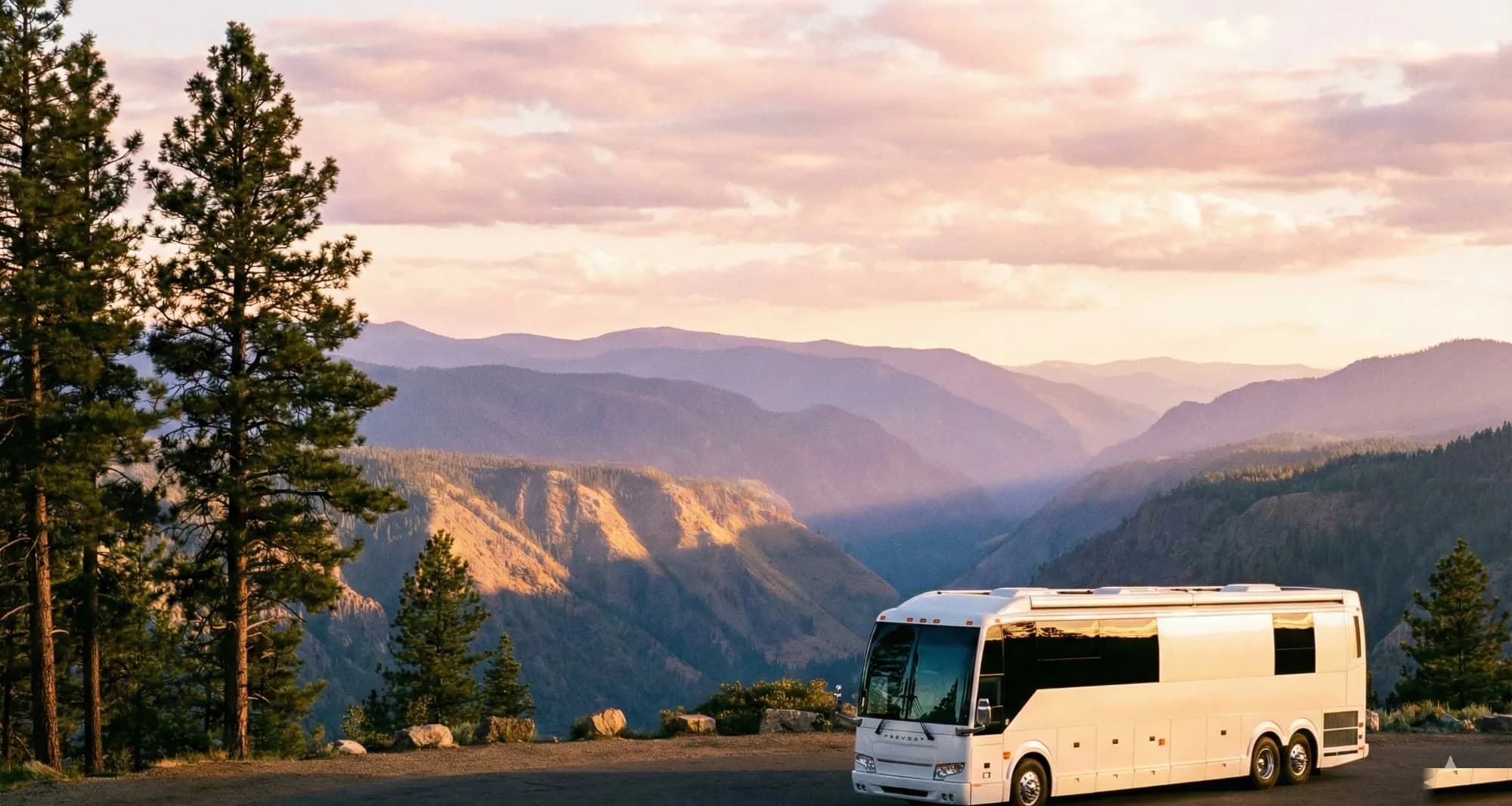
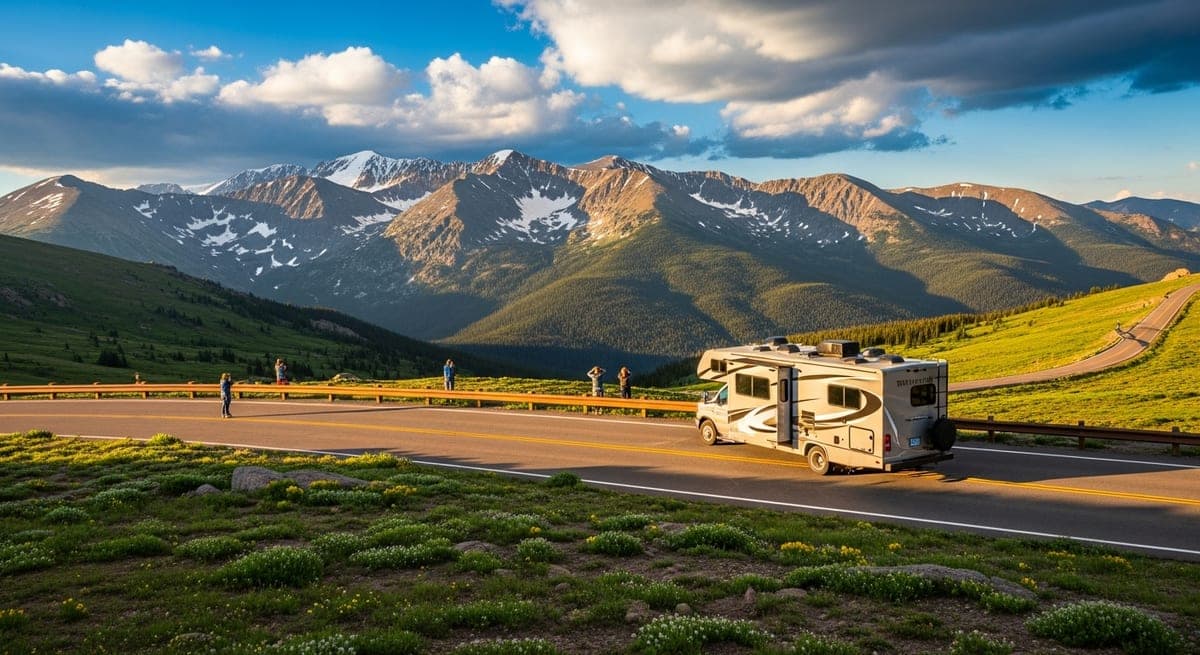
At 12,183 feet, Trail Ridge Road is the highest continuous paved road in the United States. RVers who've completed the full east-west crossing through Rocky Mountain National Park consistently flag altitude as the factor they most underestimated before arrival. Add a hard 35-foot vehicle length restriction, a timed-entry permit system, and some of the most competitive campsite reservations in the national park network, and RMNP becomes one of the more logistically demanding parks to visit in an RV.
The Altitude Penalty: What Owner Reports Actually Say
The east entrance at Estes Park sits around 7,500 feet. Trail Ridge Road peaks at 12,183 feet. That roughly 4,700-foot gain over the route is where RV owners report the most noticeable performance effects.
Engine output drops as elevation rises because thinner air reduces combustion efficiency. RVers who've run Trail Ridge Road in Class A motorhomes and heavier fifth wheels commonly describe losing somewhere in the range of 25 to 30 percent of rated engine power at the highest elevations, in line with general engineering estimates for naturally aspirated engines at altitude. The actual figure varies with engine design, vehicle weight, and load. Full-timers in RMNP trip-report threads consistently advise against trying to maintain anything near highway speed on the ascent.
Fuel economy takes a hit as well. Owner accounts frequently describe 15 to 20 percent worse mileage on extended mountain driving compared to flat-highway baselines, with altitude compounding the effects of grade and load. RVers who've done the Denver-to-Estes-Park approach commonly suggest building in an extra fuel stop or additional reserve: the sustained canyon grades reduce range noticeably, and fueling options thin out once you're in the approach corridor to Estes Park.
Rooftop AC and generator performance are the other recurring complaints in summer trip reports. Propane and gasoline generators lose output at altitude on the same principle as the engine, and RV owners who camped the Moraine Park and Glacier Basin loops in summer consistently note that rooftop AC units struggle to maintain comfortable temps at elevation, particularly during afternoon hours.
If your party is traveling from low elevation, the consensus among RMNP regulars is to spend at least one night at base elevation in Estes Park or Grand Lake before attempting strenuous hikes above 10,000 feet. Headaches and fatigue at arrival are common for sea-level travelers, and an acclimation night is a standard recommendation in the full-timer forums.
The 35-Foot Rule and What It Cuts Off
Trail Ridge Road has a posted maximum vehicle length of 35 feet. That restriction eliminates most Class A motorhomes and many longer fifth wheels from driving the full route connecting the east and west sides of the park.
RVers with rigs over 35 feet can still enter from the east entrance at Estes Park and the west entrance at Grand Lake, but cannot cross the alpine tundra section connecting them. The experience is meaningfully different without Trail Ridge. Most large-rig owners report base-camping outside the park and accessing the interior via tow vehicle or the free park shuttle rather than repositioning the rig for each day.
The Bear Lake Road corridor carries additional length and width restrictions that vary by season and road conditions. Check current NPS advisories at nps.gov/romo before arrival.
Timed Entry Permits: The Layer That Catches Visitors Off Guard
Rocky Mountain requires timed-entry reservations during peak season, typically late May through mid-October, though the exact window and structure shift year to year. Two zones carry separate permit requirements: the Bear Lake Road Corridor and the broader park area. Permits are released on Recreation.gov, and release windows have changed between seasons. The current 2026 policy should be verified directly at nps.gov/romo rather than assumed from prior-year trip reports or second-hand advice.
Early arrivals before approximately 6 a.m. and late-afternoon arrivals have historically bypassed permit requirements during some seasons, but this is policy-dependent and not guaranteed. Without a valid permit during peak entry hours, the entrance gates will turn you away.
Owner trip reports consistently emphasize that campsite reservations and timed-entry permits are separate systems, both requiring advance action. Moraine Park and Glacier Basin loops book out within hours of the reservation window opening for peak summer weekends.
Campgrounds Inside the Park
Moraine Park Campground: One of the larger campgrounds in the park, spread across multiple loops at 8,160 feet, with sites accommodating RVs up to 35 feet. A limited number of loops have electrical hookups; most are dry. Books out months ahead for summer. Owner feedback on the Moraine Park loops consistently describes the valley setting as quieter than Glacier Basin, with open meadow views toward the Continental Divide. The tradeoff is a longer shuttle ride to the Bear Lake trailheads.
Glacier Basin Campground: Similar scale and similarly competitive for reservations, at 8,600 feet. No hookups; maximum 35 feet. A free shuttle to Bear Lake departs from Glacier Basin, and full-timers consistently identify this as the practical way to access those trailheads during permit-required hours without moving the rig.
Aspenglen Campground: Smaller, near the Fall River entrance on the east side. Maximum 30 feet, no hookups. Trip reports frequently describe it as a lower-profile alternative for smaller rigs that want a quieter site close to the east entrance. Reservations tend to open up slightly later in the booking window than Moraine Park or Glacier Basin.
Timber Creek Campground: West side of the park, near Grand Lake. Maximum 30 feet, no hookups. The standard option for rigs entering from the west who want to stay inside the park boundary.
All in-park campgrounds require reservations May through October at recreation.gov. Hookups are scarce across the system. Plan for dry camping or bring a generator, and note that generator hours are restricted in park campgrounds.
Base-Camping Outside the Park: The Route Most Large-Rig Owners Take
Given the 35-foot restriction, limited hookups, and permit logistics inside the park, a large share of RV visitors base-camp in Estes Park or Grand Lake and day-trip in. Full-timers most consistently recommend this approach for Class A and large fifth-wheel owners.
- Estes Park KOA Holiday: Frequently mentioned in owner trip reports for full hookup availability and proximity to the east entrance. Pull-through sites accommodate larger rigs. Books ahead in summer but generally easier to secure than in-park sites.
- Elk Meadow Lodge & RV Resort (Estes Park): A commonly cited full-hookup option on the east side, with pull-through availability noted in owner reviews for larger rigs.
- National Forest dispersed camping (Roosevelt and Arapaho NFs): Free dispersed camping is available in the national forests adjacent to the park. Roads to dispersed sites are frequently unpaved and unsuitable for large rigs. Verify road conditions before committing a larger rig to a dispersed-site approach.
- Grand Lake area campgrounds: A smaller selection of private campgrounds with hookups on the west side. Useful for rigs approaching from the west who want a base near the Timber Creek area and the west-side trailheads.
When RMNP Regulars Actually Visit
The general advice to avoid peak summer holds up in owner experience, but the picture is more specific than a standard three-season breakdown suggests.
The September elk rut is the timing signal most experienced RMNP visitors name first. The annual rut typically peaks in the second and third weeks of September. Bull elk are active in the meadows around Moraine Park and Horseshoe Park, and RVers who've timed arrivals to the rut consistently describe the early-morning meadow activity as the most distinctive wildlife experience the park offers. Timed-entry permit requirements ease after Labor Day, campsite competition drops noticeably, and private campgrounds in Estes Park typically have hookup availability without the months-out lead time required in July and August. September is the month RMNP regulars return to most often, based on owner trip reports and forum discussions.
Late June through early July brings wildflower peak on the alpine tundra above treeline and the opening of Trail Ridge Road's full extent. The road typically opens by Memorial Day weekend from both ends but may not open completely across the alpine section until mid-June or later, depending on annual snowpack.
Late October offers aspen color on the lower slopes and minimal crowds, with one constraint to plan around: Trail Ridge Road typically begins closing at higher elevations as early as October and is generally closed to through-traffic by mid-November, though exact dates vary considerably with annual snowpack. In heavier snow years, the closure has come as early as mid-October. Owner trip reports recommend checking current road status at nps.gov/romo before planning a late-season visit built around Trail Ridge.
Winter and early spring: The lower park areas remain accessible year-round. Trail Ridge Road typically stays closed through late May, with the reopening date shifting by several weeks depending on conditions. Some RVers specifically seek out the March and April window for uncrowded snowshoeing at lower elevations and nearly empty campground availability.
Related: Zion and Bryce Canyon RV guide · Glacier National Park RV guide · Colorado RV camping guide
Is that campground membership actually worth it?
Plug in your camping nights and typical nightly rate. Our free calculator does the break-even math for Good Sam, Passport America, Thousand Trails, and KOA Rewards.
Keep Reading
RV Camping in the Appalachian Mountains: Blue Ridge, Shenandoah, and Beyond
10 min read
Destination GuidesColorado RV Camping: Rocky Mountain National Park, Mesa Verde & the Million Dollar Highway
15 min read
Destination GuidesAcadia National Park RV Camping: Size Limits, Campgrounds & the Best Way to See Mount Desert Island
13 min read