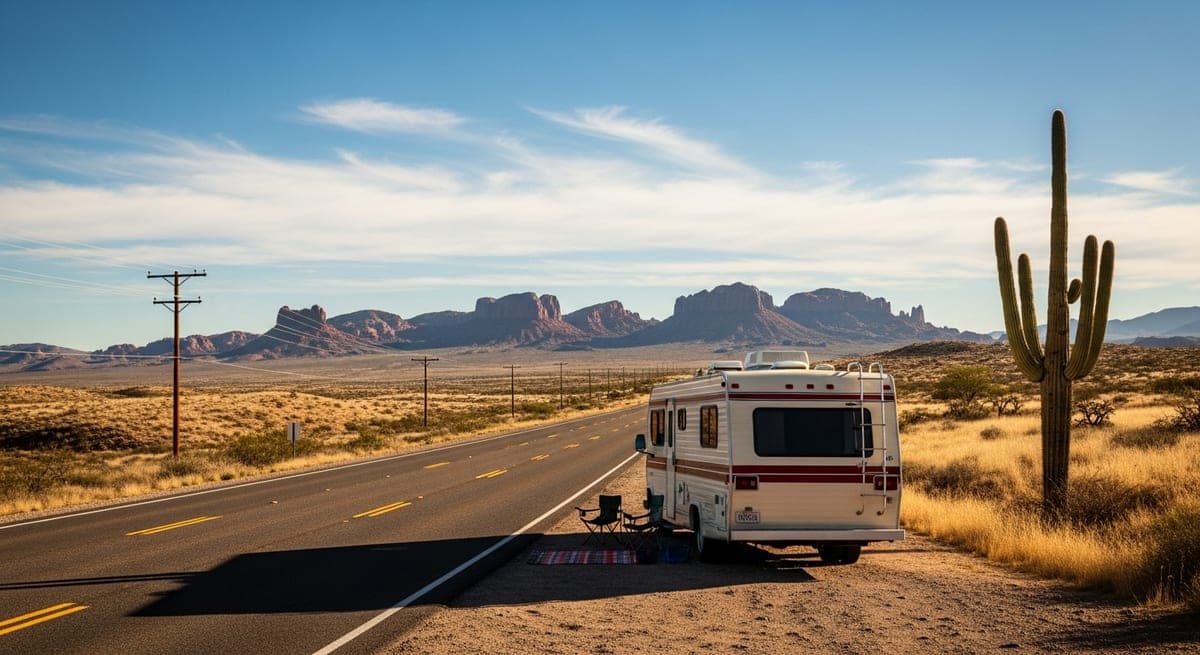
Route 66 is 2,400 miles of American mythology stretched across eight states. It's ghost towns baking in the Mojave, neon signs humming in the Oklahoma night, and that moment you crest a hill in New Mexico and see red rock country stretching to the horizon. It's also a legitimate road trip with practical challenges — not all of the historic route is easily drivable in a large RV, and some of the most iconic sections require careful planning. Here's how to do it right.
Route 66 Basics for RVers
The historic Route 66 runs from Chicago's Lake Shore Drive to the Santa Monica Pier — east to west, 2,400 miles across Illinois, Missouri, Kansas (just a corner), Oklahoma, Texas, New Mexico, Arizona, and California. The route was officially decommissioned as a US Highway in 1985, but the pavement still exists. About 85% of the original alignment survives and is drivable.
The RV-specific reality: Some historic Route 66 sections have very narrow roads, low bridges, and tight turns in small towns that are simply not accessible in rigs over 30 feet. Most of the iconic sections are fine for standard motorhomes and fifth wheels. The sections to plan around: the historic alignment through some downtown areas, and the narrow mountain passes in Arizona and New Mexico.
Trip length: Most people drive Route 66 in 2-3 weeks. A 2-week pace means averaging 170 miles per day — doable but rushed. 3 weeks (about 115 miles/day) is much more relaxed and still covers everything. If you have a month, take it.
Illinois: Chicago to the Missouri Border (300 miles)
Start at the official Route 66 Begin sign in Chicago (just south of Grant Park on Adams Street). Head southwest through the flat Illinois plains. Highlights:
- Gemini Giant in Wilmington: One of the iconic Muffler Men — a 28-foot fiberglass spaceman holding a rocket. Unmissable first stop.
- Funk's Grove Pure Maple Sirup (sic): A working maple syrup farm near Shirley operating since 1824. The spelling is intentional and historic. Buy a jar.
- Springfield: Illinois state capital and Lincoln's home city. Abraham Lincoln Presidential Library & Museum is genuinely excellent. Plan 3-4 hours.
- Cahokia Mounds: A detour but worth it — pre-Columbian Native American city that was once larger than London. UNESCO World Heritage Site.
Best RV camping: Springfield KOA (full hookups, central location). Lincoln's New Salem State Historic Site has basic camping nearby.
Missouri and Oklahoma: The Ozarks and the Plains (600 miles)
Missouri gives you the Ozarks and Route 66's most historic surviving sections. Oklahoma has open road, great live music in Tulsa, and the iconic Blue Whale of Catoosa.
- St. Louis Gateway Arch: The Arch National Park is the most impressive monument you'll pass on Route 66. Walk across the Chain of Rocks Bridge — the original Route 66 crossing of the Mississippi.
- Meramec Caverns (Stanton, MO): Historic cave system that claimed to be Jesse James's hideout. Barn ads advertising it survived on Route 66 barns for decades. Still open and interesting.
- Tulsa, Oklahoma: Art Deco downtown, excellent food scene, and genuinely beautiful architecture. The Route 66 experience here is more urban than most of the trip.
- Blue Whale of Catoosa: A blue concrete whale in a pond. It's exactly what it sounds like. Go see it — this is Route 66.
Texas Panhandle: 180 Miles of Wide Open
Texas's Route 66 section is short but iconic — the Staked Plains, the Texas Panhandle, and Amarillo.
- Cadillac Ranch: Ten Cadillacs buried nose-first in a wheat field outside Amarillo. Bring spray paint — it's invited. This is one of Route 66's defining images.
- Big Texan Steak Ranch: The 72-oz steak challenge. You won't do it, but you'll enjoy watching someone try.
- U-Drop Inn (Shamrock): One of the best-preserved Art Deco buildings on Route 66 — a fuel station and diner from 1936 that looks exactly like it did then.
New Mexico: High Desert and the Best Food on Route 66
New Mexico delivers red and ochre badlands, pueblo villages, and the best green chile you will ever eat.
- Tucumcari: One of the most neon-preserved stretches of historic Route 66. Stay at a vintage motel (RVers: Blue Swallow Motel won't take you, but there are several RV parks in town).
- Santa Fe detour: Santa Fe is 70 miles off the main route but worth the detour — extraordinary food, the historic plaza, and the Georgia O'Keeffe Museum.
- Albuquerque: The Rio Grande, Old Town, and the most authentic New Mexican food on the route. The Albuquerque International Balloon Fiesta (October) is spectacular if your timing works out.
- El Malpais National Monument: Ancient lava flows and lava tube caves. Very accessible with a short hike — surreal landscape.
Arizona: The Heart of Route 66
Arizona has the longest continuous surviving stretch of the original highway (158 miles from Seligman to Topock), the Grand Canyon a short detour north, and some of the most dramatic scenery on the route.
- Petrified Forest National Park: Ancient logs turned to colorful crystal, strewn across painted desert badlands. Take the scenic drive.
- Painted Desert: Best at sunrise and sunset when the purples, reds, and blues are amplified. Most accessible from the east park entrance.
- Winslow, Arizona: "Standing on a corner in Winslow, Arizona" — the Eagles reference is memorialized at Standin' on the Corner Park. You must stop.
- Seligman: The town that saved Route 66. Angel Delgadillo's barbershop is the spiritual center of the Route 66 preservation movement.
- Grand Canyon South Rim: 80 miles north of Route 66 via Williams. Required if you've never been. Desert View Drive is less crowded than the main visitor area.
- Hackberry General Store: Living time capsule — vintage gas pumps, Route 66 memorabilia, and a friendly cat. Perfect stop.
California: Mojave to the Pacific
California's Route 66 is the finale — the Mojave Desert, the San Gabriel Valley, and the Pacific Ocean.
- Amboy and Roy's Motel: A perfectly preserved 1950s desert outpost that's been abandoned and preserved. The Amboy Crater (extinct cinder cone volcano) is a short hike nearby.
- Needles to Barstow: Through the Mojave on a clear day, this is the classic Route 66 desert imagery — long straight roads, heat shimmer, and empty country.
- Pasadena and Los Angeles: Route 66 winds through the LA metro on Foothill Boulevard and Colorado Boulevard. Traffic is formidable in a large RV — plan for slow going.
- Santa Monica Pier: The endpoint. The Route 66 end sign is at the pier. Dip your feet in the Pacific, take the photo, and feel accomplished.
Practical RV Tips for Route 66
Fuel: Remote stretches in New Mexico, Arizona, and eastern California can have 50-100 mile gaps between fuel stops. Fill up when you're at half tank in these areas.
Cell service: Spotty in New Mexico and rural Arizona. Download offline maps (Google Maps or Gaia GPS) before leaving areas with service.
Best apps: The Route 66 app (lists every historic site, restaurant, and attraction), RVmapper for campground planning, iOverlander for boondocking options in the more remote sections.
Best season: Spring (April-May) and fall (September-October) are ideal. Summer in Arizona and New Mexico means extreme heat (110°F+). Winter works for the western states but can bring snow and ice in Illinois, Missouri, and Oklahoma.
Related: Best RV routes through the Southwest · 15 common RV travel mistakes
Is that campground membership actually worth it?
Plug in your camping nights and typical nightly rate. Our free calculator does the break-even math for Good Sam, Passport America, Thousand Trails, and KOA Rewards.