This article contains affiliate links. If you make a purchase through these links, we may earn a small commission at no extra cost to you. Learn more.
When DIY Makes Sense
A single service call to diagnose a tripped reset button — a 10-second fix you could do yourself — can run $200 or more at an RV dealership before a wrench ever touches anything. Technicians in many markets charge $100–$150 per hour plus parts, and minimum diagnostic fees are real. The frustrating part: a large share of common RV appliance failures come down to a dirty thermocouple, a tripped reset button, or a clogged pilot assembly — fixes that take 20 minutes and cost next to nothing.
This guide walks through the most frequent culprits by appliance. If something feels beyond your skill level — gas line work, carbon monoxide concerns, or anything involving live 120V circuits you're not confident reading — call a pro. But a lot of this stuff you can absolutely handle on a campsite with basic tools.
Refrigerator Won't Cool (Absorption Fridge)
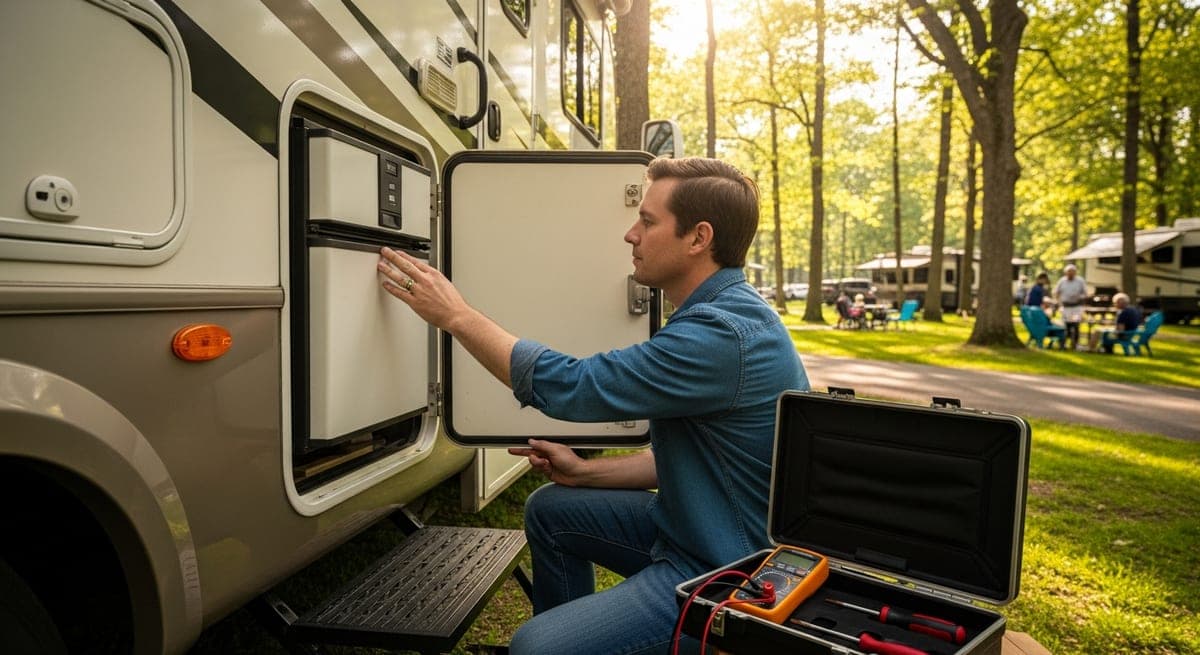
Most RV refrigerators — Dometic and Norcold are the two big names — are absorption-style units. Instead of a compressor, they use a heat source (propane flame or 120V electric element) to drive a chemical cooling cycle. That makes them quiet and efficient, but also finicky in ways a home fridge isn't.
Not level: Absorption fridges need to be reasonably level to function — both Dometic and Norcold specify this, though exact tolerances vary by model and year. Older units tend to be more sensitive. If you've been parked on a slope and the fridge is warm, level the rig first and give it a few hours before assuming something is broken. Recovery typically takes two to four hours, though it can stretch longer on a hot day or in a warm compartment.
Dometic vs. Norcold for DIY: Both brands are repairable at home, but Norcold parts tend to be easier to source online and the burner assembly is generally more accessible. Newer Dometic units often display error codes, which speeds up diagnosis. Either way, the repairs below apply to both.
No propane flame: Make sure the gas valve is open and the tanks aren't empty — check both if you're running dual tanks. Clean the burner orifice with compressed air if it won't light. A yellow or weak flame usually points to contamination or low line pressure rather than a bad component. Turn off propane at the tank before inspecting the burner assembly.
No 120V heat (electric mode): Test the heating element with a multimeter — it's one of the most common failure points on absorption fridges. Replacement elements vary in price depending on your model year and where you source them, so pull your unit's part number before ordering. Check the circuit breaker and fuse for the fridge circuit first.
Cooling unit failure: An ammonia smell or yellow powder corrosion at the back of the fridge means the cooling unit itself has failed — that's a major repair. Some RVers replace the whole absorption fridge with a 12V compressor unit at this point and don't look back. Better performance, simpler troubleshooting.
Water Heater Won't Light
RV water heaters — mainly Atwood/Dometic and Suburban — run on propane with either a manual pilot or DSI (direct spark ignition). Before touching anything, turn off the propane supply and let the unit cool completely. Most of these fixes are minor, but hot burner assemblies don't forgive impatience.
- Tripped high-limit switch: Find the small reset button on the outside access panel — usually red. Press it once. If it trips again right away, something else is wrong: thermostat failure, a dying heating element, or restricted water flow. Don't keep resetting it and ignoring the pattern.
- Dirty thermocouple (pilot models): The thermocouple is a thin metal probe that sits in the pilot flame. It fails two ways — dirty or just worn out. Start with fine-grit sandpaper. If it still won't hold the pilot open after cleaning, replace it. They're inexpensive and widely available at RV supply stores.
- DSI ignition board failure: On DSI models, if the burner won't ignite at all or lights briefly and shuts down, the circuit board is often the culprit rather than the gas side. Atwood and Suburban boards aren't interchangeable, so verify your model number before ordering. Turn off 12V power to the unit before swapping the board.
- Electrode gap: The ignition electrode should sit roughly 1/8" from the burner tube. Carbon buildup or physical shift can close that gap over time. Clean with fine sandpaper and adjust. A weak or intermittent spark is usually this before it's a board failure — check the easy thing first.
Air Conditioner Not Cooling
Dirty filters: Start here every time. RV AC filters should be cleaned every couple of weeks during hard use — a clogged filter is the most common reason an AC underperforms. Pull them, rinse with water, let them dry fully, reinstall. Takes five minutes and fixes more problems than people expect.
Iced-over evaporator coils: If the filters are clean and airflow is good but the unit is barely keeping up, the evaporator coils may have iced over. This happens when the AC runs in low ambient temps or with restricted airflow. Turn the unit completely off and let the ice melt before restarting. Running it iced just compounds the problem.
Refrigerant leak: If the unit runs and sounds normal but produces no cold air at all, you're likely looking at a refrigerant leak. This is a professional repair — recovery and recharge requires EPA certification and the right equipment. If you have an older Dometic Penguin or Coleman Mach that's been cooling weakly for a season, get a proper diagnosis before assuming compressor failure.
Capacitor failure: A humming AC that won't cool — compressor clicks on but doesn't run — often points to a failed start capacitor. They're inexpensive parts, but capacitors hold charge even when unplugged and can deliver a serious shock. Discharge it before handling. If that step gives you pause, this is a reasonable service call.
Furnace Won't Start
RV furnaces — Atwood, Suburban, and Duo-Therm are the most common — run on propane with an electric blower and DSI ignition. The blower draws real 12V current, which means a weak battery will produce symptoms that look exactly like a furnace problem. Start with voltage before pulling anything apart.
- Low battery voltage: If you're sitting below 12.0V, charge first and retest. A soft battery mimics DSI failures, sail switch faults, and ignition problems — all of them. Rule this out before going further.
- Clogged combustion tube: This one catches people off guard. Wasps, mud daubers, and mice all like the furnace exhaust vent during storage. Before the first cold night of the season, pull the exterior vent cover and look inside. A blocked tube means no combustion air — the furnace fires, goes into lockout, and you scratch your head all night. Clear it out and try again.
- Sail switch stuck: The sail switch is a small flap inside the blower assembly that confirms airflow before allowing ignition. If it's stuck closed, the furnace won't fire regardless of everything else working correctly. Accessing it means removing the furnace cover — it's one of the easier furnace repairs once you're in there.
- Circuit board failure: When the blower runs, the combustion tube is clear, voltage is solid, and you're still getting spark-but-no-flame or no spark at all, the DSI board is the next suspect. Atwood and Suburban boards differ significantly — verify your model. Turn off 12V to the furnace before swapping.
Related: RV maintenance checklist · RV generator maintenance · RV winterization guide
Ready to Plan Your Trip?
Put this knowledge to work. Let our AI build a personalized RV itinerary for your next adventure, or browse community trips for inspiration.