
This article contains affiliate links. If you make a purchase through these links, we may earn a small commission at no extra cost to you. Learn more.
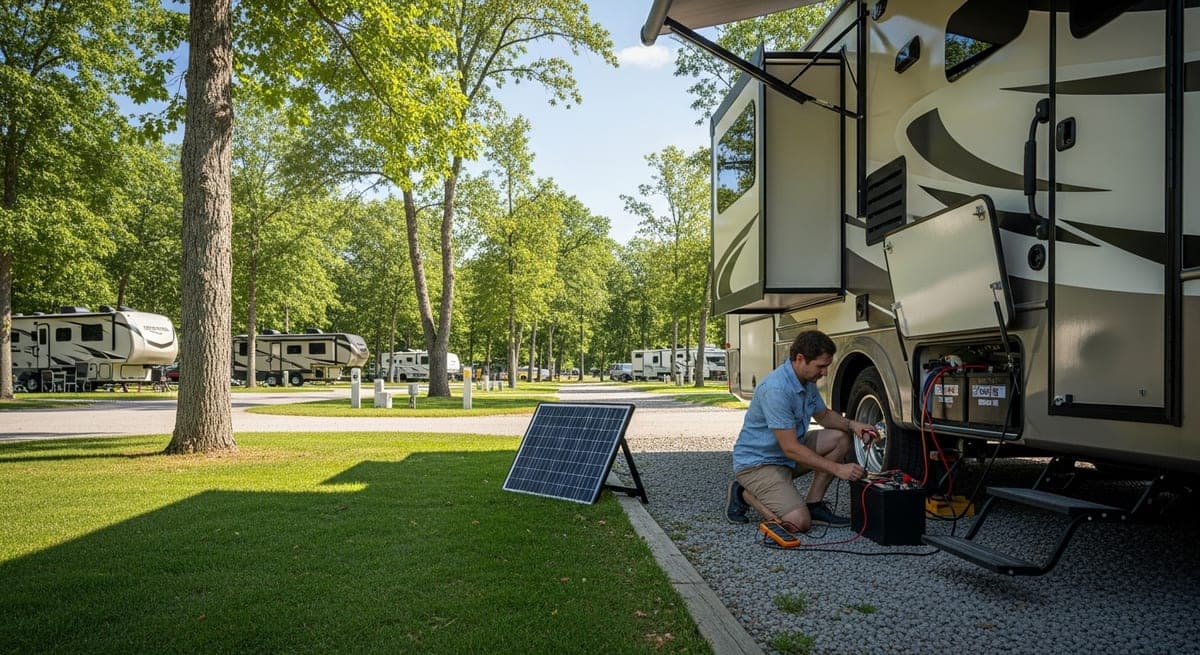
Why Batteries Fail Prematurely
A flooded lead-acid battery left sitting at 50% state of charge for 30 days can lose a significant portion of its usable capacity — permanently — and most RVers do exactly this every winter storage season without realizing it. A quality AGM or flooded lead-acid battery typically lasts 4–7 years in RV service; many don't make it past 2–3, almost always from the same two preventable problems.
Chronic undercharging: Lead-acid batteries (flooded and AGM alike) that cycle through partial discharges without ever reaching 100% state of charge develop hardened lead sulfate crystals on the plates — sulfation. It's irreversible past a point. I've seen rigs come back from a month of boondocking in the Sonoran Desert with batteries that read 12.4V on the meter but couldn't hold a load past midnight. They weren't dead — they were quietly capacity-starved from months of partial charging. The habit of plugging in just enough to run things overnight and never finishing the charge is the fastest way to halve your battery bank's lifespan.
Over-discharge: Discharging below 50% state of charge (roughly 12.1V under load on a 12V nominal system) damages the plates. Each deep discharge below this threshold chips away at total capacity. AGM batteries tolerate deeper discharge somewhat better than flooded, but both suffer from regular cycling below the recommended floor.
Charging Best Practices
The goal is simple: reach 100% state of charge as often as possible. Each charging method has its role:
- After every trip: When you pull back in — whether it was one night at a state park in the Smokies or two weeks off-grid out in Escalante — plug into shore power and leave it until the charger hits float mode. Don't store discharged batteries.
- Shore power and converter/charger: Most older converters trickle-charge at a fixed voltage that slowly overcooks batteries over time. If your converter is more than 10 years old, upgrade to a 3-stage smart charger (bulk, absorption, float) — something like the Progressive Dynamics PD9280 or WFCO 9855-AD. They charge more completely and are dramatically gentler on battery health.
- Generator charging: Works well, but run it long enough to hit the absorption stage — not just to bounce off 80% and stop. A 2,200W inverter-generator like the Honda EU2200i paired with a quality inverter-charger gets you there faster than an underpowered unit running flat out for hours.
- Solar charging: An MPPT charge controller is the best tool for maintaining battery state of charge while boondocking. Manufacturer specs typically cite 20–30% better harvest over PWM controllers, though real-world gains vary by panel type, shading, and temperature. The bigger advantage is that MPPT controllers include proper 3-stage charging profiles that most PWM units skip entirely. The Victron SmartSolar MPPT 100/30 is the most widely used option in the RV community — it pairs with the VictronConnect app so you can monitor charge state from your phone in real time.
Flooded Lead-Acid Battery Maintenance
If your RV runs flooded (wet) lead-acid batteries rather than AGM, they need regular hands-on attention that sealed batteries don't. I've watched more than a few RVers skip these steps for a season and come home to batteries that wouldn't hold a charge through the night:
- Check electrolyte (water) levels monthly during heavy use — plates must stay submerged at all times
- Top off with distilled water only — tap water minerals accumulate on the plates and slowly reduce capacity
- Check levels after a full charge, not before — charging drives off water through gassing
- Keep terminals clean and coat them with petroleum jelly or dielectric grease to prevent corrosion buildup
- Wear eye protection and gloves — battery electrolyte is dilute sulfuric acid, and it will ruin clothes (and skin) on contact
Monitoring Battery State of Charge
Know where your batteries stand before you go to bed. A dedicated battery monitor — the Victron BMV-712 and Victron SmartShunt are both solid choices — tracks voltage and amp-hours consumed together, which is far more accurate than voltage alone for determining actual state of charge.
Voltage-based reference (12V nominal flooded/AGM, resting — not actively charging or under load):
- 12.7V+ = 100% (full)
- 12.4V = ~75%
- 12.2V = ~50% (stop here for lead-acid)
- 12.0V = ~25% (emergency only)
- Below 11.8V = active plate damage
Related: RV solar system sizing · Boondocking beginner's guide
From the RVmapper team
Fishing along your route?
Hooked Fisherman publishes fishing reports for all 50 states, species guides, and honest gear reviews. Know what's biting before you park the rig.