This article contains affiliate links. If you make a purchase through these links, we may earn a small commission at no extra cost to you. Learn more.
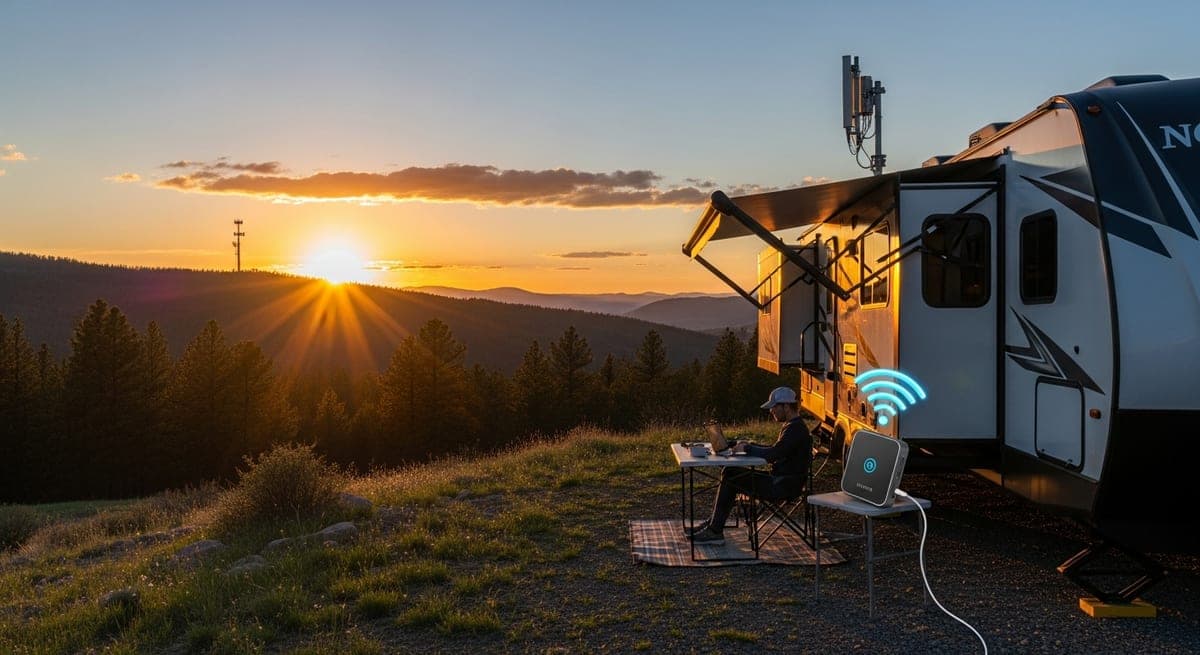
The stretch of US-191 between Moab and Monticello in Utah runs about 50 miles with virtually no usable signal from any carrier — and it's not even close to the worst dead zone on the Colorado Plateau. For RVers who built their internet setup around a single cellular plan, gaps like that aren't inconveniences, they're operational failures. The good news: the options available in 2026 are genuinely strong. The challenge is knowing which combination fits how you actually travel.
This breakdown is based on patterns reported across iRV2 forums, r/fulltimers, and FMCA community threads through early 2026 — where coverage holds, where it doesn't, and what experienced travelers have landed on after testing different setups. — RVMapper editorial team
Cellular Hotspots: The Baseline — and Its Hard Ceiling
A mobile hotspot device — or your phone's personal hotspot — connects to the same cellular towers your calls use and shares that connection with your other devices. For most RVers, this is where the setup starts.
In areas with strong 4G LTE or 5G coverage, a good hotspot delivers 30–100+ Mbps — more than enough for video calls and streaming. The ceiling isn't speed; it's geography. Once you leave the I-25 corridor in New Mexico, head into the Grand Staircase–Escalante region, or get off the main highway in northern Montana, cellular coverage drops fast and stays down for miles at a time.
Carrier differences matter more than most people realize. Verizon runs the most geographically broad rural coverage in the country — its network advantage in the Southwest, Appalachia, and the northern Plains is documented in FCC broadband coverage filings and consistently reported by the iRV2 community. T-Mobile's network has improved substantially and now leads in many metro and suburban corridors, but rural gap coverage still favors Verizon in the regions where RVers most often need a backup.
On the Atlantic Seaboard and through the Southeast — Florida, Georgia, the Carolinas — AT&T competes more directly with Verizon. Snowbirds who concentrate their winter miles in that corridor often find AT&T adequate as a primary carrier.
Plans worth knowing about (verify current terms directly with each carrier before purchasing):
- Verizon Unlimited Plus / Unlimited Ultimate: Typically includes a block of priority hotspot data before speeds are deprioritized — thresholds and throttling terms have shifted across plan revisions, so confirm current limits before signing up. Verizon's rural coverage advantage is the main reason full-timers often anchor their setup here.
- T-Mobile unlimited mobile plans (Go5G Plus and similar tiers): Solid flat-rate mobile data on T-Mobile's network at a price point lower than Verizon. Note: T-Mobile Home Internet is a separate, fixed-address residential product that requires a registered home address and a plug-in gateway — it is not designed for mobile use and won't travel with you. For RV travel, the relevant T-Mobile products are their standard postpaid unlimited tiers.
- AT&T Unlimited Premium: Worth evaluating if your travel route concentrates in the Southeast or Texas, where AT&T's infrastructure density is highest.
- MVNOs (Visible on Verizon, Mint Mobile on T-Mobile): Lower monthly cost, but typically with reduced hotspot data priority — manageable for lighter users, harder to rely on for full-time remote work.
Based on threads across iRV2 and r/fulltimers, a large share of full-timers run two carriers — most commonly Verizon plus T-Mobile — specifically to cover the gaps in each network. The combined cost of two solid unlimited plans runs $100–120/month and eliminates most cellular dead zones you'll encounter along the main travel corridors.
When You've Got One Bar and Need Three: Signal Boosters
Signal boosters (sometimes called amplifiers) don't create signal where none exists. What they do: take a weak 1-bar signal — the kind that's technically present but unusable — and amplify it enough to make connections that would otherwise time out actually work.
The situations where boosters earn their keep: along the edges of coverage zones, in valleys where your rig sits lower than surrounding terrain, and at campgrounds where the nearest tower is 15–20 miles out but signal physically reaches you at ground level. Along the I-70 corridor through the Colorado Rockies — particularly in Glenwood Canyon and the Vail Pass area — boosters consistently help where canyon walls cut signal before it reaches the valley floor.
The boosters most commonly cited in RV hardware discussions:
- weBoost Drive X RV: The most frequently recommended option in iRV2 hardware threads. Roof-mounted antenna, amplifies all major carriers simultaneously. ~$400–500.
- SureCall Fusion2Go RV: Comparable performance to the weBoost, often at a slightly lower price in retail channels.
- Hiboost Travel 4G LTE: Budget option with lower maximum gain than the premium units — works in moderate-gap situations at a lower entry cost.
A booster is not a substitute for Starlink in genuinely remote areas. If you're camping at a dispersed site in the Escalante Canyons or on BLM land in the Oregon Outback, no amount of signal amplification will turn zero bars into usable internet.
Starlink: What It Fixes, What It Costs, What to Know
Starlink is SpaceX's low-earth orbit satellite internet service. For RVers who regularly camp in national forests, on BLM land, or at dispersed sites more than 15–20 miles from any cellular tower, it's the only technology that delivers reliable broadband — no cellular network reaches those places.
Starlink offers a mobile tier ("Starlink for Roam") in regional and global variants. Pricing has changed multiple times since launch and is likely to continue shifting — verify current rates at starlink.com before committing. As of early 2026, community reports indicate mobile regional plans running in the $150/month range, with global mobility plans at a higher tier, but these figures aren't guaranteed. Hardware costs have similarly fluctuated between roughly $350–$600 for the dish and mounting hardware; confirm the current figure at checkout.
What stays consistent: speeds of 25–100 Mbps are typical at most campgrounds and dispersed sites. Latency is higher than cellular, noticeable in some real-time applications but adequate for video calls and streaming. The service works wherever you have sky view — which means it works at Nevada Basin and Range BLM sites, national forest dispersed camping in the Cascades, and remote stretches of the Colorado Plateau where cellular has never reached.
The regional Starlink plans allow monthly pausing, which changes the cost math for travelers who are remote in summer but near cell towers in winter. Roof-mounting kits are available through Starlink directly and from third-party vendors — flush mounts suit full-timers; portable tripod setups work for seasonal users who prefer to store the dish when not in use.
Campground WiFi: Free, Convenient, Frequently Unusable
Campground WiFi is worth using when it works and worth ignoring when it doesn't — and the divide is mostly predictable. Aging infrastructure, shared bandwidth across dozens or hundreds of sites, and poor signal propagation at large campgrounds make most campground WiFi unreliable for anything time-sensitive.
The exceptions: premium parks that have invested in modern infrastructure. Certain KOA Deluxe locations, Thousand Trails premium sites, and Jellystone Parks have received consistently positive reports on campground forums for actual usable bandwidth. Ask at the front desk about current speeds before depending on it for work.
A WiFi range extender — devices like the GL.iNet Beryl or Winegard ConnecT 2.0 — can pull campground signal that's adequate at the office but too weak at your site. Useful when the signal quality exists but distance degrades it before it reaches your rig.
Building the Stack That Fits Your Travel Pattern
There's no single setup that works for every travel style. The configurations that communities of full-timers have converged on, roughly by travel pattern:
- Occasional weekender: Phone hotspot only. Campgrounds within cell range cover most needs. No additional equipment warranted unless you camp in known dead zones.
- Regular trips in established campgrounds: Single unlimited cellular plan (Verizon for rural coverage depth, T-Mobile for cost and metro coverage) plus a weBoost Drive X RV. Budget: $50–80/month ongoing, ~$400–500 one-time.
- Full-timer in developed campgrounds: Two carriers (Verizon + T-Mobile) for coverage diversity, plus a WiFi extender for campground networks. The dual-carrier setup eliminates most dead zones along major travel corridors — I-90, I-40, I-10, US-101. Budget: $100–120/month.
- Full-timer with significant boondocking: Dual cellular plus Starlink, with Starlink paused during months spent near cell coverage. This combination handles the Colorado Plateau, BLM land in the Nevada Basin and Range, and national forest dispersed camping in the Cascades. Budget varies based on pause schedule.
- Remote-work full-timer: Dual cellular plus an active Starlink subscription kept live year-round. For anyone whose income depends on connectivity, this is infrastructure, not a luxury. Budget: $200–250/month for the full stack.
One pattern the iRV2 and r/fulltimers communities flag consistently: the setup that felt like overkill before a trip to a remote area usually feels exactly right after it. Travelers who've been doing this for several years tend to run more redundancy, not less. — RVMapper editorial team
Related: RV solar power guide · Full-time RV living costs
Is that campground membership actually worth it?
Plug in your camping nights and typical nightly rate. Our free calculator does the break-even math for Good Sam, Passport America, Thousand Trails, and KOA Rewards.