This article contains affiliate links. If you make a purchase through these links, we may earn a small commission at no extra cost to you. Learn more.
Opensignal's 2024 Mobile Network Experience report — the most-cited third-party carrier benchmark in full-timer communities on iRV2 — ranked T-Mobile ahead of Verizon in median rural download speeds for the first time, a finding that reshuffled years of conventional wisdom about which carrier to prioritize. At the same time, Starlink's low-earth orbit constellation has expanded enough that RVers camping in areas like Utah's Grand Staircase-Escalante and Michigan's Upper Peninsula report consistent usable speeds with no cellular fallback at all. The connectivity picture has shifted significantly — but which solution makes sense still depends heavily on where you camp and how much you need the connection.
Starlink for RVs: What Owner Feedback Shows
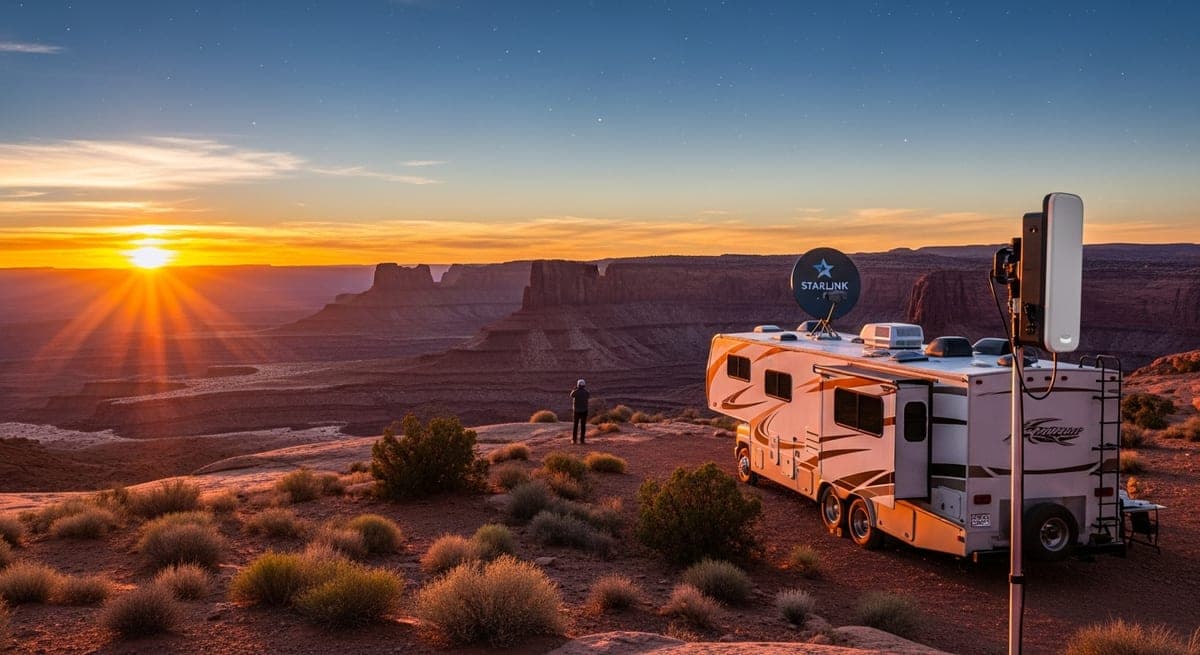
Starlink's RV-friendly service tier (marketed as "Starlink Roam" as of early 2026) has become the dominant recommendation in full-timer communities for remote camping situations. The plan allows pausing and resuming by month, so RVers pay only for active months — a feature frequently cited in iRV2 and RVillage threads as the deciding factor over fixed-cost alternatives.
Reported speeds: Owner reports collected across iRV2 forum threads through early 2026 describe download speeds in roughly the 50–200 Mbps range under open-sky conditions, with variability based on satellite density and weather. Latency, per Starlink's own published specifications, typically falls in the 20–40ms range for its low-earth orbit constellation — sufficient for video calls, though owners in high-demand campgrounds have noted congestion during peak evening hours.
Where it performs well: RVers camping on dispersed sites along the Grand Staircase-Escalante corridor — where T-Mobile signal drops entirely past Escalante town limits — in the Ouachita National Forest in Arkansas, and throughout Michigan's Upper Peninsula consistently report Starlink as their only reliable option. The common thread across owner reports: open-sky exposure matters more than geography.
Where it struggles: Dense forest canopy is the most-cited limitation in RV owner forums. Owners camping under tree cover in the Pacific Northwest and Appalachians report frequent dropouts. RVers in forested Ouachita NF sites describe needing to position the dish at the edge of a site or on a roof mount to get adequate sky view.
Cost (as of early 2026 — verify current pricing at starlink.com before purchasing): Hardware has ranged from approximately $349 to $599 depending on dish generation; SpaceX has restructured hardware SKUs multiple times, and the lower end of that range may no longer reflect available options. Monthly Roam service has been priced around $150/month, though Starlink's plan pricing has changed repeatedly — treat any figure here as a starting point. Full-timers on iRV2 frequently cite total first-year costs of $400–$700 in hardware plus ongoing monthly service.
Cellular Connectivity: Carrier Coverage and the Dual-SIM Approach
For RVers who camp primarily at developed campgrounds, state parks, and along major highway corridors, cellular data is often sufficient — and typically less expensive than Starlink. The carrier comparison that dominates RV community discussions:
Verizon: Owner feedback on iRV2 consistently cites Verizon as stronger in the rural South, Great Plains, and mountain west. Full-timers who spend significant time in Wyoming's high desert or along remote stretches of US-191 in Montana report Verizon as the only carrier with any signal. Plans run higher than T-Mobile's comparable tiers.
T-Mobile: The 2024 Opensignal rural coverage report documented continued T-Mobile expansion in rural markets, and RV forum feedback reflects this shift — owners in the Pacific Northwest and upper Midwest report T-Mobile performing comparably to Verizon across many corridors where it lagged two or three years ago. Pricing is generally lower for equivalent data allowances.
The consensus among full-timers across iRV2 and RVillage is to carry two SIMs — one Verizon, one T-Mobile — to cover each other's dead zones. Dual-SIM hotspots like the Netgear Nighthawk M6 Pro allow switching between carriers without swapping hardware, an arrangement that owners in extended forum threads describe as substantially reducing connectivity gaps on driving days.
A note on T-Mobile Home Internet: T-Mobile's Home Internet product (priced around $50/month as of early 2026) restricts service to a fixed registered address under its terms of service — it is not designed or authorized for mobile RV use. Using it while traveling likely violates those terms. RVers looking for lower-cost T-Mobile data should evaluate standard mobile hotspot plans instead.
Cellular Boosters: Signal Amplification in Marginal Areas
A cellular booster amplifies an existing weak signal — it does not generate coverage where none exists. In areas with one or two bars of LTE, owner feedback across booster-focused iRV2 threads suggests a quality unit can meaningfully improve speeds and call reliability. In a true dead zone, no booster changes the situation.
The WeBoost Drive Reach RV is the most frequently recommended product in RV connectivity forums — owners cite its large directional outdoor antenna and multi-carrier compatibility. Current pricing shifts periodically; checking WeBoost's site directly is recommended (the range commonly cited in forum threads runs roughly $499–$650, though this should be verified). The Surecall Fusion2Go Max is cited as a capable alternative at a lower price point, typically around $349–$400 — though owners who camp frequently in marginal areas tend to favor the WeBoost's higher gain for the most challenging scenarios.
Installation matters significantly. Owner reports describe oscillation issues — where the device feeds back on itself — when the outdoor and indoor antennas are positioned too close together. Proper vertical separation between the roof antenna and the interior antenna is the most common setup error cited in forum threads, and manufacturers publish minimum separation guidelines for each unit.
What Setup Fits Which RVer
Based on community-aggregated patterns across RV owner forums, two configurations cover the majority of use cases:
Full-timers and remote workers: The combination most frequently described by working full-timers on iRV2 and RVillage is Starlink for camp use, a T-Mobile or Verizon unlimited mobile hotspot plan for driving days, and a WeBoost booster for marginal cellular areas. Owner-reported upfront costs for this configuration typically run $800–$1,200; monthly ongoing costs fall around $150–$200 depending on carrier plan selection.
Weekend and vacation RVers: Owner feedback in community threads consistently describes a single carrier unlimited hotspot plan — T-Mobile or Verizon, depending on primary camping regions — as sufficient for developed campground use. A cellular booster adds $350–$500 upfront for improved signal at remote state parks and national forest sites.
The FCC's Broadband Map (broadbandmap.fcc.gov) provides a publicly available starting point for checking carrier-reported coverage at specific campgrounds. RV forum members frequently note, however, that carrier-reported coverage and real-world performance at ground level often diverge — particularly in canyon country, dense forest, and terrain-heavy areas like those around the Ouachita highlands and the Upper Peninsula's interior.
Related: Full-time RV living guide · Workamping guide · Boondocking guide
Ready to Plan Your Trip?
Put this knowledge to work. Let our AI build a personalized RV itinerary for your next adventure, or browse community trips for inspiration.