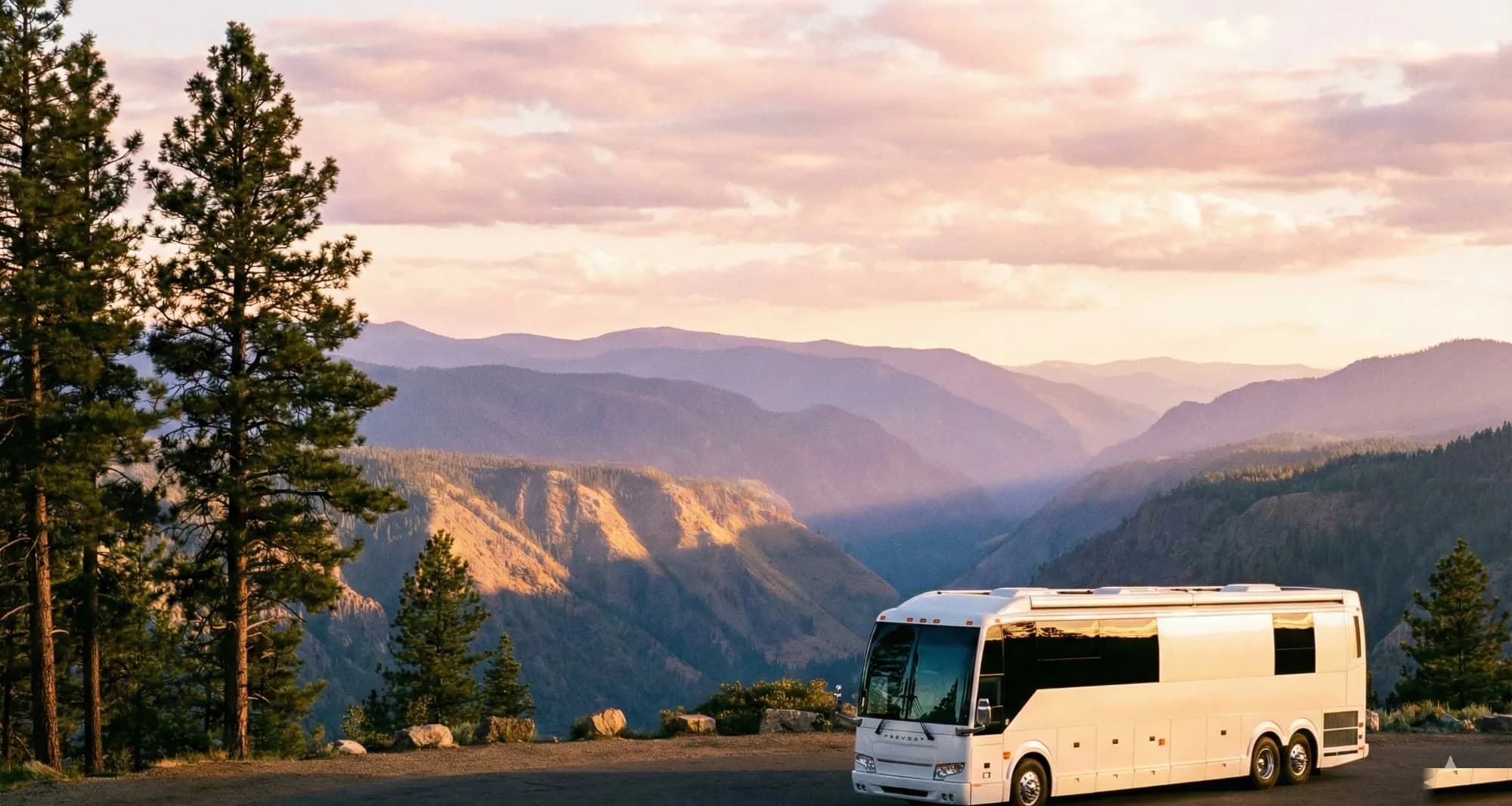

Where you choose to base your RV life — your legal domicile — affects your taxes, vehicle costs, insurance rates, and access to services. Where you choose to spend your time affects your quality of life entirely. These are two different questions that RVers often conflate. Here's the breakdown on both: the best domicile states for full-timers and the best states for actually camping and living day-to-day.
Best Domicile States for Full-Time RVers
A domicile state is your legal "home base" — where you're registered, pay taxes, and hold your driver's license. For full-timers with no fixed address, choosing strategically can save thousands per year.
South Dakota — the #1 choice for most full-timers
- No state income tax
- Low, flat vehicle registration fees regardless of vehicle value
- No vehicle inspection required
- Established mail forwarding infrastructure specifically for RVers (America's Mailbox, Dakota Post)
- Easy domicile establishment — one night in the state is sufficient for residency
- Escapees CARE Center (full-timer support organization) has a chapter here
Texas
- No state income tax
- Large, established full-timer community in the Rio Grande Valley (especially Harlingen/South Padre area)
- Good mail forwarding options
- Annual vehicle inspection required — straightforward and cheap
- Vehicle registration costs are modest for most rigs
- No state income tax
- Popular for wintering — many full-timers maintain FL domicile while spending winter in the state
- Vehicle registration can be expensive for newer, heavier rigs — check your specific vehicle's registration cost before committing
Nevada
- No state income tax
- No vehicle inspection requirement
- Washoe County (Reno area) has relatively low registration fees for large vehicles
- Less developed full-timer infrastructure than SD or TX but viable
Best States for Camping and RV Living Day-to-Day
Domicile is separate from where you want to spend your time. These are the states that offer the best combination of campground access, natural scenery, climate, and RV-friendly infrastructure.
Arizona (October–April season)
The premier winter RVing destination. Quartzsite in January is literally a city of RVers in the desert. The Sonoran Desert is spectacular in February and March (wildflowers in good years). Tucson, Sedona, and the Verde Valley offer excellent base camping. BLM land everywhere — weeks of free camping for those who want it. La Paz County has the highest density of long-term RV camping in the US. The downside: summer temperatures make most of Arizona uninhabitable for RV camping without full AC and hookups.
Colorado (May–September season)
Arguably the finest state for summer RV camping in the West. National forests with excellent dispersed camping, spectacular mountain scenery, and a network of state parks with good facilities. The San Juan Skyway, Rocky Mountain NP, and the Western Slope (Grand Junction, Ouray, Silverton) are all world-class destinations. High elevation means cool temperatures even in July. Winters close many mountain campgrounds and are unsuitable for most RV camping above 7,000 feet.
Oregon and Washington (May–October)
Pacific Northwest summers are exceptional — mild temperatures, dramatic scenery from the coast to the Cascades to the Columbia River Gorge, and excellent state park systems with great campgrounds. Olympic NP (WA), Crater Lake (OR), the Oregon Coast, and North Cascades (WA) are all outstanding. The Washington and Oregon state park systems are well-funded and have excellent hookup campgrounds.
Florida (November–April season)
The original snowbird destination. The Florida peninsula stays warm when the rest of the country is cold. The Florida state park system is one of the best in the US — well-maintained, reservable, good facilities. The Everglades, Keys, and Gulf Coast offer unique camping experiences. The RV community is enormous from November through March.
Montana / Wyoming (June–September)
Glacier NP, Yellowstone, Grand Teton, and the surrounding national forests are among the finest RV destinations in North America. Short season (many campgrounds close after Labor Day), significant reservation competition for summer, and bear country logistics — but extraordinary camping for those who plan ahead.
States to Approach Carefully
- California: Excellent destinations (Yosemite, Pacific Coast Highway, Joshua Tree), but state park reservation systems are competitive, private campground prices are high, and income tax is significant for domicile purposes. Worth visiting but rarely worth establishing domicile.
- New England in summer: Beautiful but logistically challenging for large RVs — narrow roads, covered bridge clearance issues, campgrounds that fill months in advance at peak season.
Related: Full-time RV living beginner's guide · Boondocking beginner's guide · Full-time RV living costs
From the RVmapper team
Fishing along your route?
Hooked Fisherman publishes fishing reports for all 50 states, species guides, and honest gear reviews. Know what's biting before you park the rig.