This article contains affiliate links. If you make a purchase through these links, we may earn a small commission at no extra cost to you. Learn more.
By the RVMapper team — road-testing campsites and chasing forecasts across 38 states since 2019
At sustained outdoor temperatures above 100°F, a closed RV without shade can exceed 130°F internally within an hour — and the rooftop AC unit that handles a comfortable summer day may be completely overwhelmed. That's not a fringe scenario. Last summer in Amarillo, I watched my interior thermometer climb to 97°F with the AC running on a 104°F afternoon, because I'd parked without a shade buffer and the unit couldn't keep pace.
But heat wasn't even my most humbling weather lesson on the road. That came from a canyon storm outside of Moab — awning extended, bedroom vent cracked, shore power plugged in — three mistakes, one squall, and a wet mattress by the time I figured it out.
An RV is mobile by design, and the tradeoffs that make it rollable also make it weather-vulnerable. Lighter walls, a roof membrane instead of shingles, water lines running through exposed underbelly compartments — these aren't defects, they're engineering tradeoffs. The question is whether you know where the vulnerabilities sit before the forecast changes. After years of finding out the hard way, this is what I've settled on for each weather type.
Thunderstorms: Act Before the First Drop
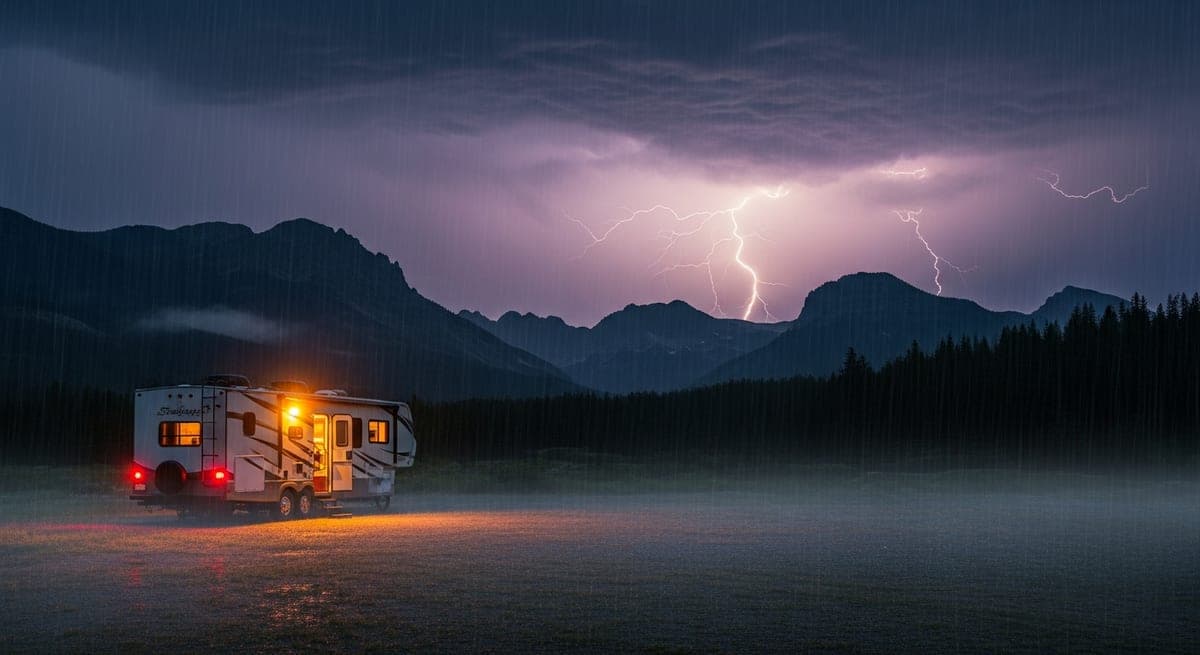
Most campground thunderstorms are fine — some rain, some rumble, 45 minutes and it's over. But the ones that weren't fine have been my best teachers. RVs in open campgrounds are basically weather antennas: metal chassis, extended awning arms, slide toppers that catch wind like sails. My routine the moment a storm's within range:
- Retract the awning immediately — always first. An awning in a 40 mph gust doesn't just get damaged; it can rip the mounting bracket clean off the sidewall. I learned this the slow way outside of Moab, which is why it's now the first thing I do, not the third.
- Close every roof vent and window before rain arrives. A Fantastic Fan left cracked in a downpour will soak your mattress, ceiling liner, and the shelf below it in minutes. I've done this more than once.
- If lightning is actively close, disconnect from shore power. A surge protector is insurance, not a guarantee — a near-direct strike can push more voltage than any suppressor is rated to handle.
- After heavy rain, spend 30 seconds checking for pooling on a rubber roof. Standing water on aging EPDM is a slow leak invitation — seams that were fine last season may not be this one.
- Stay inside during active lightning. The metal chassis provides reasonable protection, measurably better than standing outside, though not as solid as a hard-topped structure. Don't test this unnecessarily.
Heat: The Threat That Sneaks Up on Experienced Campers Too
I say "experienced campers too" because the Amarillo situation happened on our fifth full summer on the road. The math on RV heat is unforgiving: a dark roof absorbs radiant heat, a small interior volume heats fast, and a 15,000 BTU unit — the standard on most class B+ and C rigs — has a real ceiling on what it can fight. Interior temps in a parked, closed RV can hit 130°F or higher in direct summer sun. That's not a worst-case number; that's a clear-sky afternoon in the Southwest.
- Position for afternoon shade: Morning sun on the bedroom side is manageable. Afternoon sun on the main living side is brutal. When I'm picking a site, I'm looking west at what will shade the back half of my rig after noon.
- Reflectix in the windshield and windows: This is the single highest-impact DIY heat fix I've found. The reflective panels cut interior heat gain dramatically — especially in a motorhome where the cab glass turns the front end into a greenhouse.
- Pre-cool, don't play catch-up: Dropping an interior that's already hit 85°F takes far longer than maintaining a cool one. I set the AC on a timer to run 90 minutes before we get back to the rig.
- Know your AC's actual limits: When sustained ambient temps top 100°F, a standard rooftop unit is working at or near its ceiling. In boondocking setups, solar-plus-lithium can run a rooftop AC — but not continuously through extreme heat. When temperatures stay above 100°F for days, a campground with hookups isn't a compromise, it's the practical call.
- Pets don't wait for a generator restart: If the AC fails while you're away, a dog in a closed summer RV can be in distress in under 20 minutes. After a close call outside of Flagstaff, I started using a temperature alert app tied to a sensor inside the rig whenever I leave my dog behind. Non-negotiable for me now.
Below Freezing: Where Three-Season Rigs Run Out of Margin
The most common cold-snap story I see in RV forums is this: "We woke up and had no water." Sometimes it's the garden hose frozen solid at the outdoor pedestal. Sometimes it's a water line in an underbelly compartment that's never seen insulation. I've done both, on separate trips, before I got serious about cold-weather prep.
The divide between a four-season rig and a three-season rig isn't just marketing — it's whether your underbelly is enclosed and heated, and whether your tanks have heater pads. If yours doesn't have those features, sustained below-freezing camping requires active management:
- Check your underbelly honestly: Poke the belly wrap. If it's sagging, torn, or open at a seam, cold air channels directly to your water lines. I've had better results with foam pipe insulation on exposed lines in unheated compartments than with heat tape alone — foam doesn't need power and doesn't fail silently.
- Heat tape works, but draws current: Electric heat tape on exposed lines is effective in sustained cold, but it runs constantly. Know what it's pulling before you're counting on it through a subzero night on limited shore power or generator capacity.
- Leave a faucet dripping below 25°F: Moving water is significantly harder to freeze than standing water. A slow kitchen drip overnight isn't wasteful — it's the cheapest insurance on this entire list.
- Tank heater pads for your gray and black tanks: Your fresh water tank is usually inside or well-insulated. Gray and black tanks often hang exposed underneath. Stick-on heater pads run on 12V and are worth having if you're camping regularly below 30°F.
- Below 20°F, disconnect the hose and fill from your onboard tank: The outdoor water connection and garden hose are your first freeze points. Disconnect, drain the hose, cap the inlet, and use your onboard fresh water until temps recover. Straightforward, but easy to skip when it's 9 PM and already cold outside.
- Watch your propane level in sustained cold: RV furnaces work well in cold weather, but propane pressure drops as temperatures fall and the tank empties. I try to stay above 1/3 full when camping anywhere below freezing regularly — the pressure margin matters more than the volume.
Wind: The One That Catches RVers Off Guard Every Single Time
A fully loaded Class A or fifth wheel has the wind-exposed surface area of a small billboard. I was parked in a campground in western Kansas when a line of storms pushed through with 65 mph sustained winds — slides in, awning retracted, rig properly buttoned up — and I still had things fall off the counter. The rig was rocking hard enough that the stabilizing jacks were essentially decorative.
This is what most RVers don't fully accept until they've felt it: stabilizing jacks handle vertical bounce, not lateral wind load. They're not designed for broadside gust resistance — that's just not what they do.
- Retract all awnings and slide-outs when sustained winds are forecast above 35 mph — not gusts, sustained. Slide toppers in particular act like wind scoops when they're extended.
- Point your nose into the wind when possible. The front profile of a motorhome is narrower than the broadside — same logic as turning a boat into current rather than letting it hit you from the side.
- If forecast winds exceed 60 mph, move the rig if you can. A grove of trees or a building on the windward side changes the equation significantly. An open flat does not.
- Driving in high crosswinds is a separate, serious category. Highway bridges, desert stretches, mountain passes — I've had gusts push a Class C hard enough to cross a lane line. Check wind forecasts for your route, not just your destination. Pull over and wait if you're seeing sustained crosswinds above 50 mph on exposed highway.
Weather is the one variable on a road trip you genuinely cannot schedule around. Some of these lessons came from trips that went fine and some came from trips that didn't — but they all came from being out there when conditions shifted.
The checklist helps. The experience helps more. Hopefully reading this means you can skip at least one of the hard lessons.
— The RVMapper team, road-testing campsites and forecasts since 2019
Related: RV camping packing list · RV propane safety guide · RV water system guide
Ready to Plan Your Trip?
Put this knowledge to work. Let our AI build a personalized RV itinerary for your next adventure, or browse community trips for inspiration.