
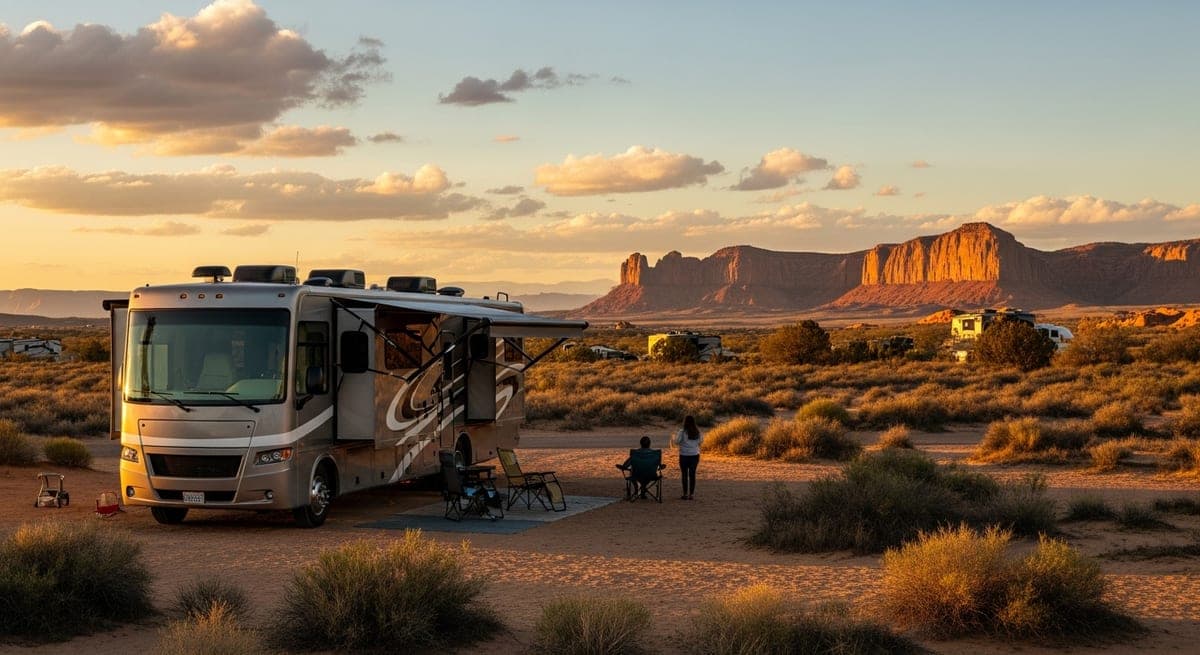
Is Full-Timing Right for You?
Most people who quit full-time RVing do so in the first 90 days — not because the lifestyle failed them, but because they launched in the wrong season without a shakedown plan. Full-time RV living — selling or renting your home to live permanently in an RV — has grown from a niche retiree lifestyle into a mainstream choice for remote workers, young families, and anyone who values experiences over square footage. But the gap between the Instagram version and reality is significant. This guide gives you the honest picture before you make one of the biggest lifestyle decisions of your life.
When to Start: Timing Your Launch
March through May is the sweet spot for first-year launches. You'll avoid brutal Southwest heat and have the full shoulder season to work out your systems — water pump quirks, propane burn rate, slide seal leaks — before you're managing them in 100°F Arizona summer or freezing Montana fall. Avoid a November start: condensation problems, frozen tanks, and limited campsite availability make winter a brutal teacher for a new full-timer.
Before you sell the house, do a 2–3 week shakedown trip and live in the rig full-time. The Texas Hill Country loop and the Blue Ridge Parkway corridor are popular choices — approachable roads, good campground infrastructure, and close enough to home that you can deal with problems without panic. You'll discover fast whether you actually like this, and you'll find the mechanical issues while you're still in familiar territory.
What Full-Timing Actually Costs
The honest range is $2,500–$5,000/month for a comfortable full-timing lifestyle, though some run lean at $1,500 and others spend $7,000+. What drives the variation isn't really the rig — it's how you camp.
Full-timers who spend the most are almost always paying nightly campground rates ($40–$80/night) without a monthly deal. The ones who keep costs down have worked out a rotation: a monthly spot at a mid-tier park ($800–$1,400/month), two weeks of free dispersed camping on BLM land near Quartzsite, AZ during winter, and Harvest Hosts stays at wineries and farms in between. That rhythm drops your overnight average significantly.
Fuel runs $200–$600/month depending on how much you move — most full-timers settle into a 2–4 week rhythm at each location, which keeps diesel manageable. RV maintenance is real and lumpy; industry guidance suggests budgeting 1–2% of the rig's value annually as a rough planning target, though individual years vary a lot. Some years nothing breaks. Others you're replacing a slide motor or a water heater in the same month. For insurance, full-timer-specific coverage is different from standard recreational-use policies — get quotes from Good Sam, Roamly, or National General before you build your budget, because rates vary more than you'd expect.
Three Full-Timer Profiles
The remote-work couple, early 30s: Launched in a used Class C after selling their Denver condo. They work standard hours remotely and need reliable internet above everything else. Their setup: Starlink dish, WeBoost cell booster, and a backup LTE router on T-Mobile's unlimited plan. Monthly budget around $3,800 — biggest line items are full-hookup campgrounds with 30-amp service and the occasional co-working day pass in cities. They've learned to book ahead in popular corridors like the Oregon Coast and Colorado's Front Range.
The retired couple, early 60s: Full-timing in a 40-ft Class A diesel pusher, moving slowly — 2–3 weeks per location — and chasing weather: Quartzsite and the Sonoran Desert January through March, the Pacific Coast in summer, New England in fall. Monthly spend around $4,200 including fuel for a big rig. They domiciled in South Dakota for the streamlined process and no state income tax, and use a mail forwarding service that scans and holds physical mail until they need it forwarded.
The solo van dweller, late 20s: A converted Sprinter, solar-powered, boondocking 80% of the time on Forest Service roads and BLM land across the Mountain West. Monthly spend around $1,600 total. The trade-off: real space constraints, no climate control beyond fans, and a 14-day dispersed camping limit that means constantly scouting the next spot via the FreeRoam app before moving on.
Domicile: Picking Your Legal Home State
When you have no fixed address, you still need a legal state of residence — it affects your taxes, voting rights, driver's license, and vehicle registration. Most full-timers end up in one of three states, and the right choice depends on your situation more than any general ranking.
South Dakota is the path-of-least-resistance pick. No state income tax, low fees, and the residency process is genuinely streamlined — typically a brief in-person visit to establish your mailing address through a registered service, plus a DMV stop. Requirements can shift, so verify current SD DMV guidelines directly before you go. It's the most popular domicile state among full-timers for exactly these reasons.
Texas draws people who want an established full-timer mail and community infrastructure. Several forwarding services operate in East Texas and are specifically built around the full-timer lifestyle — Escapees has historically been headquartered in that region, though confirm their current details directly. No state income tax, reasonable registration fees, and straightforward residency.
Florida works best if you already have ties there — family, a storage unit, a mail address — because establishing Florida residency requires more documentation of actual presence than South Dakota or Texas. Starting from scratch? South Dakota is simpler.
Mail, Banking, and Healthcare
Mail: Use a mail forwarding service — Anytime Mailbox, Traveling Mailbox, and Earth Class Mail all work well for full-timers. They receive your physical mail, scan it, and forward selectively on request. Non-negotiable for managing bills, government correspondence, and packages when you have no street address.
Banking: Online banks are the practical choice. Charles Schwab's checking account reimburses all ATM fees worldwide — genuinely useful when you're in a rural stretch with one ATM and a $4 fee. Ally and Capital One 360 are solid backups with strong mobile deposit and no branch requirements.
Healthcare: The hardest problem in full-timing. ACA marketplace plans vary widely — look specifically for nationwide PPO networks rather than HMO plans tied to a local provider. If you're employed remotely, keep your employer plan as long as possible. Christian healthcare sharing ministries are used by many full-timers but are not regulated insurance, so understand exactly what you're buying. For younger, healthier travelers, short-term travel health policies can fill gaps during transitions. Healthcare planning alone can determine whether full-timing works financially for your situation — don't leave it until after you've sold the house.
What You Give Up. What You Gain.
You give up space (a lot of it), a functional full-size kitchen, reliable Amazon delivery, stable social roots, and the psychological anchor of a permanent home base. The space thing is not abstract — a 300 sq ft RV with two people in it for a rainy week in the Smokies will test your relationship in ways a floor plan rendering won't warn you about.
You gain genuine freedom of location, dramatically simplified possessions (most full-timers say after 6 months this starts to feel like relief rather than loss), more time outside, and — for families — a kind of forced togetherness that either deepens relationships or surfaces problems that were already there.
The First Year: What to Expect
Almost every full-timer says the first three months are overwhelming. Systems fail. The space is smaller than you imagined. You miss things you didn't think you'd miss. Routines you've had for years don't exist anymore. Give yourself a hard rule: make no permanent decisions — about quitting, about selling the rig, about anything — until you're past month 6.
Full-timers who push through that window almost universally become advocates for the lifestyle. The ones who quit typically do so before they've found their rhythm. The learning curve is real, and it's survivable. The people who thrive are the ones who treat the first year as tuition, not failure.
Related: RV camping packing list · RV internet connectivity guide · RV campground etiquette guide
Is that campground membership actually worth it?
Plug in your camping nights and typical nightly rate. Our free calculator does the break-even math for Good Sam, Passport America, Thousand Trails, and KOA Rewards.