
This article contains affiliate links. If you make a purchase through these links, we may earn a small commission at no extra cost to you. Learn more.
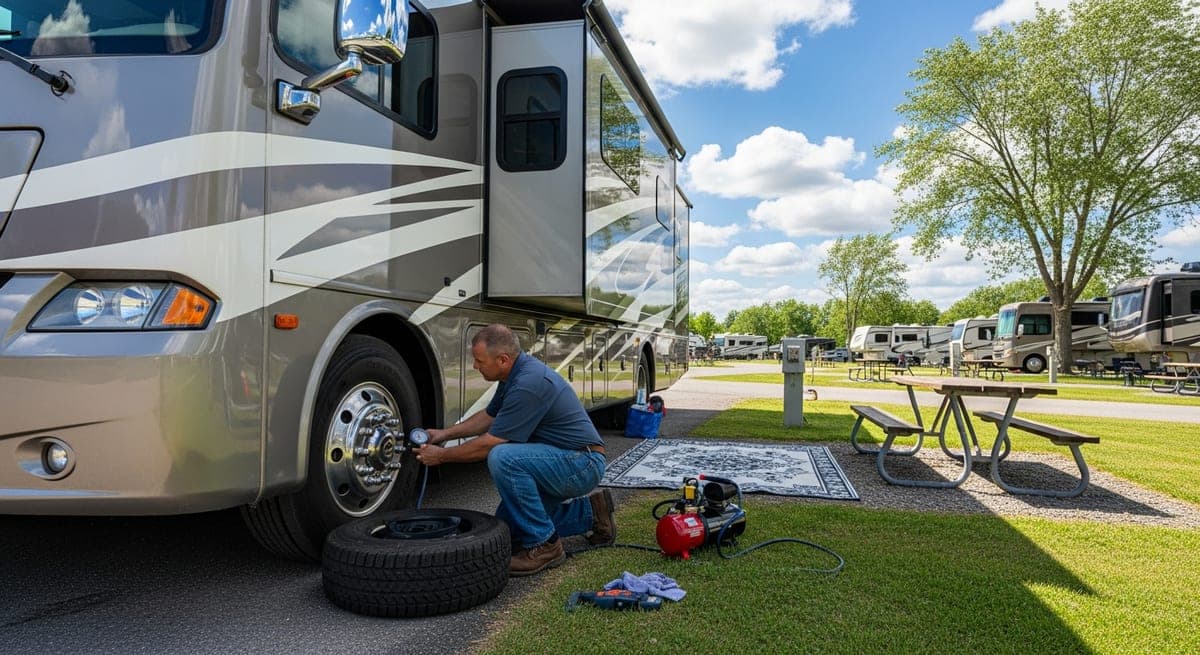
Why RV Tires Fail
An RV tire can look brand new, hold air overnight, pass a visual walk-around — and still blow apart on I-40 at 65 mph. That's not a scare tactic; it's what makes RV tire failures different from car tire failures. The rubber compounds in an RV tire degrade from UV exposure, heat cycling, and ozone whether the rig is moving or sitting in storage. Mileage is almost irrelevant.
Most RV tire failures trace back to three things: age, underinflation, and overloading. The troubling part is that none of them announce themselves ahead of time.
The Age Problem
A tire with good tread depth and no visible cracks can still be past its safe service life. The inner cords that give an RV tire its structural strength aren't visible from the outside — they degrade quietly, and the first sign of failure is often a blowout at speed.
The general industry guideline, echoed by most major tire manufacturers, is to replace RV tires somewhere around 5–7 years regardless of tread depth — and many manufacturers print a hard 10-year limit on the sidewall regardless of condition. That timeline makes a lot of RVers uncomfortable, especially on tires that still look fine. But the internal failure mode is invisible, which is exactly the point.
A fellow RVer I met at a campground near Zion showed me a tire he'd pulled off a used Class A he'd just bought. Clean tread, no visible cracks — and a DOT code showing it was 12 years old. He'd driven it 800 miles without knowing.
How to find your tire's birthday: Look for the DOT code molded into the sidewall — it ends in four digits. Those last four digits are the week and year of manufacture. "2719" means the 27th week of 2019. Check every tire, write the dates down, and add them to your rig's maintenance log.
Inflation: The Failure That's Entirely Preventable
Underinflated tires flex more than they're designed to, which builds heat in the sidewall. Heat degrades rubber. That process is cumulative — you can't undo miles driven underinflated, even if you correct the pressure later.
The right pressure depends on your actual loaded weight and your RV type. A Class A on Michelin XZE2+ steers typically runs 100–115 PSI on the fronts; a Class C or travel trailer will run significantly lower. Your tire manufacturer publishes load/inflation tables — use those, not the maximum number molded on the sidewall. The right pressure is determined by your axle weight, which you won't know until you've been to a CAT Scale.
Check pressure cold — before you've driven — every morning on travel days. A gauge you trust matters more than an expensive one; a quality dual-foot gauge from Milton or Longacre will read more consistently than most budget digital models.
TPMS: A tire pressure monitoring system watches your pressures and temperatures in real time while you're rolling — which matters most on towable trailers where the tires are behind you and out of sight. The TireMinder A1A and TST 507 Flow-Thru Cap Sensor are both well-regarded in the RV community. Expect to spend somewhere in the $150–$300 range for a quality system. That's less expensive than a blowout-caused accident.
Load Rating and Overloading
Every tire has a load rating — the maximum weight it can safely support. Exceed it, even briefly, and you cause internal damage that may not show as a failure until miles later.
Overloading happens to careful people. A rig that hits its GVWR on the dealership lot has zero margin for full water tanks, a loaded pantry, tools, generator fuel, and passengers. RVers who've never visited a CAT Scale — found at most truck stops, free with the CAT Scale app — are often surprised by their actual axle numbers.
Weigh your rig loaded exactly as you travel. Compare per-axle weights to your tire's load rating. If you're over, the fix is usually redistributing load, reducing what you carry, or moving to a higher load range tire — a conversation worth having with a shop that handles commercial and RV vehicles, like a Les Schwab or a Flying J tire center.
Visual Inspection Routine
Before every driving day, walk the rig and look at each tire:
- Check inflation with a gauge — not your eye. A tire can be 20 PSI low and still look inflated from a distance.
- Sidewall cracks: Fine surface crazing from age and ozone is normal. Deep cracks that penetrate into the rubber layers, especially near the rim or tread grooves, mean it's time for replacement.
- Sidewall bulges or bubbles: These indicate internal structural failure. Don't drive on it.
- Tread wear pattern: Center wear points to chronic overinflation; edge wear points to underinflation. Cupped or scalloped tread usually means a suspension problem, not a tire problem.
- Valve stems: Rubber stems crack over time. Metal stems hold up better at highway speeds. A blown valve stem looks and feels exactly like a blowout — including the loss of control.
Your Spare Might Be the Problem
Spare tires are the most neglected tires on any RV. Check yours before each season: pressure, DOT date, and condition. I've heard enough roadside stories where the spare was either flat or older than the tires that failed to treat this as optional. A spare you can't use is dead weight you're hauling for no reason.
If You Have a Blowout
The instinct is to brake hard. That's wrong. At highway speed, hard braking after a blowout shifts weight forward and can cause the rig to pivot around the failed tire — especially on a trailer. The trained response:
- Grip the wheel firmly with both hands
- Add a brief, slight throttle — this counteracts the drag of the failed tire and helps stabilize the rig
- Hold your lane and let the vehicle settle before making any steering corrections
- Ease off the throttle gradually to bleed speed
- Apply brakes gently only once speed is under control
- Get safely off the road
Counterintuitive enough that it's worth rehearsing mentally before you need it. Panic braking causes more blowout accidents than the blowout itself — that's documented in RV safety training from organizations like RVSEF. Run the scenario in your head a few times before your next highway stretch.
Related: RV maintenance checklist · RV winterization guide · RV weather preparedness
Ready to Plan Your Trip?
Put this knowledge to work. Let our AI build a personalized RV itinerary for your next adventure, or browse community trips for inspiration.