
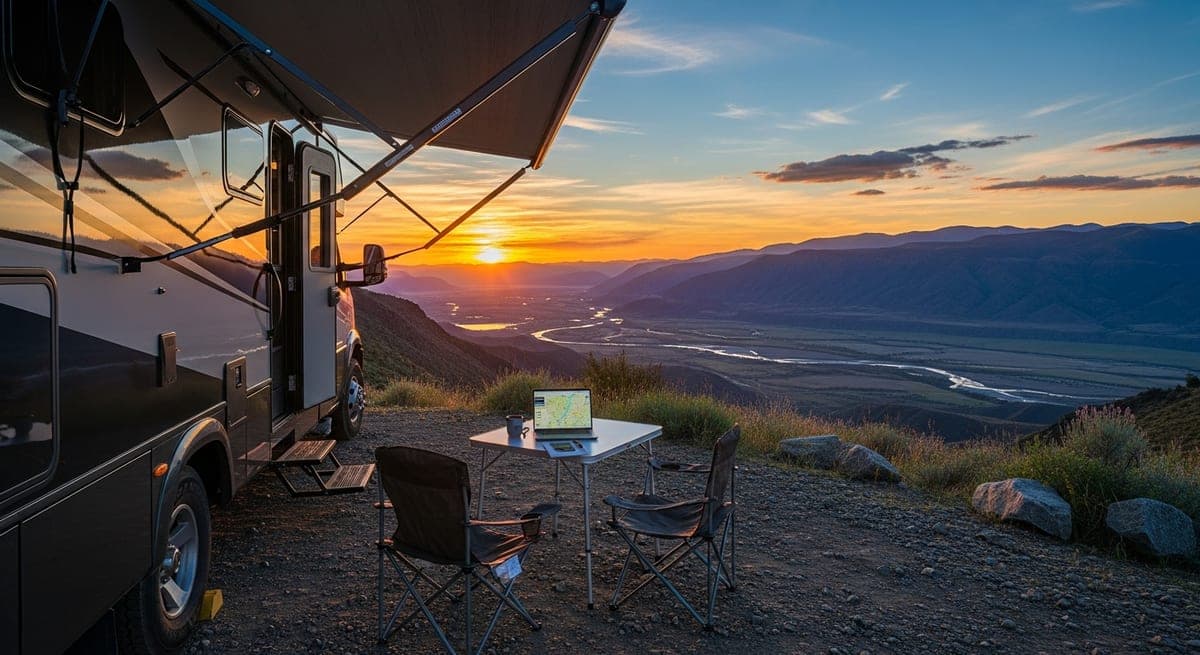
When full-timers discuss app stacks in communities like iRV2 and the RV Travel Forum, a consistent pattern surfaces: most run at least three separate tools during trip planning — one for campground finding, one for RV-specific routing, and at least one dedicated to membership or boondocking discovery. No single platform handles all three well enough that experienced travelers rely on just one. What works depends on rig size, travel style, and whether campground memberships are a meaningful part of the budget.
Campground Finding and Reservations
Recreation.gov: The federal booking portal for NPS, US Forest Service, BLM, and Army Corps campgrounds. Community members treat it as the only option for national park stays — there's no workaround. Release windows vary more than many first-timers realize: NPS campgrounds typically open reservations roughly six months out, while BLM and USFS sites often run shorter rolling windows, sometimes as few as 14 days. Forum members frequently note that third-party alert services are as important as Recreation.gov itself for high-demand sites, which can open and close within minutes.
Campendium: Full-timers consistently return to Campendium for cell signal reporting — peer reviews here tend to include carrier-specific performance and actual in-site readings rather than campground-reported ranges, which community experience has found notoriously optimistic. Reviews cover public and private campgrounds, dispersed areas, and RV parks, and typically include site-level photos and hookup details. Free with optional premium tiers; pricing has shifted over time, so verify current rates before subscribing.
The Dyrt: The Dyrt's review community skews toward dispersed camping and boondocking, and regular users note it surfaces locations that don't appear in Campendium — making the two platforms more complementary than redundant. Weekend campers on established campground networks use it less; travelers heading into BLM and USFS land off the main grid rely on it more consistently. Forum members across remote-camping threads consistently call the premium version's offline maps a non-negotiable feature for areas without cell coverage.
Harvest Hosts / Boondockers Welcome: Membership programs for stays at wineries, breweries, farms, distilleries, and fellow RVers' properties. Members consistently describe Harvest Hosts as most practical for filling gaps between destination campgrounds — a single night at a working farm or vineyard mid-route rather than an unplanned paid park. Both programs charge annual fees that shift periodically; verify current rates before committing.
Navigation and Routing
Google Maps / Apple Maps: Owner communities are consistent here: consumer mapping apps work well for traffic and point-of-interest lookups but are not suitable as a primary RV routing tool. Neither platform accounts for vehicle height, weight, or length restrictions. Forum archives document low-clearance incidents on Google-routed paths with enough regularity that experienced travelers treat RV-specific routing as a baseline requirement, not an upgrade.
CoPilot RV / RV LIFE Trip Wizard: Both tools route around low bridges, weight-restricted roads, and length-limited corridors based on your rig's dimensions. Based on app store review history and community forum longevity, CoPilot carries one of the longest track records among RV-specific GPS tools; RV LIFE Trip Wizard has grown substantially and integrates routing directly with its campground-finding platform, which full-timers managing their entire planning stack in one place often prefer. Owner consensus across forums is that the subscription cost is justified given what's at stake.
iOverlander: Community-sourced database covering free camping spots, water sources, dump stations, fuel, and services along remote routes. Most relevant for travel through dispersed-camping corridors — southern Utah BLM lands, the northern Nevada basin, remote Alaska Highway sections — where established campground networks thin out. Resort-style and urban RV park travelers typically don't use it; dispersed-camping communities reference it consistently.
Fuel Management
GasBuddy: A regular tool among long-distance RVers for comparing diesel prices before committing to a fill. On a 100-gallon tank, a $0.15–$0.20 per gallon differential adds up to $15–$20 per stop, and community members note that spreads along rural interstate corridors can exceed that range. Free tier available; check current premium features, as the app's structure has evolved.
TruckPark: Owners of larger Class A motorhomes and fifth wheels report TruckPark more useful than smaller-rig owners do — the primary value is confirmed fuel island access (wider commercial-vehicle lanes) and verified dump station locations, both of which standard navigation apps frequently undercount. Owners of Class B and smaller rigs generally find standard navigation adequate for fuel stops.
Campground Membership Tools
RVMapper (rvmapper.com): Users report that the AI itinerary tool's core differentiator versus general trip planners is membership cross-referencing — it matches your specific programs (Thousand Trails, Passport America, Harvest Hosts, Good Sam, and others) against campgrounds along your actual route, surfacing which stops are free or discounted rather than requiring manual lookups across each program's separate site. Owner feedback in community threads notes that cross-referencing multiple memberships by hand is one of the more time-consuming parts of trip planning, particularly for travelers holding three or more programs simultaneously.
Passport America app: Dedicated finder for the 50% discount campgrounds in the Passport America network. Included with the membership and most useful for quick verification when routing through an unfamiliar region between planned destination stops.
Weather and Road Conditions
Weather.gov / Windy.com: Full-timers who regularly cross mountain passes — the Cascades, the Colorado Rockies, Wyoming's open plains — consistently recommend Windy.com over consumer weather apps for wind forecasting. High-profile rigs are substantially affected by crosswinds, and community members note that standard apps don't surface the low-altitude wind data that matters for large vehicles on exposed highway sections.
AirNow: Air quality monitoring has become a routine planning check for western US travel from June through October as wildfire smoke seasons have extended. Community members in western-travel forums describe adding AirNow checks to their pre-departure routine in recent seasons — campfire bans combined with poor visibility from smoke have prompted route adjustments more than a few times.
Related: Campground reservation strategy · RV internet connectivity · Maximizing your campground memberships
Is that campground membership actually worth it?
Plug in your camping nights and typical nightly rate. Our free calculator does the break-even math for Good Sam, Passport America, Thousand Trails, and KOA Rewards.