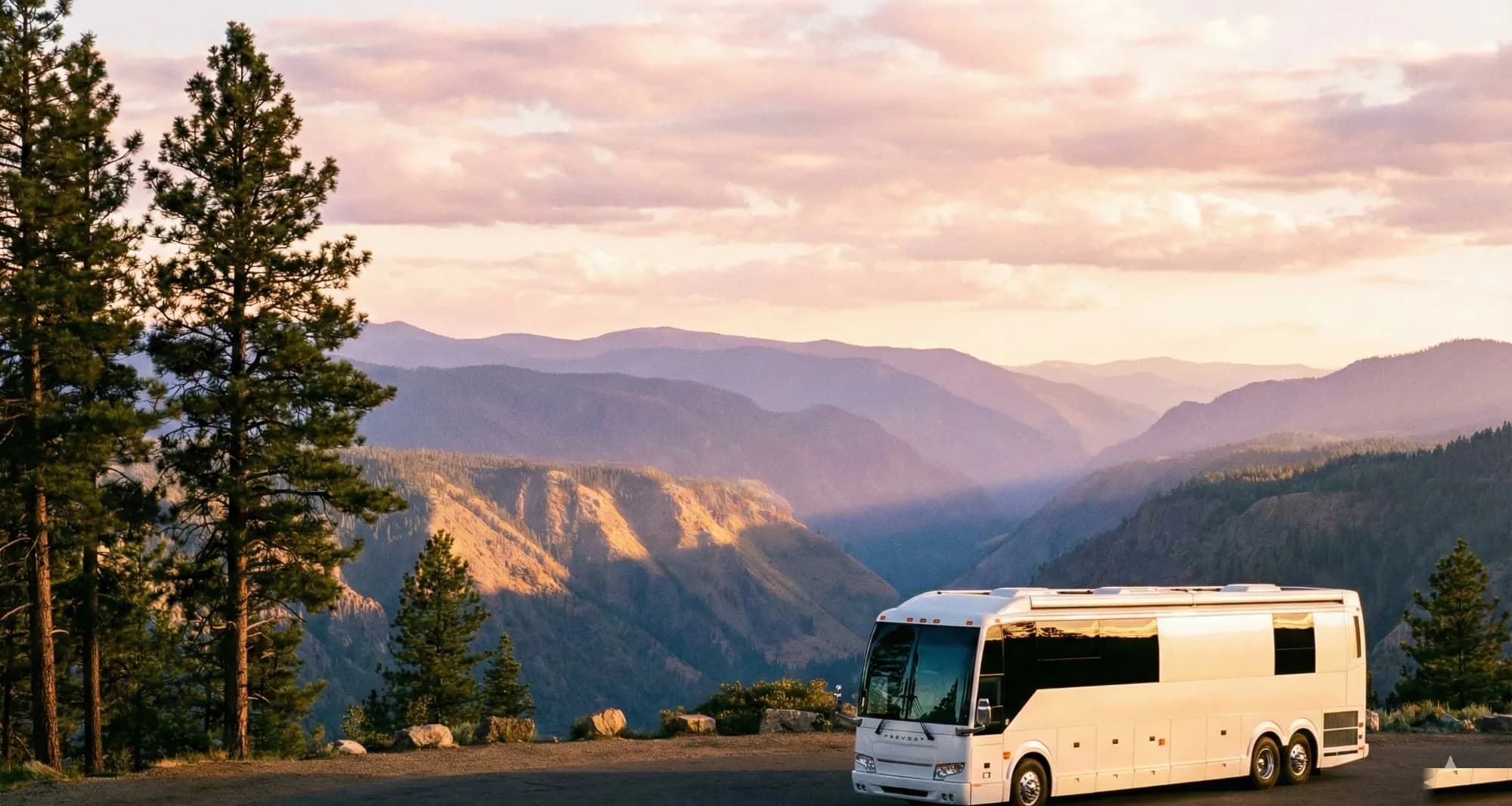
Full-timers who've logged a year or more on the road consistently rank sedentary driving days — not campground food or irregular meal schedules — as their top health concern, a pattern that surfaces repeatedly in owner threads on iRV2 and the Full-Time Families forums. A typical travel day between campgrounds can mean five to seven hours behind the wheel before setup begins. The RVers who've built lasting health routines share a common observation: structure has to come from the traveler, not the campground.
Breaking Up the Drive Before It Breaks You
Back pain, poor circulation, and fatigue are the physical complaints most frequently reported by RVers on extended trips, based on recurring threads across forums like RVillage and iRV2. Long-haul trucking research has linked uninterrupted sitting to reduced alertness after roughly an hour and a half, and experienced RV travelers echo a similar rule of thumb: stop and walk every hour or two, even if stiffness hasn't set in yet.
What full-timers actually do varies more than any single prescription suggests:
- Walking at every fuel stop: Many experienced RVers report setting a timer and walking 10–15 minutes at each stop, regardless of whether they feel stiff. The Pilot Flying J and Love's locations along the I-40 and I-10 corridors are frequently cited in owner threads for having enough lot space to walk a meaningful perimeter.
- The campground arrival walk: A widely-shared habit in the full-timer community — after setting up camp, a 20-minute walk around the campground before sitting down for the evening. Experienced owners consistently describe this as the single highest-impact daily habit for resetting the body after a long drive day.
- Choosing campgrounds for trail access: Full-timers on longer itineraries frequently report selecting campgrounds specifically for proximity to trails, targeting one active hiking day per two or three travel days. Campgrounds along the Blue Ridge Parkway, near Arches National Park, and in the Shenandoah Valley are commonly cited examples where trail systems begin within walking distance of the campsite.
Working Out in Whatever Space the Rig Provides
The "no gym, no workout" mindset is one of the first things experienced full-timers report abandoning. Bodyweight training in and around the rig has become a standard workaround — but the RV community's collective experience has surfaced constraints that generic fitness advice doesn't account for.
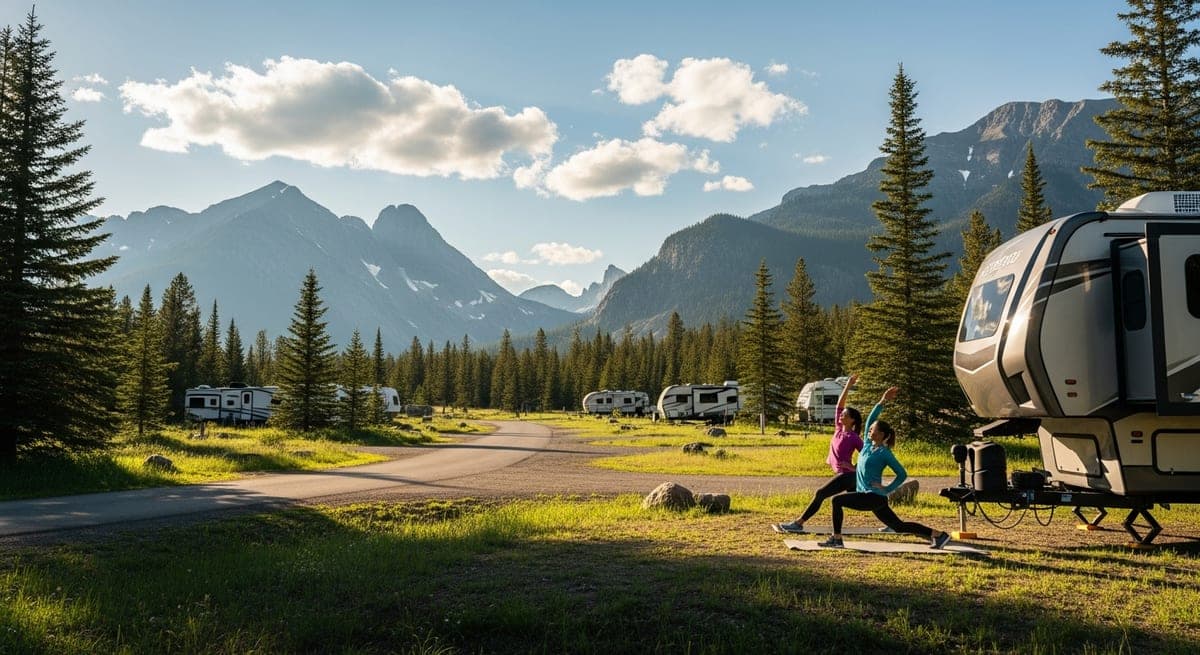
Leveling is the first variable. On uneven sites — common at Corps of Engineers campgrounds, state forests, and dispersed BLM land — an RV that's two to three degrees off-level makes push-ups and planks noticeably awkward and can shift load on lunges enough to affect form. Owners who camp frequently on uneven terrain report doing floor work outside on a travel yoga mat rather than inside, where the angle is compounded by the narrow floor plan.
Slide-out floor space is the second variable. Rigs with one or two slides can open up enough room for a full circuit once extended, but owners with smaller Class Bs or older Class Cs report doing most indoor work in the aisle or stepping outside entirely. A typical campsite-based routine reported across full-timer threads:
- Push-ups, squats, and lunges (3 rounds, 12–15 reps) — done outside on a mat or on a firm campground pad; many owners prefer gravel or grass sites over concrete for joint comfort
- Plank holds and mountain climbers (30 seconds each, 4 rounds) — flat ground recommended; owners report placing leveling boards under a mat when the site isn't level enough for comfortable floor work
- Core work (crunches, bicycle, dead bug) — can be done inside when slide-outs extend enough for a 6-foot mat
Resistance bands are the single most-recommended compact fitness tool in full-timer communities — a basic set fits in a shoe bag and handles pulling and pressing work that bodyweight alone misses. Suspension trainers are used by some full-timers attached to trees at wooded sites; those who've experimented with attaching them to RV door frames note that most interior frames aren't designed to support bodyweight loads, and the community recommendation is to use exterior anchor straps specifically rated for suspension training instead.
The RV Kitchen Advantage — and Where It Runs Out
On-site cooking is consistently rated as both a budget tool and a health advantage by full-timers. The ability to batch-cook on a non-travel day is something RVers returning from extended trips frequently cite as underappreciated before their first long trip — it's the difference between eating well and defaulting to fast food after a six-hour drive day.
- Batch cooking on stationary days: Full-timers who stay two or more nights commonly cook a large batch of grains, roasted vegetables, or protein on day one that carries through subsequent meals. This approach is widely discussed in full-timer video communities and the r/fulltimetravel subreddit as a practical alternative to daily cooking after long drive days.
- Regional grocery chains as anchor stops: Experienced travelers report identifying the regional anchor grocery chain before entering a new area — Kroger in the Midwest and South, HEB in Texas, Publix across the Southeast, Wegmans in the Mid-Atlantic — as more reliable for produce quality than relying on whatever happens to be near the campground.
- Pantry staples as the floor: The consensus in full-timer forums is that a well-stocked dry pantry (olive oil, canned beans, dried pasta, rice, oats, nuts, spices) provides a reliable fallback when fresh produce runs low between shopping stops — particularly relevant at remote campgrounds like those in the Ouachita National Forest or Grand Staircase–Escalante, where the nearest grocery store can be 30 or more miles out.
- Restaurant frequency: Most experienced full-timers report settling into a rhythm of cooking at the rig four to five nights per week, with restaurant meals reserved for new regions or rest days — partly for budget reasons, and partly because owners consistently note they feel better when cooking their own food regularly.
Getting Consistent Sleep in Campgrounds That Weren't Designed for It
Sleep disruption is the health complaint RVers mention most in their first six months on the road, based on recurring threads on iRV2 and Reddit's r/RVLiving community. The variables are different from home: generator noise from neighbors, campground lighting that ranges from near-dark to stadium-bright, road noise at highway-adjacent sites, and the psychological adjustment of sleeping in different locations week after week.
The adaptations full-timers report converging on after enough nights on the road:
- White noise — a travel machine or app running through earbuds handles generator hum and highway sound better than earplugs alone, per community consensus; many owners run both
- Blackout curtains or reflective window covers — campground lighting varies dramatically, and owners consistently rate this among the highest-ROI comfort upgrades on any rig
- A consistent pre-sleep routine independent of location — the same wind-down sequence whether the rig is at a full-hookup resort or a dry camping spot in the Mojave Desert
- Deliberate campsite selection — premium sites in back loops away from entrance roads are frequently reported as significantly quieter; campgrounds like Shenandoah's Big Meadows and Glacier's Apgar are cited examples where site selection makes a material difference in noise exposure
The adjustment period is real. Full-timers on RVillage threads frequently report that consistent sleep didn't stabilize until two to four months in — once a personal system was in place. The community consistently flags this as a calibration period, not a sign something is wrong with the lifestyle.
Healthcare Logistics Without a Permanent Address
Healthcare planning is one of the most actively discussed logistical challenges in full-timer communities, and the solutions that have become consensus differ meaningfully from standard travel health advice.
- Telemedicine as primary care: Services like One Medical, Forward Health, and Amazon Clinic provide virtual primary care access regardless of location — an approach full-timers increasingly use as their default for non-emergency issues. The full-timer community generally recommends establishing this relationship before leaving home, not mid-trip when an acute issue has already come up.
- Urgent care networks for acute issues: Most urgent care chains — CareNow, FastMed, AFC Urgent Care — accept major insurance without requiring established patient status. Full-timers report that keeping insurance cards and a current medication summary accessible on a phone makes these walk-in visits significantly smoother in unfamiliar cities.
- Mail-order pharmacy for ongoing medications: The consensus among long-term RVers managing chronic conditions is to switch to 90-day mail-order fills (offered by most major insurers) before the first extended trip. CVS and Walgreens can fill nationally in a pinch, but mail-order to a trusted address — a family member's home or an RV mail service like Escapees or South Dakota Mail Forwarding — is consistently rated as more reliable than hunting down a specific pharmacy in an unfamiliar town.
- Domicile state and insurance networks: Full-timers who've navigated insurance residency requirements note that establishing legal domicile in South Dakota, Texas, or Florida — the three most RV-friendly domicile states — affects which insurance networks are available. This comes up regularly in healthcare threads on the Escapees forums and is worth researching before committing to a full-timer setup rather than discovering it after.
Related: Full-time RV living costs · RV meal planning guide · Senior RV travel tips
From the RVmapper team
Fishing along your route?
Hooked Fisherman publishes fishing reports for all 50 states, species guides, and honest gear reviews. Know what's biting before you park the rig.